
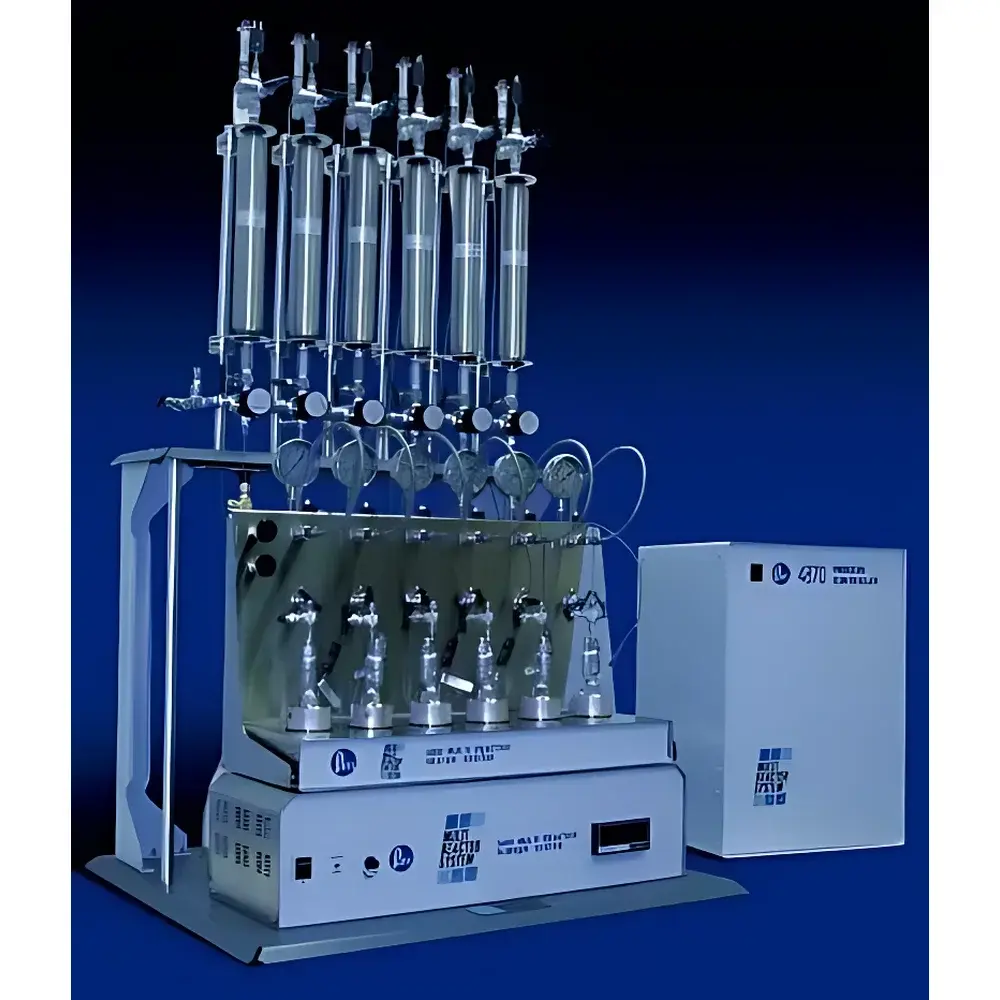
Parr MRS5000 Automated Parallel Reaction System
| Brand | Parr |
|---|---|
| Origin | USA |
| Manufacturer Status | Authorized Distributor |
| Origin Category | Imported |
| Model Series | 5000-Series Parallel Reactor System |
| Vessel Volume Range | 0.27–0.45 L (270–450 mL) |
| Construction Material | 316 Stainless Steel (T316SS), Hastelloy C-273/C-2000/B2/B3, Monel, Zirconium Alloys |
| Operating Pressure | Up to 5000 psi (345 bar) |
| Operating Temperature | Up to 350 °C |
| Stirring Speed | 0–600 rpm |
| Vacuum Capability | Down to 3000 psi (negative pressure not applicable |
| Control System | Honeywell 4870 Multi-Parameter Process Controller with PID and ramp/soak programming |
| Software Interface | Windows-based PC control with real-time data acquisition, historical database logging, and graphical analysis |
Overview
The Parr MRS5000 Automated Parallel Reaction System is a high-integrity, multi-vessel benchtop platform engineered for accelerated catalyst screening, reaction optimization, and kinetic profiling under rigorously controlled high-pressure and high-temperature conditions. Based on Parr’s proven stirred autoclave architecture, the MRS5000 integrates six independently operated 45 mL or 75 mL reaction vessels into a single coordinated system—each equipped with individual temperature, pressure, and agitation control. Its core operational principle leverages simultaneous parallel experimentation to decouple variables (e.g., catalyst identity, feed composition, T/P setpoints) while maintaining strict comparability across runs—a methodology aligned with Design of Experiments (DoE) frameworks widely adopted in catalytic process development and pharmaceutical API synthesis. The system operates within a validated envelope of up to 350 °C and 5000 psi (345 bar), making it suitable for hydrogenation, hydroformylation, oxidation, polymerization, and supercritical fluid reactions where reproducibility, traceability, and thermal stability are non-negotiable.
Key Features
- Six independent reaction stations—each with fully programmable PID temperature control, digital pressure transduction, and variable-speed magnetic or mechanical stirring (0–600 rpm).
- Vessel construction options include ASTM-certified 316 stainless steel, Hastelloy C-273/C-2000/B2/B3, Monel 400, and zirconium alloys—selected per chemical compatibility requirements and corrosion resistance standards (ASTM G31, NACE MR0175/ISO 15156).
- Honeywell 4870 multi-parameter controller provides deterministic sequence logic, ramp/soak profiles, safety interlocks (over-temperature, over-pressure, motor stall), and configurable alarm thresholds compliant with IEC 61508 functional safety principles.
- Integrated real-time data acquisition via USB/Ethernet interface; all parameters (T, P, RPM, torque, time) logged at user-defined intervals into timestamped, CSV-compatible datasets.
- Windows-native control software supports experiment scheduling, parameter mapping, live trend visualization, and post-run comparative analysis—including derivative plots (dP/dt) for reaction rate inference and exotherm detection.
- Modular design enables operation in full-parallel mode or selective activation of 1–6 reactors—minimizing reagent consumption during method scouting and reducing turnaround time between iterations.
Sample Compatibility & Compliance
The MRS5000 accommodates heterogeneous and homogeneous catalytic systems, slurries, viscous media, and gas-liquid-solid multiphase mixtures. Vessel linings (e.g., glass, PTFE, or quartz inserts) may be deployed for acid-sensitive or photoactive chemistries. All pressure-containing components conform to ASME Boiler and Pressure Vessel Code Section VIII, Division 1, with full traceability documentation (material test reports, hydrostatic test certificates). The system meets GLP/GMP data integrity requirements per FDA 21 CFR Part 11 when configured with electronic signature-enabled software, audit trail logging, and role-based access control. It supports ISO 17025-compliant calibration protocols for temperature (PT100 RTD, ±0.1 °C accuracy), pressure (strain-gauge transducers, ±0.25% FS), and rotational speed (Hall-effect sensing).
Software & Data Management
The proprietary Windows application provides intuitive workflow management—from experiment definition and hardware initialization to automated shutdown and report generation. Raw data streams are stored in a relational SQLite database with automatic versioning, metadata tagging (operator ID, batch number, vessel ID), and export to Excel, MATLAB, or third-party cheminformatics platforms (e.g., KNIME, Spotfire). Built-in analytical tools include baseline correction, integration of pressure decay curves, Arrhenius plot generation, and statistical comparison (ANOVA, t-test) across replicate or variant runs. Audit trails record all parameter changes, manual overrides, and system events—retained for ≥36 months per internal SOPs and regulatory expectations.
Applications
- Catalyst library screening: Evaluate >6 catalyst formulations simultaneously under identical T/P/atmosphere conditions to rank activity, selectivity, and deactivation behavior.
- Reaction condition mapping: Systematically vary temperature (±1 °C resolution), pressure (±5 psi), and residence time across vessels to define operability windows and identify optimal regimes.
- Solvent and feedstock effect studies: Isolate influence of co-solvents, impurities, or substrate stoichiometry on reaction kinetics without cross-contamination.
- Thermal hazard assessment: Monitor adiabatic temperature rise and pressure evolution during exothermic events per ASTM E1981 and CCPS guidelines.
- Process intensification development: Validate microscale reaction performance prior to pilot-scale reactor design—reducing scale-up risk and capital expenditure.
FAQ
What safety certifications does the MRS5000 hold?
The system complies with UL 61010-1 (Laboratory Equipment Safety) and carries CE marking for EMC Directive 2014/30/EU and Low Voltage Directive 2014/35/EU. Pressure vessels are stamped with ASME U-stamp certification.
Can the system be integrated into a centralized lab automation network?
Yes—via Modbus TCP or OPC UA protocol support, the MRS5000 can interface with LIMS, MES, or SCADA systems for enterprise-level data aggregation and remote monitoring.
Is validation documentation available for regulated environments?
Parr provides IQ/OQ templates, calibration certificates, and 21 CFR Part 11 readiness assessment reports upon request—supporting GxP-compliant deployment in pharmaceutical and fine chemical R&D labs.
What maintenance is required for long-term reliability?
Annual verification of pressure transducer linearity, RTD calibration, and stirrer seal integrity is recommended. Spare parts kits—including O-rings, rupture discs, and thermocouple assemblies—are stocked globally through authorized service partners.
Does the system support inert atmosphere purging and gas flow control?
Integrated mass flow controllers (MFCs) and automated vent/purge sequences enable precise gas composition management (e.g., H₂/N₂/CO blends) with real-time feedback control and leak-check routines per ASTM E471.
Related Products



