
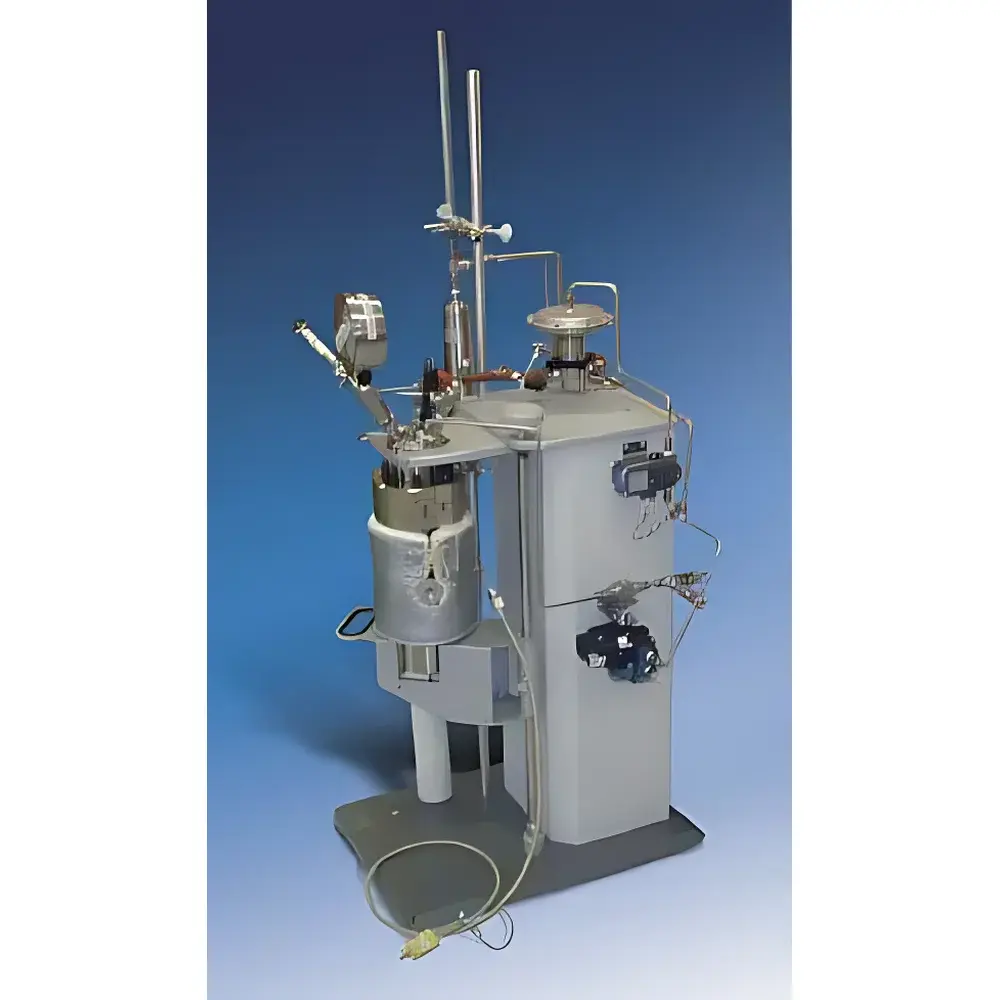
Parr Supercritical Fluid Extraction and Reaction System
| Brand | Parr |
|---|---|
| Origin | USA |
| Manufacturer Status | Authorized Distributor |
| Product Origin | Imported |
| Model | Parr Supercritical Fluid Extraction and Reaction System |
| Pricing | Available Upon Request |
Overview
The Parr Supercritical Fluid Extraction and Reaction System is an engineered platform for precise, reproducible experimentation with supercritical fluids—primarily carbon dioxide (scCO₂)—under rigorously controlled temperature and pressure conditions. Operating on the fundamental thermodynamic principle that substances above their critical point (e.g., CO₂: 31.1 °C, 73.8 bar) exhibit hybrid physicochemical properties—gas-like diffusivity and liquid-like solvating power—the system enables tunable solvent strength through minute adjustments of density via pressure and temperature modulation. This physical basis underpins its utility across extraction, nano-material synthesis, impregnation, polymer processing, and catalytic reaction studies where conventional solvents are undesirable due to toxicity, residue, or environmental impact. Designed and manufactured in the USA by Parr Instrument Company—a leader in high-pressure process equipment since 1916—the system integrates robust pressure containment, thermal stability, and programmable process control to support both exploratory research and method development aligned with ASTM D7560, ISO 14727, and USP validation frameworks.
Key Features
- Stainless steel autoclave rated to 4300 psig (300 bar) maximum operating pressure and 300 °C maximum temperature, constructed per ASME BPVC Section VIII Div. 1 standards with full traceability documentation.
- Integrated 1.2 L working-volume reactor vessel equipped with dual-zone electric heating (1500 W total), PID-controlled temperature regulation with ±0.5 °C stability over full range.
- Automated gas injection subsystem featuring precision mass-flow-controlled CO₂ delivery and a high-accuracy back-pressure regulator (BPR) capable of maintaining setpoint pressure within ±1 bar across dynamic flow conditions.
- Optional high-pressure liquid feed pump (not included standard) supports co-solvent introduction at up to 5.7 L/min and 4000 psig (275 bar), compatible with methanol, ethanol, or other polar modifiers.
- Modular architecture allows configuration as standalone extractor, batch reactor, continuous-flow unit, or hybrid extraction/reaction platform via interchangeable vessel liners, sampling ports, and quench valves.
- Full I/O integration with optional Parr 4870 Process Controller or third-party SCADA systems for real-time monitoring of P, T, flow, and valve status with audit-trail-capable logging compliant with FDA 21 CFR Part 11 requirements.
Sample Compatibility & Compliance
The system accommodates solid, semi-solid, and powdered matrices—including botanicals, polymers, pharmaceutical intermediates, catalysts, and food-grade materials—without degradation from thermal or oxidative stress. Vessel internal surfaces are electropolished 316L stainless steel (Ra ≤ 0.4 µm) to minimize adsorption and ensure cleaning validation per GMP Annex 15. All wetted components comply with USP Class VI biocompatibility testing and meet REACH/ROHS substance restrictions. Pressure relief devices are certified to ASME Section VIII and include redundant rupture disks and spring-loaded safety valves. System design supports GLP-compliant operation when paired with validated software and procedural SOPs.
Software & Data Management
Parr’s proprietary 4870 Control Software provides intuitive graphical interface for ramp-hold programming, multi-step pressure/temperature profiles, and automated sequence execution (e.g., pressurization → equilibration → extraction → depressurization). Raw sensor data (pressure transducer, RTD, flow meter) are logged at user-selectable intervals (100 ms–10 s) in .csv or .tdms format with embedded metadata (operator ID, timestamp, version stamp). Audit trail functionality records all parameter changes, manual overrides, and alarm events with immutable timestamps. Exported datasets are compatible with MATLAB, Python (pandas), and JMP for statistical analysis, DOE modeling, and kinetic fitting.
Applications
- Green extraction of essential oils, polyphenols, caffeine, and cannabinoids from plant biomass without organic solvent residues.
- In situ nanoparticle synthesis (e.g., metal oxides, quantum dots) via rapid expansion of supercritical solutions (RESS) or supercritical antisolvent (SAS) precipitation.
- Catalytic hydrogenation, oxidation, and transesterification reactions under single-phase scCO₂ media to enhance mass transfer and selectivity.
- Supercritical drying of aerogels and bio-scaffolds preserving nanostructure integrity without capillary collapse.
- CO₂-based cleaning of microelectronic wafers and MEMS devices where aqueous or halogenated solvents are prohibited.
- Method development for regulatory submissions requiring documented process understanding (QbD) per ICH Q5C and Q8(R2).
FAQ
What is the maximum allowable operating pressure and temperature of the reactor vessel?
The standard reactor is rated for continuous operation up to 4300 psig (300 bar) and 300 °C, with full ASME certification documentation provided.
Can the system be used with solvents other than CO₂?
Yes—compatible with N₂O, ethane, propane, and other low-critical-point fluids; compatibility verification required for each fluid based on material limits and safety data.
Is remote monitoring and control supported?
Yes—Ethernet-enabled controllers support Modbus TCP and OPC UA protocols for integration into lab-wide automation networks.
Does the system meet FDA or ISO compliance requirements for regulated environments?
When configured with validated software, electronic signatures, and audit trail enabled, it supports 21 CFR Part 11 and ISO 17025 compliance; IQ/OQ/PQ protocols available upon request.
What maintenance is required for long-term reliability?
Annual calibration of pressure transducers and RTDs is recommended; O-rings and rupture disks should be replaced per usage logs or manufacturer schedule—typically every 500 cycles or 12 months.



