
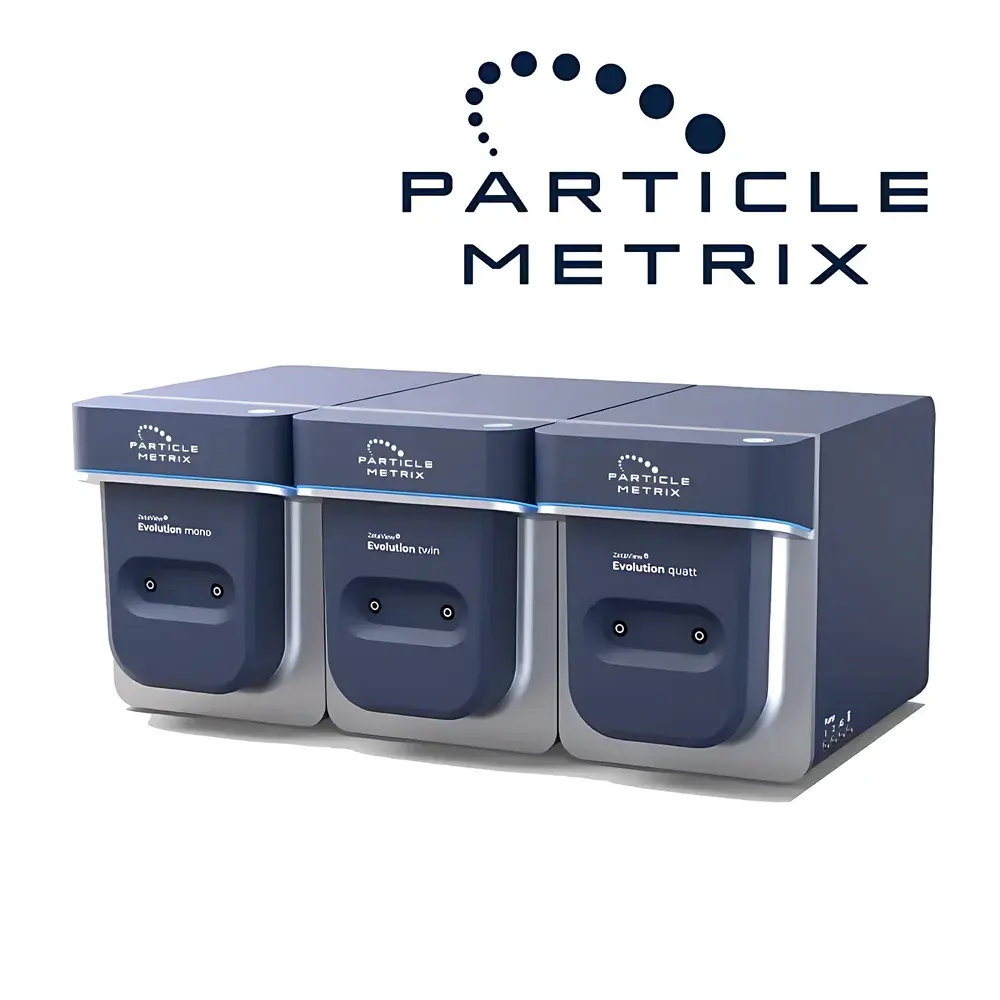
Particle Metrix ZetaView® Evolution Nanoparticle Tracking Analyzer (Biological Nano-Tracking)
| Brand | Particle Metrix |
|---|---|
| Origin | Germany |
| Manufacturer Type | Authorized Distributor |
| Origin Category | Imported |
| Model | ZetaView® Evolution |
| Zeta Potential Range | ±500 mV |
| pH Range | 1–13 |
| Operating Temperature Range | 5°C to 55°C |
| pH Resolution | 1–13 |
| Temperature Resolution | 0.1°C |
| Size Accuracy | ±5 nm |
| Size Repeatability | ±2 nm |
Overview
The Particle Metrix ZetaView® Evolution Nanoparticle Tracking Analyzer is an advanced, benchtop instrument engineered for high-resolution, multi-parametric characterization of nanoparticles in liquid suspension. It employs the well-established principle of Nanoparticle Tracking Analysis (NTA), combining laser illumination with high-sensitivity video microscopy to visualize and track individual particles undergoing Brownian motion in real time. By applying the Stokes–Einstein equation to mean-squared displacement data derived from particle trajectories, the system determines hydrodynamic diameter distribution and absolute particle concentration—without reliance on calibration standards. Unlike ensemble techniques such as dynamic light scattering (DLS), NTA delivers true particle-by-particle resolution, making it especially valuable for heterogeneous, polydisperse, or low-concentration samples common in extracellular vesicle (EV), viral vector, liposomal drug delivery, and protein aggregate research.
Key Features
- True single-particle tracking across a broad size range (10 nm – 2000 nm), with size accuracy of ±5 nm and repeatability of ±2 nm
- Integrated Zeta potential measurement via microelectrophoresis directly in reusable quartz cuvettes—no disposable capillaries or electrodes required
- Concentration scanning technology: full-volume scanning enables calibration-free quantification, cross-channel comparability (scattering vs. fluorescence), and robust performance across wide concentration ranges (1×10⁵ – 1×10⁹ particles/mL)
- Fluorescence-enhanced NTA (F-NTA) with up to four independently switchable lasers (405 nm, 488 nm, 520 nm, and either 640 nm or 660 nm) and 11 configurable fluorescence detection channels using user-selectable emission filters
- Co-localization NTA (C-NTA): simultaneous dual-color fluorescent labeling enables identification and tracking of biomarker-coated particles at the single-particle level—critical for EV subtyping, receptor-ligand binding studies, and targeted nanocarrier validation
- Real-time environmental control: precise temperature regulation (5°C–55°C, ±0.1°C resolution) and compatibility with pH 1–13 buffers ensures stability during extended measurements under physiologically or industrially relevant conditions
Sample Compatibility & Compliance
ZetaView® Evolution supports diverse biological and synthetic nanosystems including extracellular vesicles, exosomes, liposomes, polymeric nanoparticles, virus-like particles (VLPs), protein aggregates, and inorganic colloids. Its open-flow cuvette design accommodates viscous, opaque, or high-salt media without clogging or optical interference. The system complies with GLP/GMP-aligned data integrity requirements: ZetaSphere software includes full audit trail functionality, electronic signatures, and secure user access levels per FDA 21 CFR Part 11 guidelines. All measurements are traceable to SI units through documented instrument calibration protocols and reference material validation (e.g., NIST-traceable polystyrene standards). Method suitability testing aligns with ISO 22412:2017 (NTA) and ASTM E2834-12 (Zeta potential by electrophoretic light scattering).
Software & Data Management
ZetaSphere software represents the next-generation analytical platform for nanoparticle characterization. Built upon the validated foundation of ZetaView software, it introduces modular workflows optimized for routine QC, exploratory research, and regulatory submission. Key capabilities include pre-configured application templates (e.g., “Exosome Isolation QC”, “Liposome Batch Release”), real-time histogram overlay of size/concentration/Zeta distributions, and automated generation of compliant multi-parameter reports (PDF/CSV/XLSX). Laser switching is performed with one click; all raw trajectory data, metadata, and processing parameters are stored in a relational database with timestamped event logging. Exported datasets retain full traceability—including environmental conditions, instrument settings, and operator ID—for seamless integration into LIMS or ELN environments.
Applications
- Extracellular vesicle phenotyping and purity assessment via C-NTA co-localization of CD63/CD9/CD81 markers
- Stability profiling of mRNA-LNP formulations under accelerated storage conditions
- Batch-to-batch consistency evaluation of viral vectors (AAV, lentivirus) for gene therapy manufacturing
- Detection and quantification of sub-visible protein aggregates in biopharmaceutical formulations
- Surface charge mapping of functionalized nanoparticles across varying pH and ionic strength gradients
- Multi-modal quality control of nanomedicines incorporating targeting ligands and imaging agents
FAQ
Does ZetaView® Evolution require calibration standards for size or concentration measurements?
No. The system uses intrinsic physical principles (Brownian motion + Stokes–Einstein relation) and does not rely on reference materials for primary size or concentration determination. Calibration verification may be performed optionally using traceable standards.
Can ZetaView® Evolution measure Zeta potential in highly viscous or turbid samples?
Yes—within operational limits. The microelectrophoresis module is optimized for low-conductivity media; however, samples with viscosity >10 cP or absorbance >1.5 AU at excitation wavelength may require dilution or specialized cuvette configurations.
Is F-NTA compatible with common fluorescent dyes used in EV research (e.g., PKH67, DiI, CFSE)?
Yes. Excitation/emission profiles for standard lipophilic dyes, antibody conjugates, and quantum dots are supported across the available laser/filter combinations. Spectral deconvolution tools assist in resolving overlapping signals.
How is data integrity ensured during long-duration measurements or multi-user lab environments?
ZetaSphere enforces role-based access control, automatic session logging, immutable raw data archiving, and cryptographic hashing of analysis parameters—meeting requirements for regulated environments under 21 CFR Part 11 and EU Annex 11.
What maintenance is required for the optical path and fluidic components?
The system features a sealed, alignment-free optical train and non-contact sample handling. Routine maintenance is limited to periodic cleaning of the quartz cuvette and verification of laser power output using integrated photodiode monitoring.



