
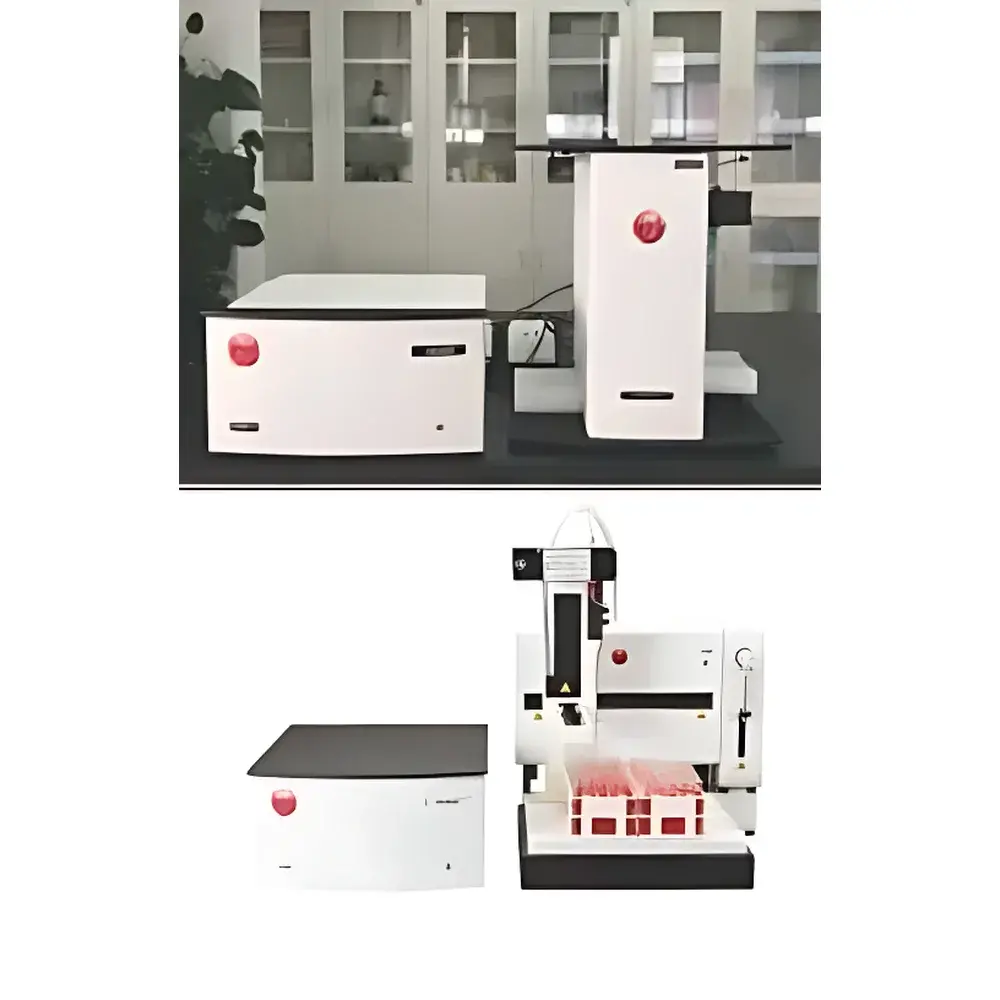
Particle Sizing Systems AccuSizer 780 A2000 SIS Insoluble Particle Detector
| Brand | Particle Sizing Systems (PSS) |
|---|---|
| Origin | USA |
| Model | AccuSizer 780 A2000 SIS |
| Detection Principle | Single Particle Optical Sensing (SPOS) with Light Obscuration (LO) and Enhanced Light Scattering (LS) |
| Size Range | 0.5 µm – 400 µm |
| Compliance | USP <787>, <788>, <789>, <1788>, Ch.P, EP, JP |
| Automation | Fully automated sampling, analysis, data processing, and system cleaning |
Overview
The Particle Sizing Systems AccuSizer 780 A2000 SIS Insoluble Particle Detector is an advanced, fully automated analytical instrument engineered for quantitative characterization of insoluble particulate matter in parenteral drug products. It operates on the foundational principle of Single Particle Optical Sensing (SPOS), integrating dual-mode optical detection—Light Obscuration (LO) and complementary Light Scattering (LS)—to deliver high-resolution, particle-by-particle enumeration and sizing across a broad dynamic range. Unlike ensemble-averaging techniques such as dynamic light scattering (DLS), SPOS enables statistically robust, direct-count measurement of individual particles suspended in liquid media, making it uniquely suited for regulatory-grade quality control of injectables where low-abundance, submicron contaminants pose critical safety risks. The system is explicitly designed to meet the stringent requirements of pharmacopoeial standards governing intravenous formulations, including sterile solutions, lyophilized powders, concentrated solutions, and sterile active pharmaceutical ingredients (APIs).
Key Features
- Fully integrated automation: robotic autosampler, programmable syringe pump, real-time sensor diagnostics, and self-cleaning fluidic pathways minimize operator intervention and cross-contamination risk.
- Dual-sensor architecture: primary LO sensor optimized for 1.5–400 µm detection, augmented by a high-sensitivity LS sensor extending reliable quantification down to 0.5 µm—critical for detecting early-stage protein aggregates and silicone oil droplets.
- Pharmacopoeia-compliant firmware: preloaded test protocols aligned with USP , , , and , as well as Chinese Pharmacopoeia (Ch.P), European Pharmacopoeia (EP), and Japanese Pharmacopoeia (JP) monographs; supports user-defined pass/fail criteria and multi-level reporting templates.
- Robust fluidics design: chemically resistant wetted path (316L stainless steel, PEEK, sapphire flow cell), pressure-regulated sample delivery, and bubble-tolerant aspiration ensure consistent volumetric accuracy and long-term reproducibility (RSD < 2% for repeat injections).
- Regulatory-ready software architecture: audit-trail-enabled data acquisition, electronic signatures, and secure user role management compliant with FDA 21 CFR Part 11 and EU Annex 11 requirements.
Sample Compatibility & Compliance
The AccuSizer 780 A2000 SIS accommodates a wide range of parenteral matrices—including aqueous buffers, organic co-solvent systems (e.g., ethanol/water mixtures), and viscous formulations—without requiring dilution or filtration that may bias particle counts. Its validation package includes documented performance qualification (PQ) protocols for ISO 21501-4:2018 calibration traceability, NIST-traceable polystyrene latex (PSL) reference standards, and verification against pharmacopoeial reference suspensions (e.g., USP Particle Count Standards). The instrument satisfies Good Manufacturing Practice (GMP) and Good Laboratory Practice (GLP) documentation requirements, supporting full lifecycle data integrity from raw count files through final batch release reports.
Software & Data Management
AccuSizer Software v5.x provides a validated, Windows-based platform for method development, instrument control, statistical analysis, and regulatory submission-ready reporting. Key capabilities include real-time particle histogram generation, cumulative distribution plots, differential size-frequency analysis, and customizable QC dashboards with configurable alert thresholds. All raw data—including timestamped sensor voltage traces, pulse height distributions, and metadata—are stored in encrypted, tamper-evident binary archives. Export options include CSV, PDF, and XML formats compatible with enterprise LIMS and QMS systems. Full 21 CFR Part 11 compliance is enforced via biometric or token-based login, session time-outs, and immutable audit trails recording every parameter change, report generation, and user action.
Applications
- Final container testing of IV bags, vials, and prefilled syringes per USP and Ch.P Section 0903.
- Stability-indicating monitoring of protein therapeutics during accelerated and real-time storage studies.
- Investigation of filter integrity failure modes and leachables from elastomeric components (e.g., stoppers, plungers).
- Characterization of nanoscale contaminants in mRNA-LNP formulations and lipid-based delivery systems.
- Root cause analysis of visible particle incidents through forensic correlation between subvisible and macroscopic particulate populations.
FAQ
What regulatory standards does the AccuSizer 780 A2000 SIS support out-of-the-box?
The system ships with preconfigured methods for USP , , , and , as well as Ch.P, EP, and JP requirements—including automatic calculation of acceptance limits, volume correction factors, and reporting units per container.
Can the instrument differentiate between intrinsic and extrinsic particles?
While morphological classification requires coupling with imaging (e.g., Flow Microscopy), the AccuSizer’s high-fidelity pulse shape analysis and dual-sensor response ratio enable empirical discrimination between refractive index–dependent species (e.g., silicone oil vs. cellulose fibers) when combined with appropriate reference materials.
Is method transfer to another AccuSizer unit straightforward?
Yes—calibration is maintained via NIST-traceable PSL standards and internal optical alignment checks; method files are portable across instruments of the same model family, and inter-unit RSD for identical samples is typically ≤3% under controlled environmental conditions.
Does the system require routine recalibration?
Annual performance verification using certified reference standards is recommended; however, daily system suitability tests (SSTs) per USP —including background noise assessment, counting efficiency validation, and size calibration verification—are automated and logged within the software.
How is data integrity ensured during extended unattended runs?
All acquisitions are written directly to non-volatile storage with cyclic redundancy check (CRC) validation; power-loss recovery preserves incomplete run metadata, and the software enforces write-once-read-many (WORM) archiving for final reports.




