
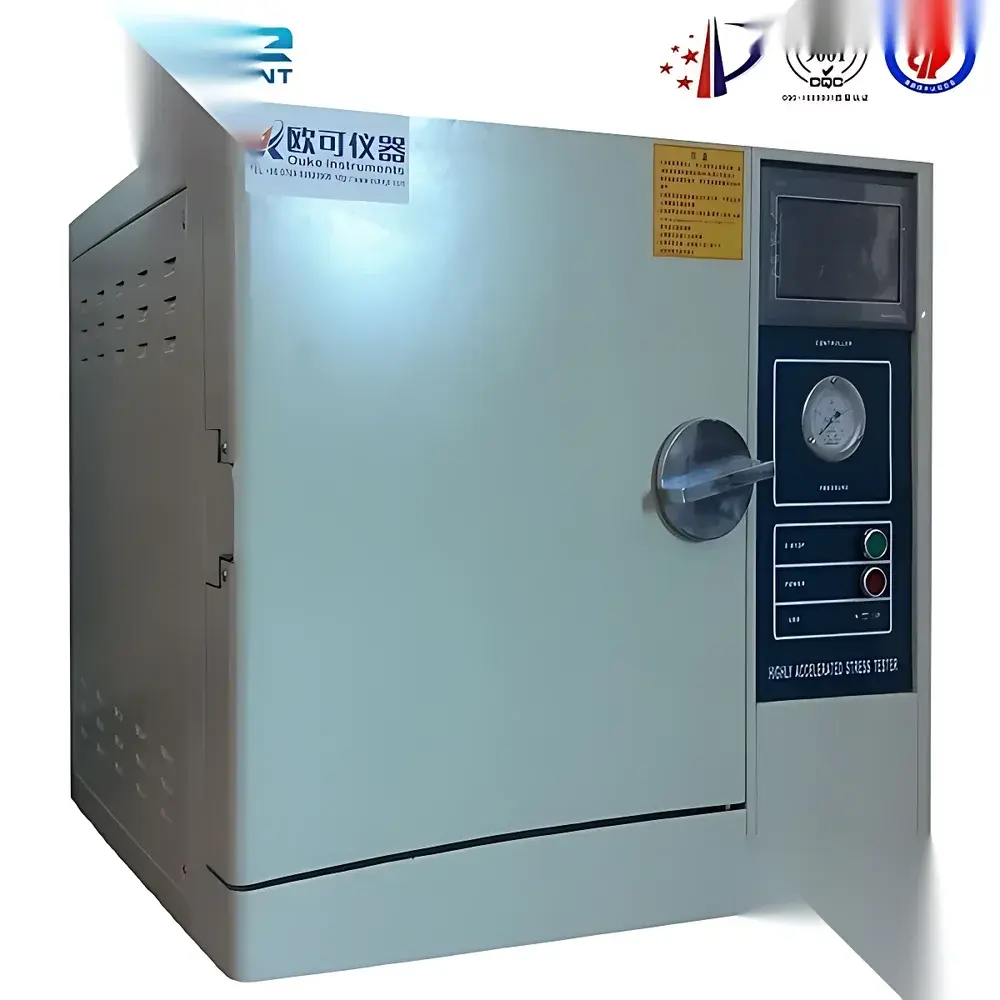
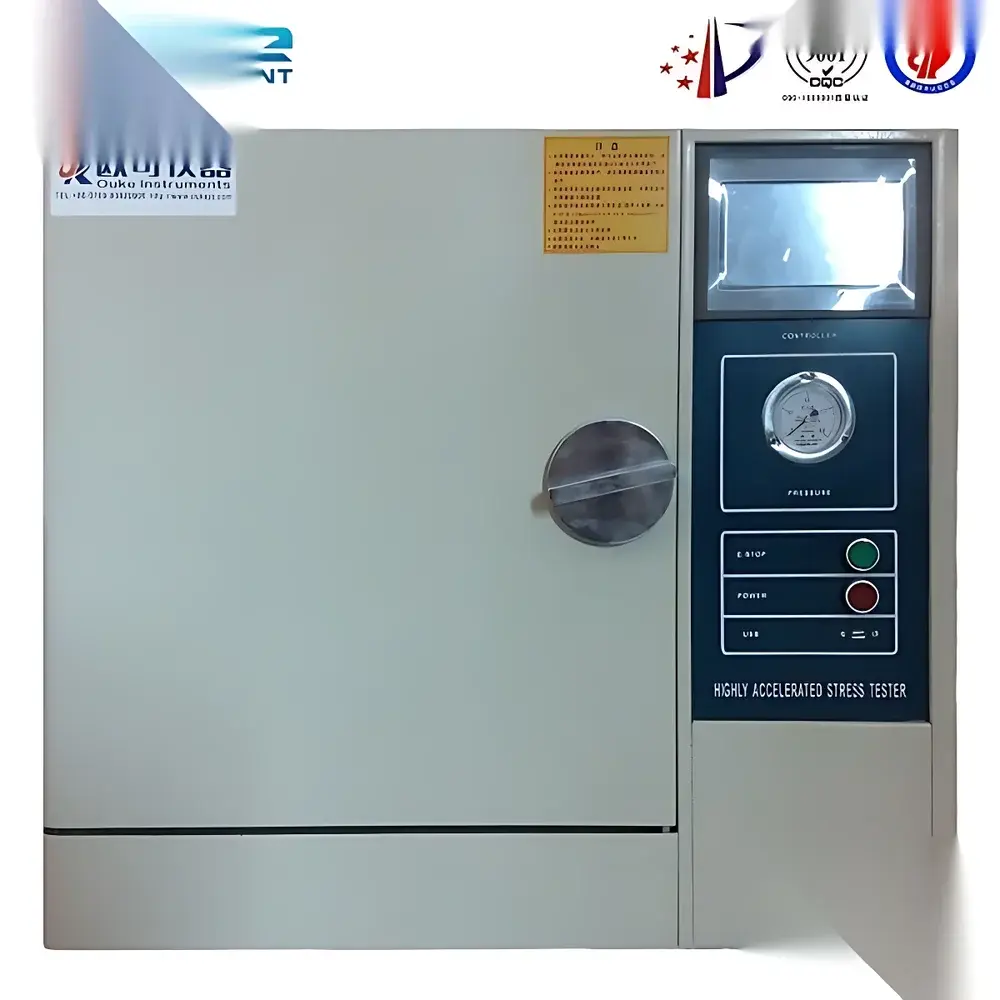
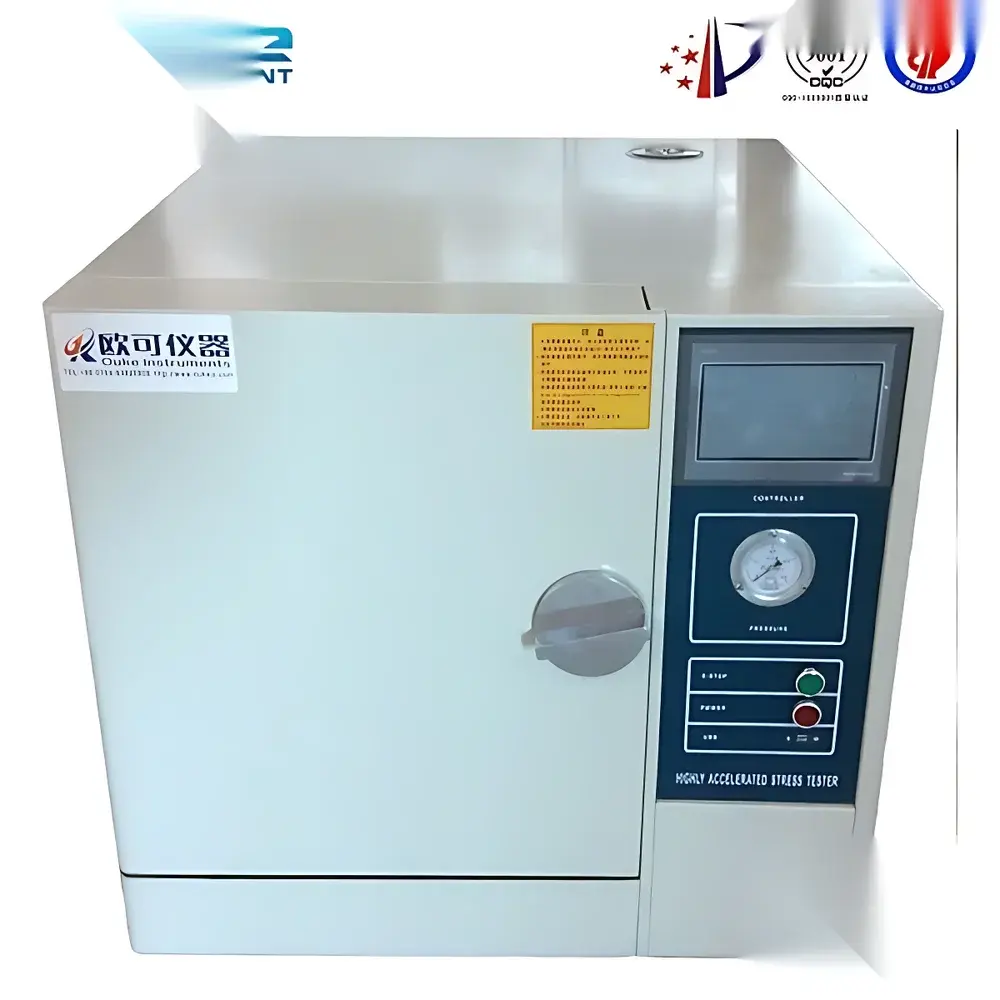
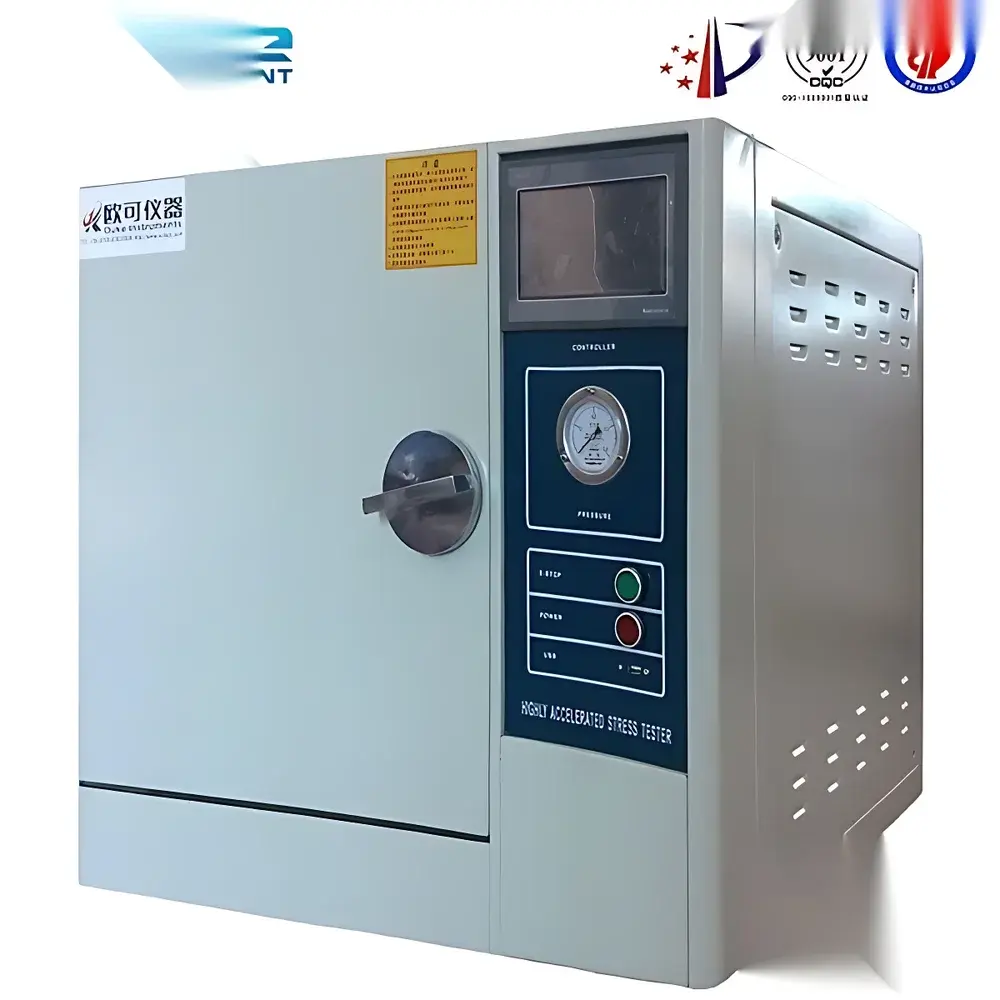
PCB PCT High-Pressure Steam Aging Chamber
| Brand | OEM / Other Brands |
|---|---|
| Origin | Imported |
| Manufacturer Type | Authorized Distributor |
| Temperature Range | RT+10°C to 125°C |
| Humidity Range | 100% RH (Saturated Steam) |
| Temperature Display Resolution | 0.1°C |
| Temperature Control Accuracy | ≤ ±0.5°C (at saturated steam condition) |
| Temperature Uniformity | ±0.5°C |
| Humidity Stability | ±1% RH |
| Pressure Range | 0–2.5 kgf/cm² (Vessel Design Pressure: 3.5 kgf/cm²) |
| Pressure Fluctuation | ±0.02 kgf/cm² |
| Test Duration | 000–999 hours |
| Pressurization Time | ≤45 min to reach 1.04 kgf/cm² |
| Standard Test Condition | 121°C, 100% RH, 1.04 kgf/cm² |
| Internal Chamber Dimensions | Φ240 × 440 mm (Vertical Cylindrical) |
| Control System | Microprocessor-Based Controller with LED Display |
| Steam Circulation | Natural Convection |
| Compliance | GB/T 2423.1–1989, GB/T 2423.2–1989, GB/T 2423.3–1993 |
| Auto Water Replenishment | Yes (Enables Uninterrupted Long-Term Testing) |
Overview
The PCB PCT High-Pressure Steam Aging Chamber is a precision-engineered environmental stress test system designed specifically for evaluating the moisture resistance and long-term reliability of printed circuit boards (PCBs), solder joints, laminates, and embedded passive components under accelerated pressure-cooker test (PCT) conditions. Operating on the principle of saturated steam aging under elevated temperature and pressure, this chamber subjects specimens to thermodynamically controlled 121°C/100% RH/1.04 kgf/cm² (15 psi) environments—conditions aligned with industry-standard JEDEC JESD22-A102 and IPC-TM-650 2.6.25 protocols. Unlike conventional humidity chambers, the PCT chamber maintains a fully saturated vapor phase with zero air exchange, ensuring consistent partial pressure of water vapor and eliminating boundary-layer drying effects. Its vertical cylindrical stainless-steel inner chamber (SUS304 mirror-finish) minimizes condensate pooling and thermal gradients, while the dual-function heating/evaporation system enables rapid, repeatable pressurization without overshoot.
Key Features
- Robust structural design featuring A3 steel outer casing with electrostatic powder coating for corrosion resistance and mechanical durability
- SUS304 stainless-steel interior chamber (Φ240 × 440 mm) with seamless mirror finish, optimized for uniform steam distribution and minimal contamination risk
- Integrated microprocessor-based controller with LED digital display for precise real-time monitoring of temperature, pressure, humidity, and elapsed time
- Automated water replenishment system enabling continuous operation over multi-day test cycles without manual intervention or chamber opening
- Dual-path thermal management: independent heating elements and refrigerant-based evaporator assembly ensure stable saturation control across full operating range (RT+10°C to 125°C)
- Natural convection steam circulation architecture eliminates fan-induced turbulence and mechanical vibration—critical for non-destructive evaluation of fine-pitch assemblies
- Pressure vessel rated to 3.5 kgf/cm² with calibrated safety relief valve and redundant pressure transducer feedback loop for fail-safe operation
Sample Compatibility & Compliance
This chamber accommodates standard PCB coupons (up to 200 × 150 mm), multilayer board stacks, bare die packages, and conformally coated modules. It supports both single-sample and batch testing configurations with adjustable sample trays. All operational parameters comply with Chinese national standards GB/T 2423.1 (cold), GB/T 2423.2 (dry heat), and GB/T 2423.3 (damp heat—steady state), and its functional envelope meets the technical prerequisites for IEC 60068-2-66 (PCT) qualification testing. While not certified to ASME BPVC Section VIII, the vessel undergoes hydrostatic validation per manufacturer’s QA protocol prior to shipment. Data logging outputs are timestamped and traceable, supporting GLP-compliant documentation workflows when integrated with external audit-ready software.
Software & Data Management
The embedded controller records temperature, pressure, and runtime at user-defined intervals (1–60 sec) and stores up to 1,000 test cycles in non-volatile memory. Export is supported via RS-232 serial interface (ASCII format) for integration into LIMS or statistical process control platforms. Optional PC-based companion software provides trend visualization, deviation alerts, and export to CSV/PDF for regulatory submission. All parameter changes are logged with operator ID and timestamp, satisfying basic requirements for 21 CFR Part 11–aligned electronic record integrity when paired with institutional access controls.
Applications
- Qualification testing of PCB substrates (FR-4, polyimide, BT resin) for moisture absorption and delamination resistance
- Evaluation of solder mask adhesion and through-hole plating integrity under high-humidity thermal stress
- Reliability screening of chip-scale packages (CSP), QFN, and BGA assemblies prior to burn-in
- Failure analysis root cause determination for popcorning, wire bond lift-off, and intermetallic growth acceleration
- Process validation of conformal coating formulations and curing parameters
- Material compatibility assessment between laminate resins and copper foil surface treatments
FAQ
What is the maximum allowable test duration without refilling water?
With the auto-replenishment system engaged and initial reservoir filled to capacity, uninterrupted operation up to 999 hours is achievable under nominal 121°C/1.04 kgf/cm² conditions.
Does the chamber support ramp-hold profiles or only static setpoints?
This model operates exclusively in fixed-setpoint mode per test cycle; programmable ramping is not supported in the base configuration.
Is third-party calibration certification available?
Yes—NIST-traceable calibration reports for temperature and pressure sensors can be provided upon request, with annual recalibration recommended per ISO/IEC 17025 guidelines.
Can the chamber be used for unsaturated humidity testing?
No—the design is optimized for saturated steam environments only; relative humidity below 100% RH cannot be reliably maintained or controlled.
What safety interlocks are implemented?
Three independent hardware interlocks prevent door opening during pressurized operation: pressure switch cutoff, thermal cutout, and solenoid lock engagement verified by PLC logic.



