
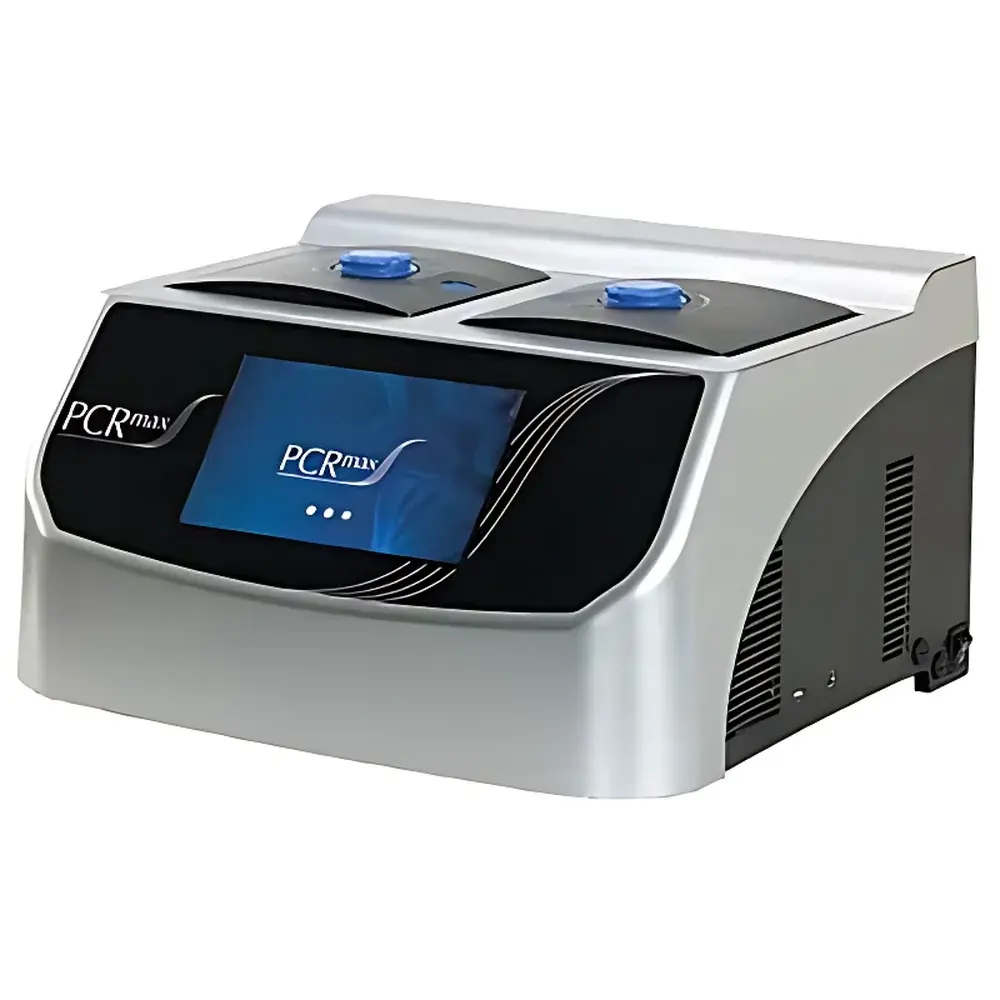
PCRmax AC-2 Dual-Module Gradient PCR System
| Brand | PCRmax |
|---|---|
| Origin | United Kingdom |
| Model | AC-2 |
| Sample Capacity | Two independent blocks (configurable as two 96-well, two 384-well, or mixed 96/384 modules) |
| Max Heating Rate | 3.4 °C/s |
| Temperature Accuracy | ±0.1 °C |
| Block Uniformity | ±0.3 °C |
| Temperature Range | 4–100 °C |
| Gradient Range | 10–100 °C |
| Gradient Span | 1–29 °C |
| Gradient Steps | 12 distinct temperatures with identical hold times |
| Thermal Lid | Adjustable manual pressure, 35–115 °C (or off), uniformity ±5 °C, preheat time <2 min |
| Cooling Method | Peltier-based semiconductor |
| Programmable Cycles | Up to 99 |
| Onboard Storage | ≥1000 protocols |
| Interface | 1× USB-A, 1× USB-B |
| Power | 900 W |
| Dimensions (W×D×H) | 470 × 535 × 330 mm |
| Noise Level | <50 dB (per module) |
Overview
The PCRmax AC-2 Dual-Module Gradient PCR System is an advanced thermal cycler engineered for high-throughput molecular biology laboratories requiring parallel, independent amplification workflows. Based on precise Peltier-driven semiconductor heating and cooling, the AC-2 implements real-time closed-loop temperature control across two physically separate reaction blocks—each capable of autonomous gradient programming, touchdown cycling, and dynamic ramp rate adjustment. Unlike network-dependent multi-instrument platforms, the AC-2 operates as a self-contained dual-channel system with no inter-block cabling or shared thermal mass, ensuring true experimental independence and eliminating cross-module thermal interference. Designed in accordance with ISO 13485-aligned manufacturing practices and validated for routine use under GLP-compliant environments, the AC-2 supports reproducible nucleic acid amplification across diverse assay types—including qPCR prep, genotyping, cloning, and NGS library enrichment—while maintaining full traceability through instrument-embedded audit logs and USB-based user authentication.
Key Features
- Two fully isolated thermal blocks: Configurable combinations include dual 96-well, dual 384-well, or hybrid 96/384 setups—no external networking or synchronization required.
- Independent 12-step gradient functionality per block: Simultaneous execution of 12 discrete incubation temperatures (spanning 1–29 °C differential) with identical dwell times—ideal for empirical annealing optimization.
- Touchdown PCR protocol support: Linear or stepwise reduction of annealing temperature over successive cycles, programmable within a single run file.
- 10-inch 1080P capacitive touchscreen interface running Android OS: Supports both graphical drag-and-drop protocol design and automated program generation via input of amplicon length, primer Tm, and extension time.
- USB-based user identity management: Encrypted login tokens stored on removable USB drives; account data never persists on instrument memory—ensuring compliance with data sovereignty requirements.
- Pre-cooling and thermal lid preheating: Reduces condensation risk and accelerates cycle initiation, particularly critical for low-volume reactions (<10 µL).
- Power-loss recovery mode: Automatically resumes interrupted runs from the last completed cycle upon grid restoration—preserving sample integrity and experimental continuity.
- Remote status monitoring: QR-code-scannable web interface provides real-time cycle progress, block temperature traces, and error diagnostics via any smartphone browser.
Sample Compatibility & Compliance
The AC-2 accommodates standard ANSI/SBS-compliant microplates (96- and 384-well), skirted/unskirted PCR plates, and tube strips without adapter modification. Its manually adjustable thermal lid applies consistent pressure across variable-height consumables—from thin-wall 0.2 mL tubes to full-height 384-well plates—minimizing evaporation and improving thermal coupling. All firmware and software components comply with IEC 62304 Class B medical device software standards. The system supports 21 CFR Part 11–compliant electronic signatures when paired with PCRmax’s optional Audit Trail Module (sold separately), enabling full ALCOA+ data integrity for regulated QC/QA labs. Validation documentation—including IQ/OQ templates and temperature mapping reports—is provided with each unit to facilitate installation into ISO/IEC 17025-accredited testing facilities.
Software & Data Management
Built-in Android OS enables seamless integration with laboratory informatics systems via HTTP API endpoints. Protocol files (.pcr format) are encrypted and digitally signed to prevent unauthorized modification. Onboard storage retains ≥1000 user-defined methods; additional protocols may be loaded directly from FAT32-formatted USB media. All run logs—including timestamps, setpoints, actual block temperatures, gradient profiles, and fault codes—are timestamped and exported in CSV or PDF format with embedded digital signatures. Audit trail records capture operator login/logout events, parameter changes, and firmware updates—retained for ≥12 months unless manually purged. No cloud connectivity is enabled by default; all data remains local unless explicitly transferred via USB or Ethernet (optional).
Applications
- High-efficiency assay development: Parallel optimization of primer annealing conditions across two independent gradients.
- Multi-target detection: Concurrent amplification of distinct gene panels (e.g., pathogen screening + host response markers) without cross-contamination risk.
- Reference material qualification: Replicate testing of certified reference standards under identical thermal profiles across blocks for inter-block precision assessment.
- Training and core facility deployment: Shared instrument access via portable USB credentials eliminates need for centralized user administration.
- Resource-constrained environments: Low power consumption (0.3 kWh per 30-cycle 96-well run) and silent operation (<50 dB) enable benchtop placement in open-plan labs.
FAQ
Does the AC-2 require network connectivity to operate both modules independently?
No. Each module contains its own dedicated thermal controller and firmware instance—no LAN, Wi-Fi, or inter-module wiring is necessary.
Can gradient parameters be edited during an active run?
No. Gradient settings are locked at run initiation to ensure thermodynamic stability and regulatory compliance; modifications require pausing and reinitializing the protocol.
Is the USB login drive compatible with Windows/macOS file systems?
Yes—formatted as FAT32, it functions identically across Windows, macOS, and Linux hosts for protocol transfer and credential generation.
What validation documentation is included?
Factory-calibrated temperature uniformity maps, IQ/OQ checklists, and a Certificate of Conformance compliant with UKCA/CE marking directives are shipped with every unit.
How is firmware updated?
Via USB stick using signed update packages distributed through PCRmax’s secure customer portal—no internet connection required on the instrument itself.




