
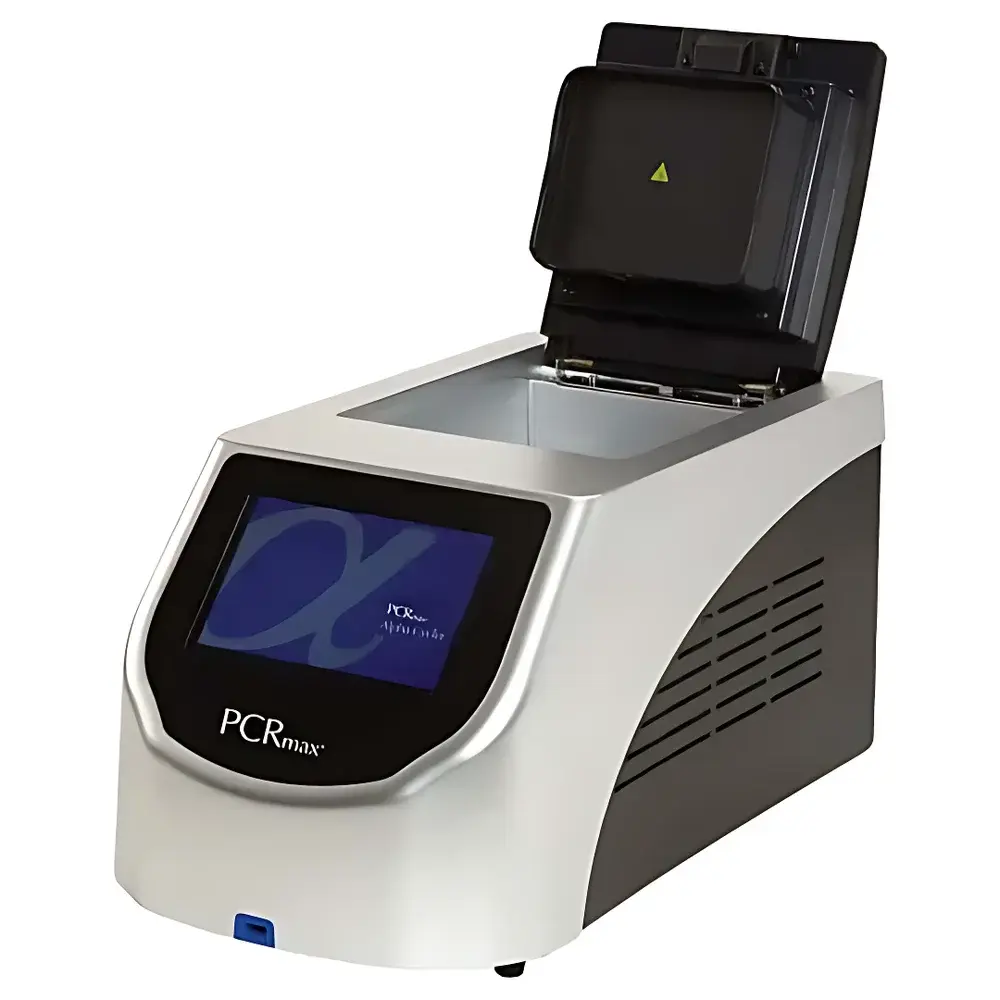
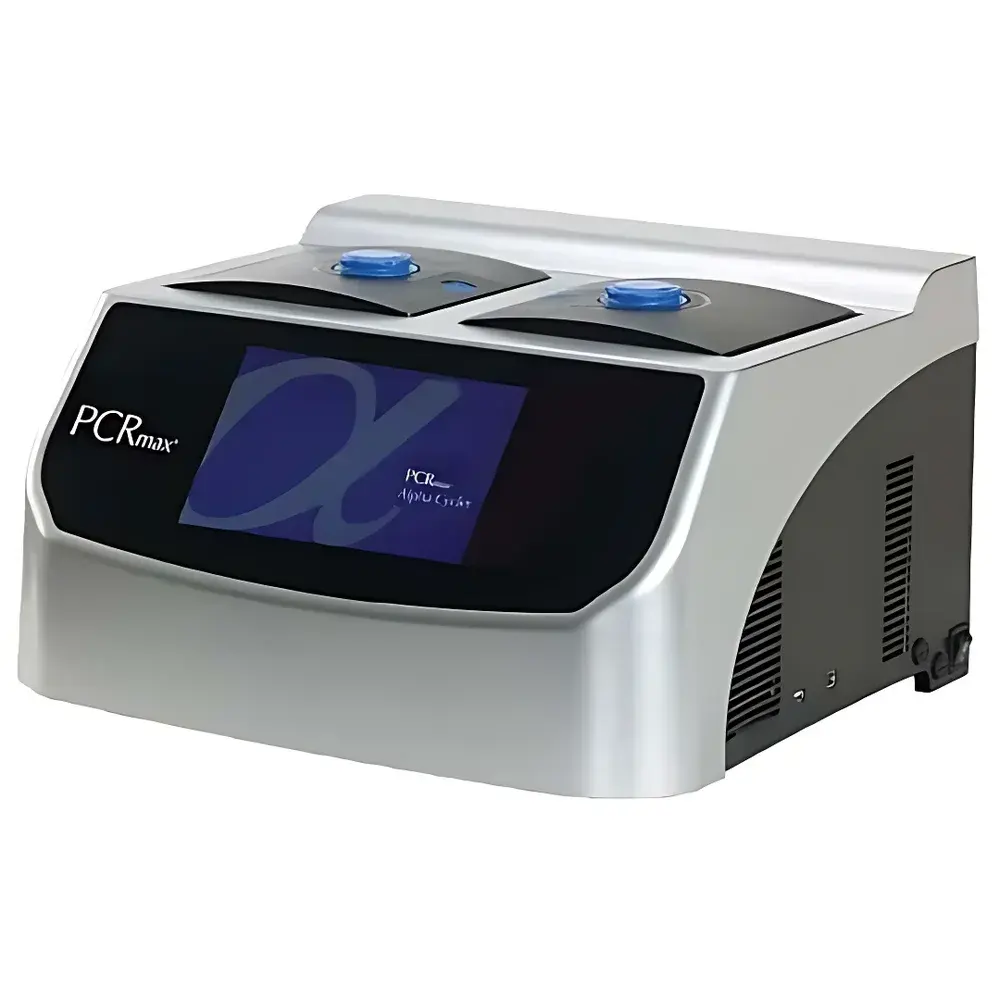
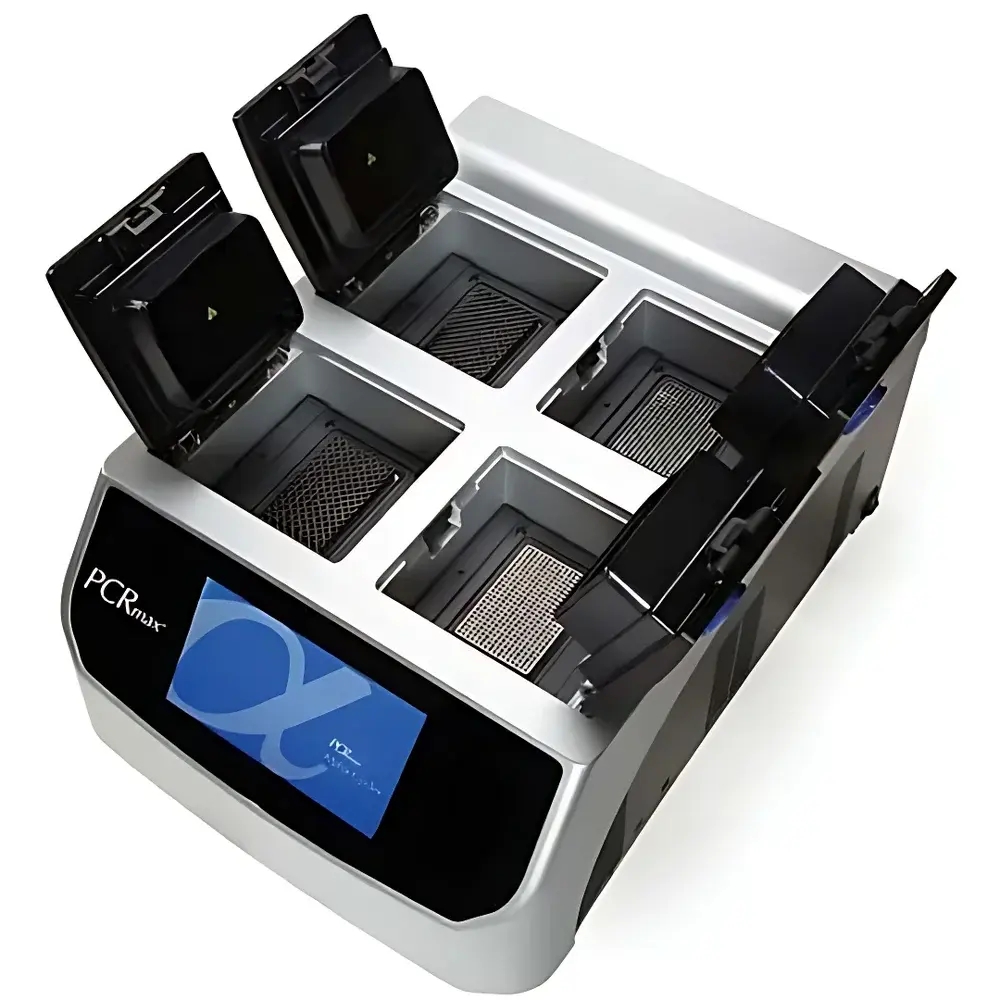
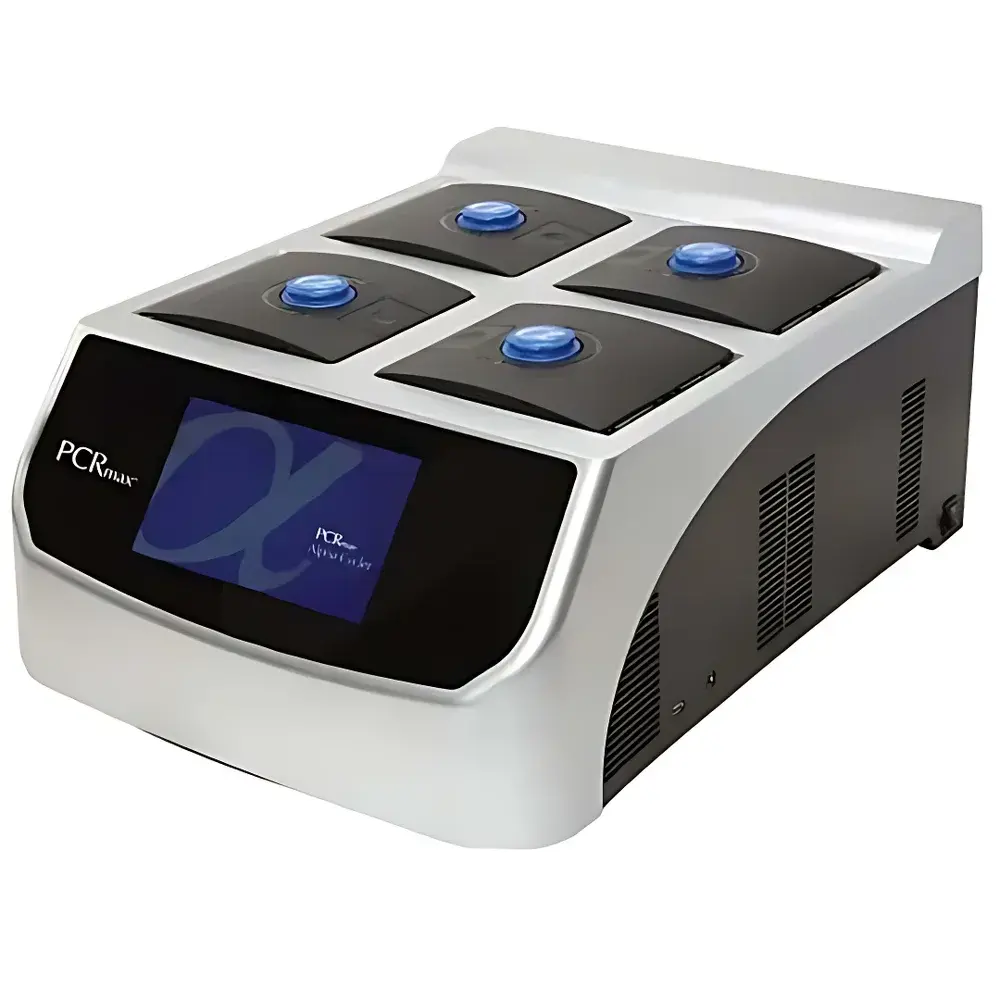
PCRmax Alpha Cycler AC-1 / AC-2 / AC-4 Series Polymerase Chain Reaction Instrument
| Brand | PCRmax |
|---|---|
| Origin | USA |
| Model | AC-1, AC-2, AC-4 |
| Heating Rate | 3.4°C/s |
| Temperature Accuracy | ±0.25°C |
| Well-to-Well Uniformity | ±0.3°C |
| Module Configuration | Independent 96-well and/or 384-well thermal blocks |
| Gradient Capability | 12-column (96-well) or 16-column (384-well) programmable gradient |
| Control Architecture | Six independent Peltier heating elements per block |
| Operating System | Android-based embedded OS with 7-inch HD capacitive touchscreen |
Overview
The PCRmax Alpha Cycler AC-1, AC-2, and AC-4 Series are modular, high-precision thermal cyclers engineered for reproducible nucleic acid amplification under stringent laboratory conditions. Based on solid-state Peltier thermoelectric technology, each thermal block integrates six independently controlled heating/cooling elements—enabling dynamic spatial temperature regulation across the entire plate surface. This architecture supports both uniform ramping and highly resolved linear or stepped thermal gradients, critical for empirical optimization of primer annealing temperatures in multiplex or low-fidelity PCR assays. Designed for workflow continuity across instrument tiers, the Alpha Cycler platform ensures full program compatibility between AC-1 (single module), AC-2 (dual-module), and AC-4 (quad-module) configurations—eliminating revalidation overhead when scaling throughput or transitioning between benchtop and core facility environments.
Key Features
- Modular thermal architecture: Selectable 96-well or 384-well blocks per module; AC-1 supports one block, AC-2 supports two independently addressable blocks, and AC-4 supports up to four—configurable as homogeneous or mixed-format (e.g., 96 + 384) combinations.
- High-fidelity thermal control: ±0.25°C accuracy across the full operating range (4–100°C) and ±0.3°C well-to-well uniformity verified per ISO 13485-aligned calibration protocols.
- Intelligent gradient optimization: 12-column (96-well) or 16-column (384-well) gradient mode enables rapid empirical determination of optimal annealing temperature; Gradient Converter function automatically extracts the column-specific temperature yielding maximal product specificity and converts the gradient step into a fixed-temperature step without manual program editing.
- Android-based embedded OS with 7-inch HD capacitive touchscreen: Supports intuitive drag-and-drop protocol building, real-time thermal profile visualization, and multi-user role management.
- Program Wizard: Guides users through automated touchdown, hot-start, and nested PCR setup based on amplicon length, GC content, and primer Tm—reducing optimization cycles.
- Alpha Track Application: Enables QR-code-based remote monitoring of run status, instrument health, and thermal history; logs timestamped events including lid temperature, block calibration drift, and power interruption recovery.
- User authentication via authorized USB drive: Any USB storage device can be registered and encrypted as a persistent login token; user-specific programs, permissions, and audit trails remain bound to the token—not the instrument—ensuring GLP-compliant portability across shared instruments.
Sample Compatibility & Compliance
The Alpha Cycler accommodates standard ANSI/SBS-compliant 96-well and 384-well PCR plates, strip tubes, and individual tubes (0.2 mL and 0.1 mL). All thermal blocks undergo factory calibration traceable to NIST standards, with documented uncertainty budgets provided in the Certificate of Conformance. The system complies with IEC 61010-1 (Safety Requirements for Electrical Equipment for Measurement, Control, and Laboratory Use) and meets electromagnetic compatibility requirements per EN 61326-1. Software functionality—including user access logs, electronic signatures, and audit trail generation—supports alignment with FDA 21 CFR Part 11 and EU Annex 11 for regulated environments. Routine performance verification follows ASTM E1578-22 (Standard Guide for Thermal Cyclers Used in Nucleic Acid Amplification).
Software & Data Management
The embedded Android OS hosts a purpose-built PCR application with local data persistence and optional cloud synchronization (via secure TLS 1.3). All run files include embedded metadata: operator ID, instrument serial number, block configuration, thermal profile checksum, and environmental sensor readings (ambient temperature/humidity). Program locking allows administrators to restrict editing, duplication, or deletion of validated methods. Audit trails record every action—including parameter modification, user login/logout, and firmware updates—with immutable timestamps and SHA-256 hashing. Export formats include CSV (for LIMS integration), PDF (for SOP documentation), and proprietary .pcrbin (for cross-platform instrument transfer).
Applications
- High-throughput genotyping and SNP detection requiring precise thermal ramping and inter-block consistency.
- Optimization of difficult templates (e.g., high-GC, secondary structure-rich, or low-input clinical samples) using column-wise gradient screening.
- Multi-assay validation workflows where identical protocols must execute identically across AC-1 (R&D), AC-2 (QC release), and AC-4 (GMP manufacturing) platforms.
- Digital PCR pre-amplification and library preparation for next-generation sequencing, leveraging 384-well format for reaction miniaturization.
- Educational laboratories requiring intuitive interface navigation, role-based access, and portable method libraries via USB-authenticated login.
FAQ
Can gradient programs be converted to non-gradient protocols without manual editing?
Yes—the Gradient Converter feature automatically identifies the column with highest amplification efficiency from a gradient run and replaces the gradient step with a fixed-temperature step at that value, preserving all other cycle parameters.
Is user data retained when switching between different Alpha Cycler instruments?
Yes—when authenticated via a registered USB drive, user profiles, saved protocols, and audit history persist across AC-1, AC-2, and AC-4 systems without reconfiguration.
What regulatory standards does the software support for electronic records?
The system implements ALCOA+ principles: Attributable, Legible, Contemporaneous, Original, Accurate, Complete, Consistent, Enduring, and Available—fully supporting 21 CFR Part 11 and EU GMP Annex 11 requirements.
Are 96-well and 384-well blocks interchangeable within the same instrument model?
Yes—AC-2 and AC-4 support hot-swappable block configurations; a single AC-4 unit may operate with any combination of 96-well and 384-well modules simultaneously, each controlled independently.
How is temperature uniformity verified during installation qualification?
Each instrument ships with a calibrated thermal mapping report generated using a 96-point NIST-traceable thermocouple array, performed per ISO/IEC 17025-accredited procedures.




