PCS Instruments ETM Extreme Pressure Traction Measurement Instrument
| Brand | PCS Instruments |
|---|---|
| Origin | United Kingdom |
| Manufacturer Status | Authorized Distributor |
| Origin Category | Imported |
| Model | ETM |
| Product Type | Laboratory Instrument |
| Test Parameter | Friction and Wear |
| Load Range | 100–1650 N |
| Maximum Contact Pressure | 3.5 GPa (standard steel test specimens) |
| Sliding Velocity | up to 3.5 m/s |
| Temperature Range | 10–150 °C |
| Sample Volume | 30 mL (10 mL with optional filler insert) |
| Operating System | Windows 10 |
| Safety Features | Dual PT100 RTD temperature monitoring, emergency stop button, interlocked lubricant reservoir lid |
| Power Supply | 100–240 V, 50/60 Hz, 1600 VA |
| Weight (main unit) | 52 kg |
| Dimensions (H × W × D) | 425 mm × 400 mm × 605 mm |
Overview
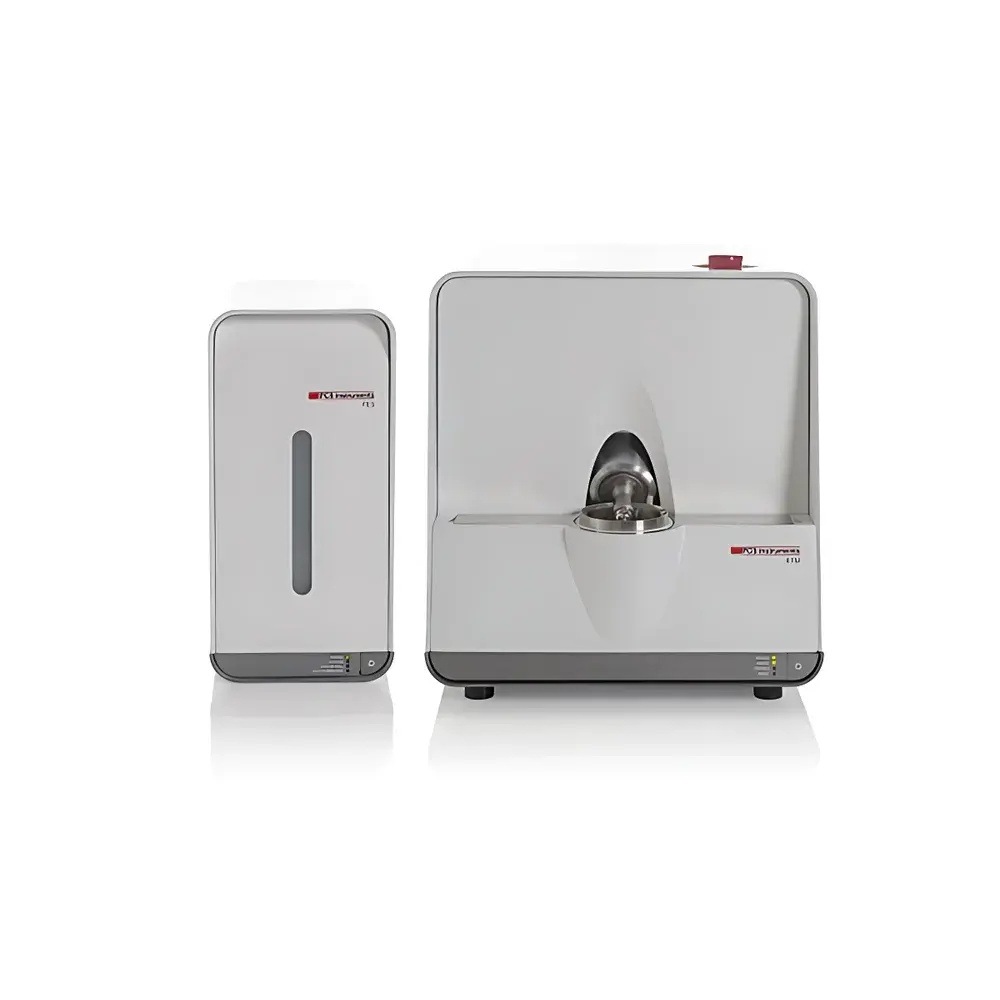
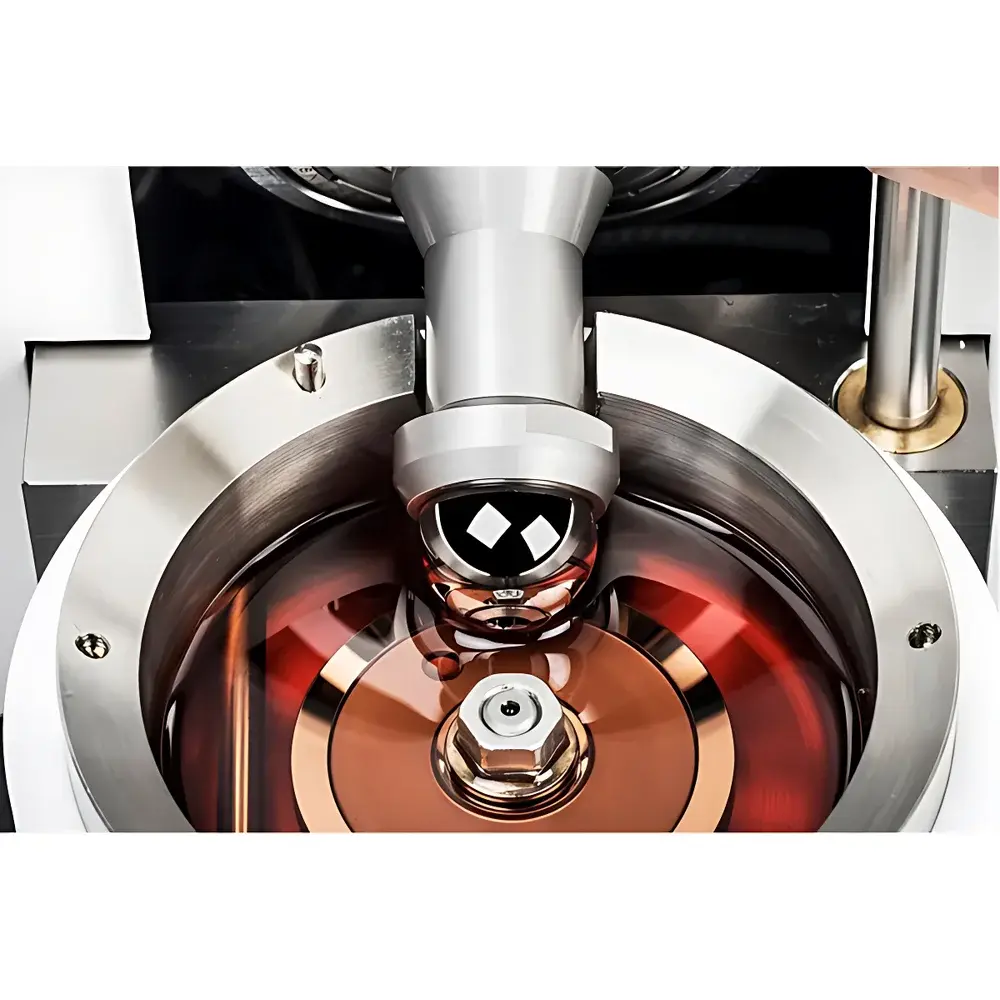
The PCS Instruments ETM Extreme Pressure Traction Measurement Instrument is a precision-engineered tribological testing platform designed for quantitative evaluation of traction and friction behavior under extreme pressure (EP) conditions representative of real-world gear, bearing, and power transmission systems. Based on the well-established ball-on-disk geometry—shared with the MTM micro-tribometer—the ETM operates under controlled mechanical, thermal, and environmental parameters to replicate boundary, mixed, and elastohydrodynamic lubrication (EHL) regimes. Its core measurement principle relies on direct torque sensing of the rotating disk while applying precisely regulated normal load and sliding velocity, enabling high-fidelity acquisition of traction coefficient (μ = Ft/Fn) as a function of pressure, speed, and temperature. Introduced in 2019, the ETM extends the capabilities of conventional tribometers by supporting contact pressures up to 3.5 GPa with standard steel specimens—and up to 7.1 GPa when using optional hardened or ceramic test specimens—making it suitable for evaluating next-generation EP additives, synthetic base stocks, and formulated gear oils under near-operational stress states.
Key Features
- Ball-on-disk configuration with interchangeable test specimen holders, ensuring geometric consistency with ISO 12156-1 and ASTM D5001 reference methodologies.
- High-stiffness load train delivering stable normal forces from 100 N to 1650 N with closed-loop PID control and sub-Newton resolution.
- Motor-driven disk rotation with programmable velocity profiles (0.01–3.5 m/s), enabling transient and steady-state traction mapping across realistic shear rates.
- Integrated dual PT100 RTD sensors for independent verification of specimen and bulk lubricant temperature, compliant with GLP temperature uniformity requirements.
- Interlocked lubricant reservoir lid with safety cutoff, preventing operation during sample access and meeting IEC 61000-6-2 electromagnetic compatibility and functional safety expectations.
- Rugged aluminum alloy frame and thermally stabilized base plate minimize vibration-induced noise and thermal drift during long-duration tests (e.g., 2–8 h EP screening protocols).
Sample Compatibility & Compliance
The ETM accommodates standard 19 mm diameter steel balls (AISI 52100, hardness 60–62 HRC) and 50 mm diameter flat disks (same material), conforming to ASTM D2782, ISO 20623, and DIN 51834 specifications. Optional specimen sets—including silicon nitride, tungsten carbide, and DLC-coated substrates—enable simulation of non-ferrous or coated component interfaces. The 30 mL sample chamber supports both immersion and meniscus-contact configurations; a 10 mL reduced-volume insert is available for precious or hazardous formulations. All hardware and firmware comply with CE marking directives (2014/30/EU EMC, 2014/35/EU LVD), and the system architecture supports audit-ready data integrity per FDA 21 CFR Part 11 when paired with validated PCS software modules.
Software & Data Management
Control and analysis are performed via PCS’s proprietary TractionLab™ software suite, running natively on Windows 10 platforms. The interface provides real-time visualization of traction coefficient, friction force, disk temperature, and load stability metrics. Automated test sequences include ramped-load EP screening (e.g., ASTM D2596 four-ball equivalent mapping), isothermal traction curves, and temperature-sweep protocols. Raw data export is supported in CSV and HDF5 formats; metadata—including instrument ID, calibration timestamps, operator logins, and environmental logs—is embedded and immutable. Optional 21 CFR Part 11 compliance packages provide electronic signatures, role-based access control, and full audit trail generation for regulated QA/QC laboratories operating under ISO/IEC 17025 or API RP 1529 frameworks.
Applications
- Quantitative ranking of extreme pressure (EP) and anti-wear (AW) additive performance in gear oils, engine oils, and greases.
- Formulation development for low-viscosity, high-efficiency driveline fluids targeting EV reduction gearboxes.
- Validation of lubricant film-forming capacity under mixed/boundary regimes encountered in wind turbine main bearings.
- Correlation studies between laboratory traction data and field-measured efficiency losses in industrial gearmotors.
- Supporting OEM lubricant qualification programs requiring ISO 12156-1 or JIS K 2510–based traction coefficient reporting.
FAQ
What lubrication regimes can the ETM simulate?
The ETM replicates boundary, mixed, and elastohydrodynamic lubrication regimes by independently controlling load, velocity, and temperature—enabling systematic transition mapping across the Strubeck curve.
Is the ETM compatible with non-standard test geometries?
While optimized for ball-on-disk, optional fixtures support pin-on-disk and roller-on-disk configurations; custom geometries require prior mechanical validation and firmware adaptation.
Does the system support automated pass/fail evaluation against industry standards?
Yes—TractionLab™ includes configurable pass/fail thresholds aligned with ASTM D2596, ISO 12156-1, and internal OEM specifications, with PDF report generation and digital signature support.
How is calibration traceability maintained?
Load cells and RTDs are calibrated annually against UKAS-accredited standards; calibration certificates and uncertainty budgets are stored within the software audit log.
Can the ETM operate unattended overnight?
Yes—integrated thermal monitoring, emergency stop logic, and power-fail recovery enable secure unattended operation for extended EP screening tests, subject to local lab safety policy approval.