
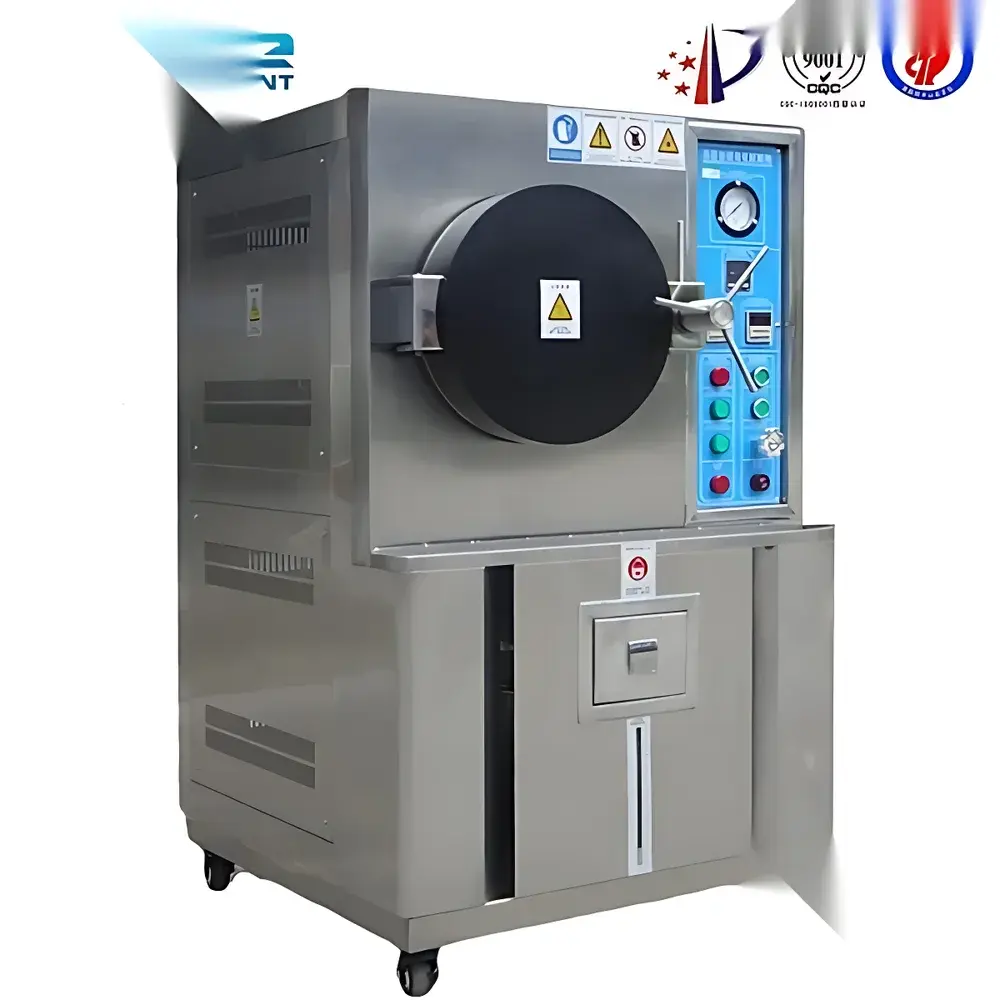
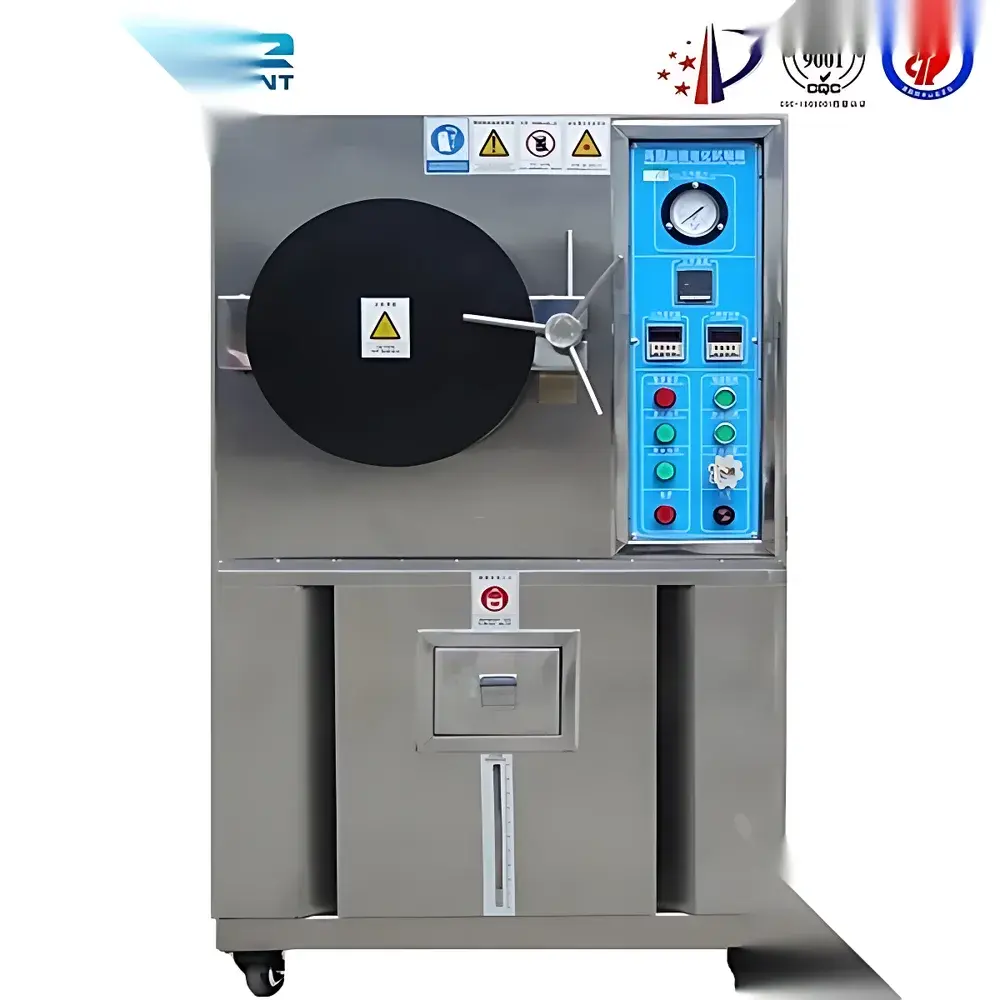
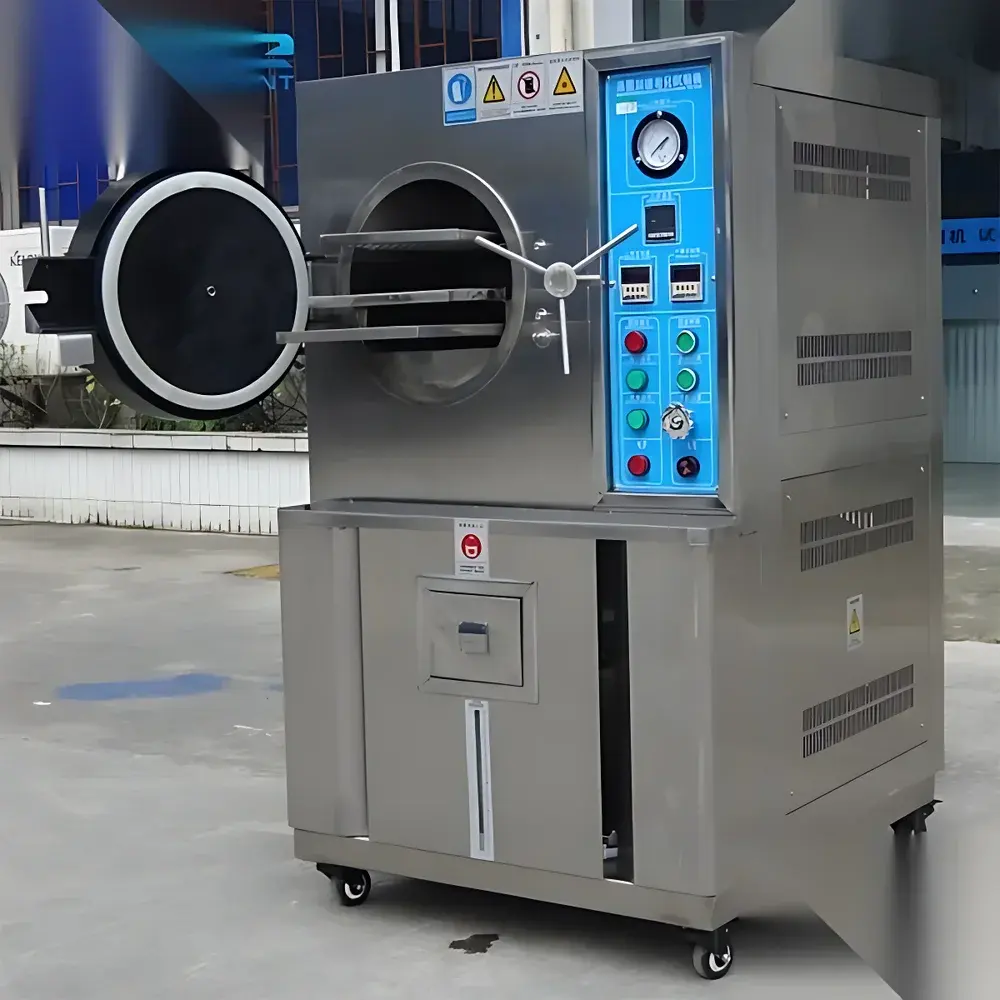
PCT High-Pressure Aging Test Chamber
| Brand | OEM |
|---|---|
| Chamber Dimensions (OK-PTC-25) | Ø250 × 450 mm (D) |
| Chamber Dimensions (OK-PTC-35) | Ø350 × 500 mm (D) |
| Temperature Range | RT+10°C to 132°C |
| Humidity Range | 100% RH |
| Pressure Range | 0.0–2.8 kg/cm² (gauge), max safety capacity 4.0 kg/cm² |
| Temp. Uniformity | ±1.5°C |
| Temp. Control Accuracy | ±0.5°C |
| Temp. Resolution | 0.1°C |
| Pressurization Time (0→2.0 kg/cm²) | ~30 min |
| Inner Chamber Material | SUS304 stainless steel |
| Outer Casing | SECC steel with electrostatic powder coating |
| Compliance | ASTM, DIN, BS, IEC, NACE, UL, CNS, ISO, JIS, MIL |
Overview
The PCT High-Pressure Aging Test Chamber is an engineered environmental stress testing system designed for accelerated aging evaluation of materials—particularly polymeric components, electronic encapsulants, printed circuit boards (PCBs), and adsorption tubes—under combined high temperature, saturated steam humidity, and elevated pressure conditions. Operating on the principle of saturated steam pressurization, it replicates harsh service environments where moisture ingress under thermal and mechanical stress leads to delamination, corrosion, intermetallic growth, or hydrolytic degradation. Unlike conventional damp heat chambers, this system maintains full saturation (100% RH) at pressures above atmospheric, enabling rapid diffusion of water vapor into microstructures and accelerating failure mechanisms in accordance with industry-standard PCT (Pressure Cooker Test) protocols defined in JEDEC JESD22-A102, IPC-TM-650 2.6.25, and AEC-Q200. Its cylindrical horizontal chamber architecture ensures uniform steam distribution and eliminates localized condensation, supporting repeatable, traceable, and auditable test cycles essential for qualification and reliability validation.
Key Features
- Cylindrical horizontal chamber design minimizes condensate accumulation and prevents direct steam jet exposure to operators during loading/unloading.
- Dual-mode control architecture: microprocessor-based PID controller with SSR output drives precise saturated steam temperature regulation; independent high-stability pressure transducer provides real-time gauge pressure monitoring.
- Integrated safety interlock system: pressure-actuated door lock mechanism—increased internal pressure enhances sealing force between door gasket and chamber flange, preventing inadvertent opening until pressure drops below 0.1 kg/cm².
- Automated safety sequence: programmable emergency shutdown triggers simultaneous pressure venting, vacuum break, and deionized water replenishment; standard reservoir supports up to 100 hours of uninterrupted operation.
- Robust thermal management: insulated SUS304 inner chamber with embedded Pt100 RTD sensors; ceramic-insulated heating elements and magnetically coupled circulation fan ensure stable thermal gradients and minimal thermal lag.
- Comprehensive environmental integrity: integrated vacuum pump evacuates ambient air prior to steam generation, followed by HEPA-filtered air reintroduction—ensuring oxygen-controlled, particulate-free test atmosphere.
Sample Compatibility & Compliance
The chamber accommodates standard adsorption tubes (e.g., Tenax TA, Carbopack™ series), PCB assemblies, semiconductor packages, conformal-coated modules, and polymer seals. Its geometry supports both vertical and horizontal sample orientation without obstruction to steam flow. All operational parameters—including ramp rates, dwell times, pressure hold profiles, and cooldown sequences—are configurable to align with ASTM D2247 (standard practice for testing coatings under high humidity), ISO 9022-3 (optics and optical instruments—environmental tests), and MIL-STD-810H Method 507.7 (humidity). The system’s documented calibration traceability, audit-ready event logs, and hardware-enforced safety limits satisfy GLP/GMP documentation requirements and support FDA 21 CFR Part 11-compliant data archiving when paired with validated software.
Software & Data Management
While the base configuration features LED-based local control, optional Ethernet-enabled data acquisition modules provide time-synchronized logging of temperature, pressure, and cycle phase status at user-defined intervals (1–60 sec resolution). Export formats include CSV and XML, compatible with LIMS integration and statistical process control (SPC) platforms. Firmware supports password-protected parameter locking, user-level access tiers (operator/engineer/admin), and automatic generation of test summary reports compliant with ISO/IEC 17025 clause 7.8. All critical events—including safety interlock activation, pressure deviation >±0.2 kg/cm², or temperature excursion beyond ±1.0°C—are timestamped with cause-code annotation for root-cause analysis.
Applications
- Qualification testing of adsorption tubes used in thermal desorption–gas chromatography (TD-GC) systems per EPA TO-17 and ISO 16000-6.
- Reliability screening of automotive electronics per AEC-Q200 Rev H, focusing on moisture-induced failure modes in under-hood applications.
- Evaluation of hydrolytic stability in biodegradable polymers, medical device packaging, and pharmaceutical primary containers.
- Accelerated corrosion testing of metallic contacts and solder joints under mixed flowing gas (MFG) + PCT hybrid protocols.
- Validation of hermetic seal integrity in MEMS devices and optoelectronic housings using pressure-differential leak detection correlation.
FAQ
What standards does this chamber support for PCT validation?
It is configured to execute test profiles aligned with JEDEC JESD22-A102, IPC-TM-650 2.6.25, and AEC-Q200 Annex G, with full traceability of temperature, pressure, and dwell time.
Can the system operate unattended for extended durations?
Yes—the integrated water reservoir supports continuous operation for up to 100 hours; optional auto-refill kits enable indefinite runtime with external DI water supply.
Is vacuum pre-conditioning mandatory before each test cycle?
Vacuum evacuation is recommended to remove residual oxygen and particulates; however, the control system allows bypassing this step for specific protocol adaptations.
How is temperature uniformity verified across the chamber volume?
Uniformity is confirmed per ASTM E2207 using nine calibrated thermocouples positioned at standardized locations; as-shipped certification includes a full mapping report.
Does the chamber support custom pressure ramp profiles?
Yes—up to 16 programmable segments per cycle, including linear and stepwise pressure/temperature transitions, with dwell stabilization logic.



