
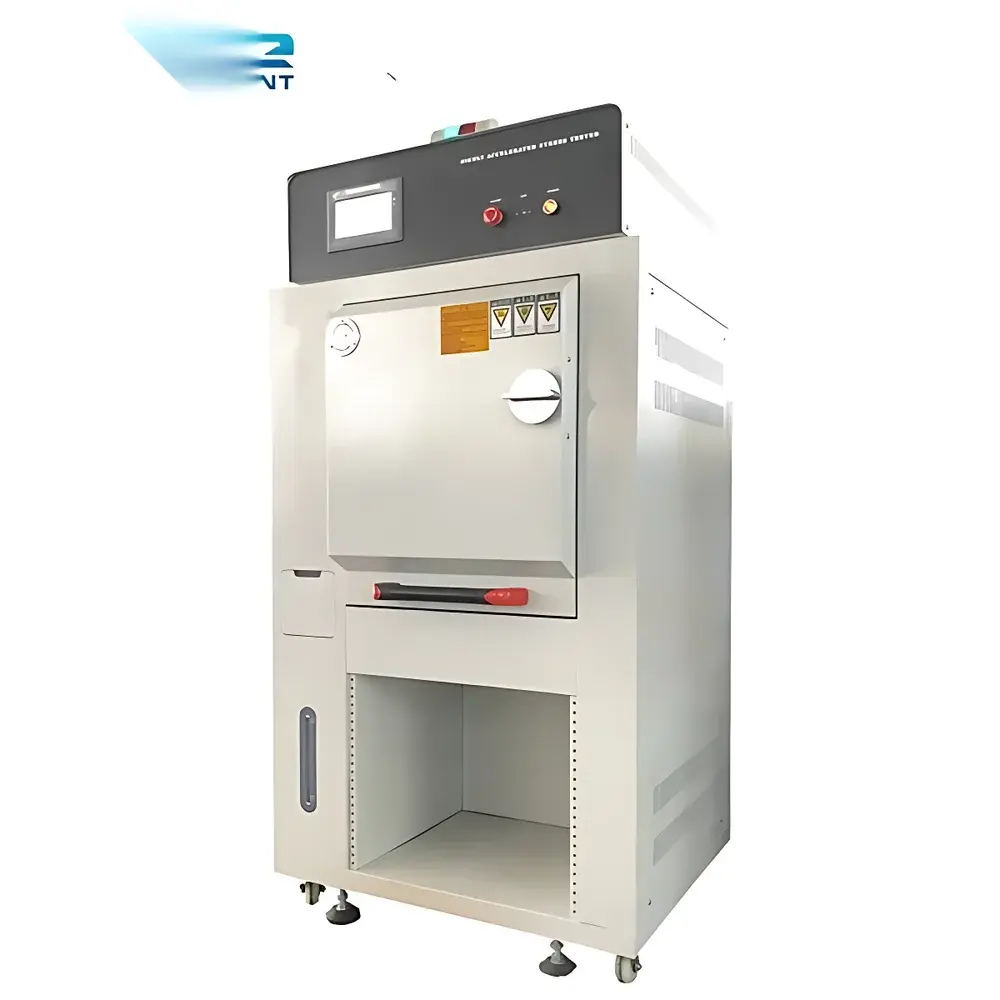
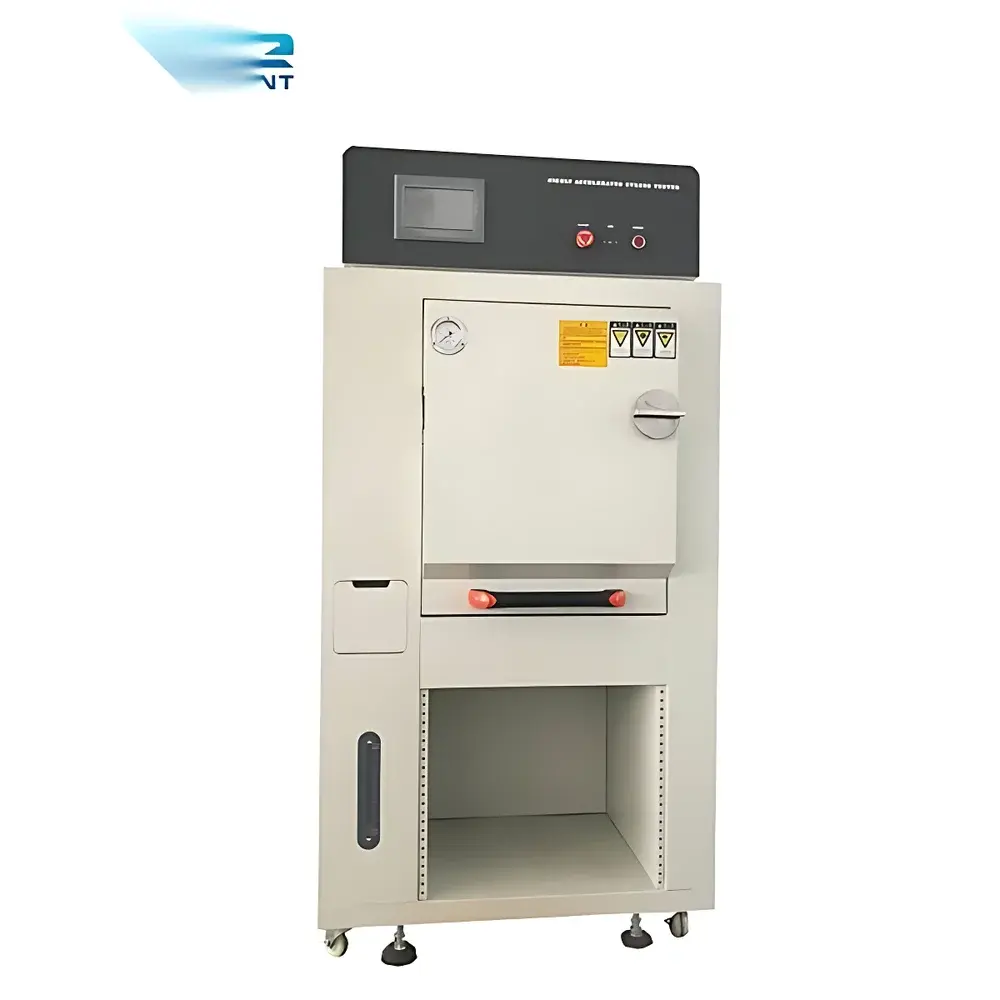
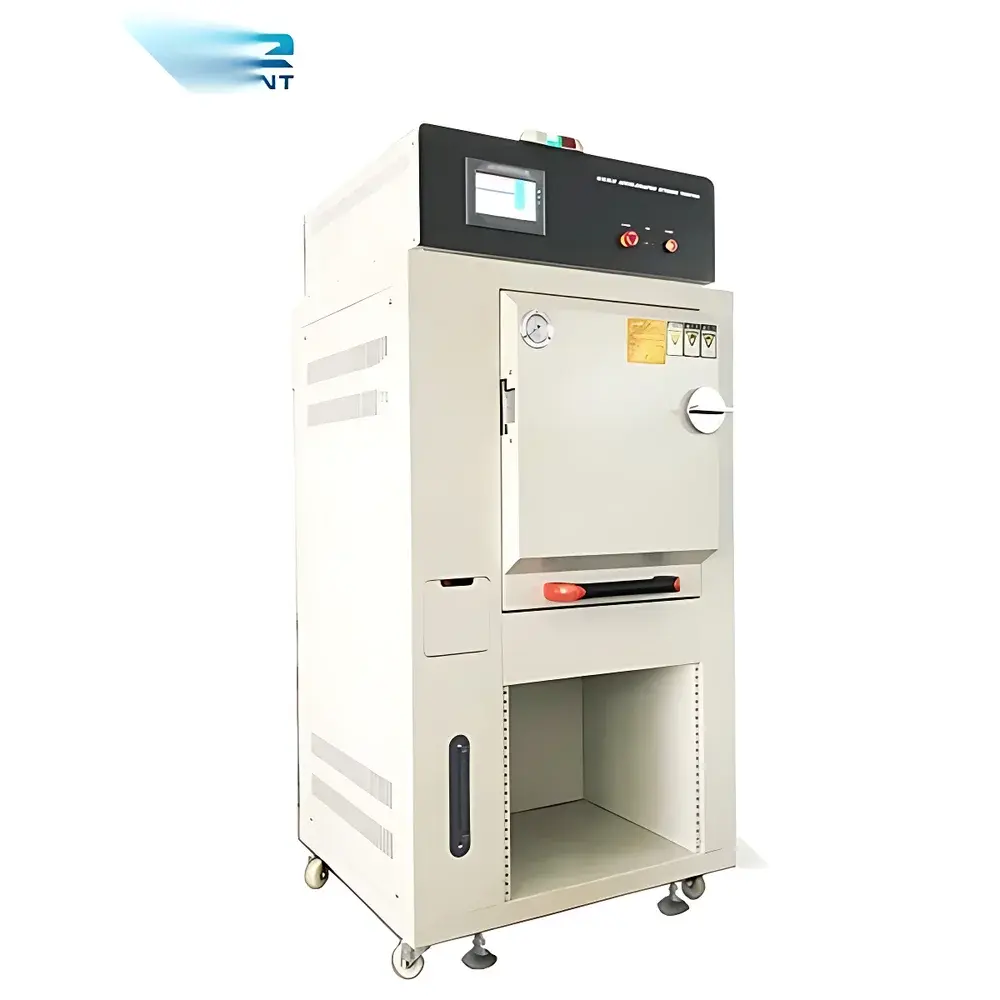
PCT High-Pressure Aging Test Chamber
| Brand | Other Brands |
|---|---|
| Origin | Imported |
| Manufacturer Type | Authorized Distributor |
| Temperature Range | 0–132 °C |
| Humidity Range | 30–98% RH |
| Temp. Uniformity | ±0.5 °C (unloaded) |
| Humidity Uniformity | ±3% RH |
| Temp. Ramp Rate | 0.7–1.0 °C/min (unloaded) |
| Temp. Cycling Range | 20–80 °C |
| Test Duration Setting | 0–9999 h |
| Power Supply | AC 380 V |
| Refrigeration System | Hermetic Tecumseh (France) Compressor |
| Insulation | High-Density Ultra-Fine Glass Wool |
| Sealing | Dual-Silicone Gasket Design |
| Interior Material | SUS304 Mirror-Finish Stainless Steel |
| Exterior Finish | A3 Steel with Electrostatic Powder Coating |
| Air Circulation | Dual-Blower Forced Convection System |
Overview
The PCT High-Pressure Aging Test Chamber is an engineered environmental stress screening system designed for accelerated reliability assessment of hermetically sealed and moisture-sensitive components under combined high temperature, high humidity, and elevated atmospheric pressure conditions. Unlike standard climate chambers, this chamber integrates controlled pressurization (typically up to 2–3 bar absolute, depending on configuration) to accelerate moisture ingress through packaging interfaces, encapsulants, and micro-cracks—enabling detection of latent defects that would otherwise remain undetected in conventional 85/85 or THB (Temperature-Humidity-Bias) testing. Its operation is grounded in the physics of water vapor diffusion under partial pressure gradients, per Fick’s second law, making it particularly effective for evaluating long-term hermeticity, solder joint integrity, wire bond corrosion resistance, and delamination susceptibility in semiconductor packages, MEMS devices, medical implants, and automotive electronics.
Key Features
- Hermetically sealed chamber with dual-silicone gasket sealing system ensuring >99.9% pressure retention over extended test cycles
- Integrated high-efficiency refrigeration circuit using a hermetically sealed Tecumseh (France) compressor—engineered for continuous operation at high ambient humidity and thermal load
- High-density ultra-fine glass wool insulation (≥100 mm thickness) minimizing thermal bridging and improving energy efficiency and chamber stability
- Dual independent blower assembly with adjustable airflow distribution, enabling uniform temperature and humidity profiles across the test volume (per IEC 60068-3-5)
- SUS304 mirror-finish stainless steel interior chamber—non-porous, corrosion-resistant, and compliant with ISO 14644-1 Class 8 cleanroom compatibility requirements
- Electrostatically powder-coated A3 steel exterior—mechanically robust, scratch-resistant, and suitable for laboratory or production floor deployment
- Precise PID-controlled humidification via stainless steel steam generator with deionized water feed; integrated condensate management system prevents cross-contamination
Sample Compatibility & Compliance
This chamber accommodates standard JEDEC trays (MO-118), 300 mm wafer carriers, PCB assemblies up to 600 × 600 × 300 mm (W × D × H), and medical device housings requiring IP67-level validation. It supports test protocols aligned with JESD22-A102 (Moisture Resistance), JESD22-A110 (Highly Accelerated Stress Test – HAST), MIL-STD-883 Method 1030.8 (Internal Moisture Content), and IPC-9701A (Performance Requirements for Pb-Free Solder Interconnections). The system architecture permits optional integration with external pressure transducers and data loggers for full traceability in GLP/GMP-regulated environments. All control firmware supports audit trail generation, user access levels, and electronic signature capability compliant with FDA 21 CFR Part 11 when paired with validated software modules.
Software & Data Management
The chamber operates via a dedicated industrial-grade touchscreen controller with embedded real-time OS, supporting multi-segment programmable profiles (up to 99 steps per cycle), event-triggered logging, and alarm escalation (email/SMS via optional gateway). Raw sensor data—including chamber pressure (bar abs), relative humidity (% RH), dry-bulb/wet-bulb temperatures, and dew point—is sampled at 1 Hz and stored internally for ≥30 days. Export formats include CSV and PDF test reports with time-stamped metadata, calibration status flags, and operator ID tags. Optional Ethernet/IP or Modbus TCP connectivity enables integration into MES platforms (e.g., Siemens Opcenter, Rockwell FactoryTalk) and centralized lab monitoring systems.
Applications
- Accelerated life testing of plastic-encapsulated microcircuits (PEMs) per JESD22-A110
- Qualification of automotive ADAS sensors exposed to under-hood thermal cycling and humidity ingress
- Validation of hermetic seals in implantable medical devices prior to biocompatibility studies
- Failure analysis root cause determination for popcorning, wire bond lift-off, and intermetallic growth in QFN and BGA packages
- Process qualification of conformal coating adhesion and curing efficacy under combined thermal-moisture stress
- Reliability screening of LED modules used in outdoor lighting applications subject to cyclic condensation
FAQ
What pressure range does this PCT chamber support?
Standard configurations operate at 2.0 bar absolute (≈1 bar gauge); custom variants are available up to 3.5 bar absolute upon request and structural verification.
Is the chamber compatible with nitrogen purge or inert atmosphere testing?
Yes—optional gas inlet/outlet ports and pressure-regulated mass flow controllers enable N₂ purging or mixed-gas environments (e.g., 5% H₂ in N₂) for specialized corrosion or oxidation studies.
How is temperature and humidity uniformity validated?
Uniformity is verified per IEC 60068-3-5 using a 9-point thermocouple/hygrometer mapping procedure during IQ/OQ; typical results show ≤±0.8 °C and ≤±4% RH deviation across the working volume.
Does the system meet CE or UKCA marking requirements?
Yes—the electrical safety and EMC design complies with EN 61000-6-2/6-4 and EN 61010-1:2010+A1:2019, with full technical documentation available for conformity assessment.
Can test data be exported for regulatory submission (e.g., ISO 13485, IATF 16949)?
Yes—CSV exports include full metrological traceability, sensor calibration certificates, and timestamped operator actions, satisfying evidence requirements for quality system audits.
Related Products



