
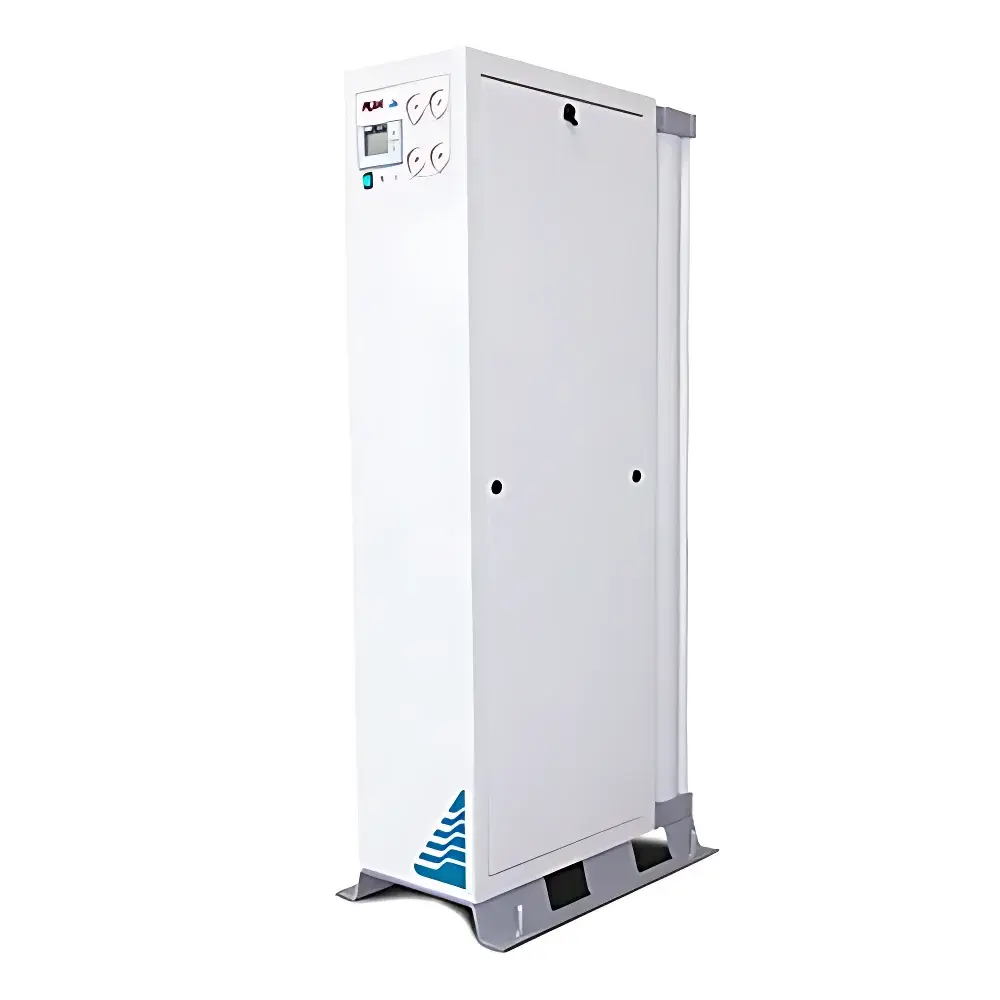
Peak i-Flow O2 Oxygen Generator
| Brand | PEAK |
|---|---|
| Origin | United Kingdom |
| Manufacturer Type | Direct Manufacturer |
| Origin Category | Imported |
| Model | i-Flow O2 |
| Oxygen Purity | 90–94% |
| Oxygen Flow Rate | 70–480 L/min |
| Output Pressure | 5 bar |
| Operating Temperature | 5–50 °C |
| Dimensions | 500 × 1738 × 760 mm |
Overview
The Peak i-Flow O2 Oxygen Generator is a modular, scalable pressure swing adsorption (PSA) system engineered for continuous, on-site production of industrial-grade oxygen. Utilizing high-efficiency zeolite molecular sieve beds, the system separates oxygen from compressed ambient air by selectively adsorbing nitrogen and other trace gases under elevated pressure, followed by rapid desorption during depressurization cycles. This proven PSA architecture delivers stable oxygen output with consistent purity—validated to 90–94% O2 by the UK’s National Physical Laboratory (NPL)—and supports flow rates from 70 to 480 L/min at a regulated output pressure of 5 bar. Designed for integration into laboratory infrastructure, pilot plants, and small-to-mid-scale industrial processes, the i-Flow O2 eliminates dependency on high-pressure cylinders or cryogenic liquid oxygen deliveries, thereby reducing supply chain risk, storage hazards, and long-term operational cost.
Key Features
- Modular PSA architecture enabling incremental capacity expansion—from single-unit deployment to multi-module configurations supporting up to 480 L/min total flow.
- Integrated PurityGuard™ real-time gas monitoring system: continuously verifies oxygen concentration via electrochemical sensing and triggers automatic shutdown or alarm if purity falls below user-defined thresholds (e.g., <90% O2), ensuring process integrity and personnel safety.
- Six programmable flow modes with proportional purity control: users select target flow rate and corresponding purity band; the controller dynamically adjusts cycle timing and bed regeneration parameters to maintain specified output consistency.
- Energy-optimized operation: features adaptive compressor control, intelligent standby mode activation during low-demand periods, and heat recovery from adsorption/desorption cycles—reducing power consumption by up to 35% versus fixed-speed legacy systems.
- Full remote connectivity via Ethernet/IP and Modbus TCP: enables secure access to real-time pressure, flow, purity, temperature, and system health metrics through web-based HMI or third-party SCADA platforms.
- Compact footprint (500 × 1738 × 760 mm) with integrated air intake filtration (ISO 8573-1 Class 2 particulate, Class 3 oil, Class 4 moisture), pre-filter, coalescing filter, and refrigerated dryer—requiring only electrical supply and ambient air inlet for commissioning.
Sample Compatibility & Compliance
The i-Flow O2 is compatible with applications requiring continuous, dry, oil-free oxygen feed gas—including analytical instrument support (e.g., ICP-MS oxidant supply, TOC combustion), cell culture incubators, ozone generation, and small-scale oxidation reactors. It complies with ISO 8573-1:2010 for compressed air quality at point-of-use and meets CE marking requirements under the EU Machinery Directive 2006/42/EC and Electromagnetic Compatibility Directive 2014/30/EU. While not certified for medical-grade use (ISO 8573-7:2003 Class 0 or USP <823>), its NPL-verified purity and traceability documentation support GLP-compliant environments where audit-ready gas sourcing is required. Optional validation packages include IQ/OQ documentation aligned with ASTM D6350 and ISO 8573-7 Annex B protocols.
Software & Data Management
The embedded i-Flow Control Suite provides local touchscreen interface and remote web portal access for configuration, diagnostics, and historical data review. All critical parameters—including purity trends, compressor runtime, filter differential pressure, and alarm logs—are timestamped and stored onboard for ≥12 months. Audit trail functionality complies with FDA 21 CFR Part 11 requirements when deployed with optional PKI-based user authentication and electronic signature modules. Data export is supported in CSV and PDF formats; integration with LIMS or CMMS platforms is achievable via RESTful API or OPC UA gateway (available as add-on).
Applications
- Continuous oxygen supply for ICP-OES and ICP-MS plasma support systems requiring stable 90–94% O2 at 100–300 L/min.
- Gas source for benchtop and pilot-scale catalytic oxidation studies where cylinder refill frequency limits experimental throughput.
- Oxygen enrichment in controlled-environment chambers for accelerated material aging tests per ASTM G151/G154.
- Feed gas for on-site ozone generators used in lab-scale water disinfection or surface sterilization validation.
- Backup or primary oxygen source for bioreactor sparging in academic and contract development labs operating under GLP conditions.
FAQ
What purity verification documentation is provided with the i-Flow O2?
Each unit ships with an NPL-certified test report confirming oxygen purity across the full flow range, traceable to UKAS-accredited calibration standards.
Can the system be integrated into existing facility building management systems (BMS)?
Yes—Modbus TCP and BACnet/IP gateways are available as factory-installed options for seamless integration with Tridium, Siemens Desigo, or Honeywell Enterprise Buildings Integrator platforms.
Is routine maintenance required, and what does it involve?
Annual preventive maintenance includes zeolite bed integrity check, sensor recalibration, filter replacement, and valve actuation testing—all documented in the service logbook and accessible via the web interface.
Does the i-Flow O2 meet explosion-proof requirements for hazardous area installation?
The standard configuration is rated for Zone 2 (IEC 60079-0) environments; ATEX-certified variants with flameproof enclosures (Zone 1) are available upon request.
How does the PurityGuard™ system respond to a detected purity deviation?
It initiates immediate audible/visual alerts, logs the event with UTC timestamp, and can be configured to divert output to vent, trigger compressor ramp-down, or halt operation—per user-defined safety logic.



