
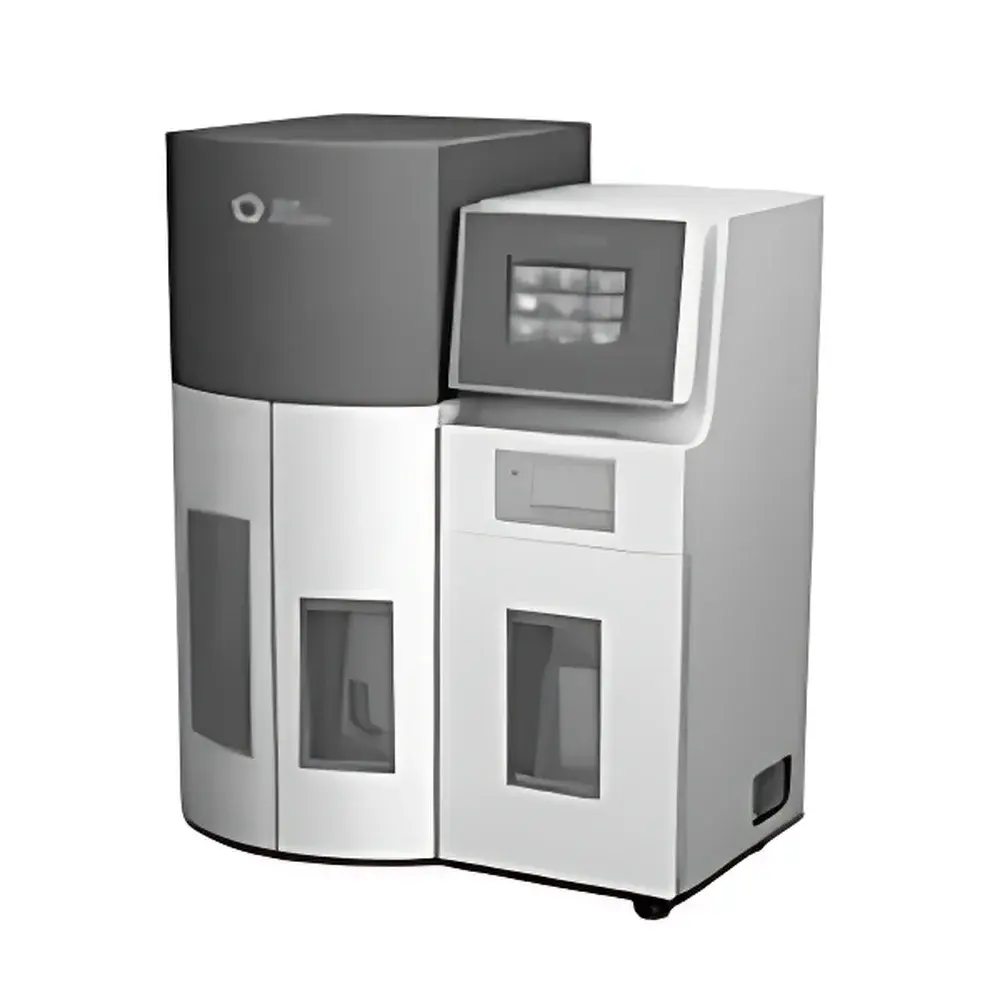
Peiou SKD-1000 Fully Automated Kjeldahl Nitrogen Determinator
| Brand | Peiou |
|---|---|
| Origin | Shanghai, China |
| Model | SKD-1000 |
| Instrument Type | Kjeldahl Nitrogen Determinator |
| Automation Level | Fully Automated |
| Nitrogen Determination Range | 0.1–200 mg N per sample |
| Distillation Time | 3–8 min per sample |
| Repeatability | ≤ ±0.5% RSD |
| Sample Weight Capacity | Solids 0.1–2 g |
| Nitrogen Recovery Rate | ≥99.5% |
| Power Consumption | ~1500 W |
| Dimensions (L×W×H) | 450 × 400 × 550 mm |
| Linear Range | 0.1–200 mg N |
| Linearity Error at 4× Nitrogen Load | ≤ ±1% |
| Compatible Standard Acid Concentrations | 0.01–0.5 mol/L HCl or H₂SO₄ |
| Titration Resolution | 0.8 µL/step |
| Acid Delivery Precision | ≤0.002 µL/step |
| Alkali Addition | Programmable segmented dosing (1–10 pulses, 0–15 s interval) |
| Delay Time Setting | 0–1800 s (for nitrate-nitrogen analysis) |
| Reagent Pump Volume Range | 0–150 mL (1 mL increments) |
| Steam Power Adjustment | Continuously variable |
| Safety Features | Dual-level steam chamber monitoring, condensate flow interruption protection, door interlock sensing, real-time cooling water pressure/flow detection, reagent level monitoring, and jacket temperature control |
Overview
The Peiou SKD-1000 Fully Automated Kjeldahl Nitrogen Determinator is engineered for precise, traceable, and high-throughput total nitrogen quantification in accordance with internationally recognized Kjeldahl methodology (ISO 8968-1, AOAC 981.10, ASTM D1122, USP , and EN ISO 1871). It implements the classical acid digestion–alkaline distillation–acid titration workflow with full automation of reagent delivery, steam generation, ammonia distillation, back-titration, and result calculation. The system employs a dual-level liquid monitoring system within the distillation chamber to prevent dry-heating incidents, coupled with real-time thermal regulation of the reaction vessel to ensure consistent vapor-phase transfer efficiency. Ammonia liberation is optimized via programmable segmented alkali addition—preventing exothermic runaway during low-steam conditions—and simultaneous distillation/titration architecture minimizes analyte loss by immediate neutralization of evolved NH₃ in standardized acid. This design delivers robust performance across diverse matrices including foodstuffs, feed, soil, wastewater, pharmaceutical excipients, and biological tissues.
Key Features
- Fully automated sequence: acid addition, alkalization, dilution, distillation, titration, data calculation, and report generation—all executed without manual intervention.
- High-resolution titration system with 0.8 µL minimum dispensing volume and ≤0.002 µL/step precision, dynamically adjusted based on titrant molarity (0.01–0.5 mol/L HCl or H₂SO₄).
- Dual-safety distillation chamber with redundant liquid-level sensors and active temperature feedback control to eliminate risk of dry-burn operation.
- Condensate flow interruption detection with automatic sample hold and alarm—prevents ammonia loss during cooling water failure.
- Interlocked safety door sensor with real-time status feedback and operational inhibition if open during active distillation.
- Programmable alkali dosing (1–10 segments, adjustable inter-pulse delay 0–15 s) ensures controlled base addition under varying steam conditions.
- Variable steam power output enables optimization of recovery for low-nitrogen samples (<5 mg N), improving accuracy at trace levels.
- Corrosion-resistant construction: ABS engineering plastic chassis and proprietary chemically inert fluidic pathways (3-year warranty on tubing).
- Real-time graphical display of red/green/blue tri-color indicator curves, titrant consumption, and calculated nitrogen/protein content throughout analysis.
Sample Compatibility & Compliance
The SKD-1000 accommodates solid samples weighing 0.1–2 g and liquid samples of 1–20 mL, supporting heterogeneous and viscous matrices through calibrated peristaltic and piston-pump reagent delivery (0–150 mL range, 1 mL resolution). Its linear response (0.1–200 mg N) and ≤±1% linearity error at quadruple load meet method validation requirements for routine QC/QA laboratories operating under GLP or GMP frameworks. The instrument complies with key regulatory expectations for auditability: all parameter settings, reagent volumes, distillation/titration timestamps, and raw titration curves are stored with user ID and timestamp metadata. Optional integration with analytical balances enables direct mass import (ASTM E2655-compliant), while wireless data export supports secure transmission to LIMS or ELN platforms. The system satisfies functional prerequisites for FDA 21 CFR Part 11 compliance when deployed with appropriate IT controls (e.g., electronic signatures, audit trail configuration, and role-based access).
Software & Data Management
The embedded control software provides intuitive touchscreen navigation with multilingual interface support (English, Spanish, French, Chinese). All analytical parameters—including delay time (0–1800 s for nitrate reduction protocols), steam ramp profiles, titration endpoint criteria (pH or potentiometric), and calibration coefficients—are configurable and saved per method template. Raw titration curves and intermediate values (e.g., acid consumed, blank-corrected volume, % recovery) are retained locally and exportable via USB or Ethernet. Audit trail functionality records operator actions, method changes, and critical events (e.g., door opening, coolant failure) with immutable timestamps. Data integrity safeguards include automatic backup upon power loss and password-protected administrator mode for method validation and system diagnostics.
Applications
The SKD-1000 serves as a primary nitrogen quantification platform in accredited food testing labs (protein content per AOAC 992.15), agricultural research centers (soil total N per ISO 13878), environmental monitoring agencies (wastewater TN per EPA 351.2), and pharmaceutical quality control units (nitrogen impurity profiling per ICH Q5C). Its extended delay capability supports validated workflows for nitrate/nitrite interference correction, while high recovery (>99.5%) and repeatability (RSD ≤0.5%) ensure compliance with stringent specification limits in ISO/IEC 17025-accredited environments. Routine use cases include dairy product protein verification, feed formulation QA, fertilizer N-content certification, and biopharmaceutical residual host-cell protein assessment.
FAQ
What safety mechanisms prevent dry-burning during distillation?
The SKD-1000 employs dual independent liquid-level sensors in the distillation chamber, backed by real-time jacket temperature monitoring and automatic steam cutoff if either threshold is breached.
Can the instrument handle nitrate-containing samples?
Yes—programmable delay time (0–1800 s) allows integration of cadmium column or Devarda’s alloy reduction steps prior to distillation, enabling compliant nitrate-N determination per ISO 14256-2.
Is method validation documentation available?
Peiou provides IQ/OQ documentation templates aligned with ISO/IEC 17025 and GMP Annex 15, including linearity, accuracy, precision, LOD/LOQ, and robustness test protocols.
How is data integrity ensured for regulated environments?
All measurements are time-stamped, user-logged, and stored with checksum-verified immutability; optional network synchronization enables centralized LIMS archiving with version-controlled method files.
What maintenance intervals are recommended?
Daily: reagent level check and waste container emptying. Quarterly: pump calibration verification and condenser cleaning. Annually: full system performance qualification (SPQ) using certified reference materials (CRMs) traceable to NIST SRM 84g.






