
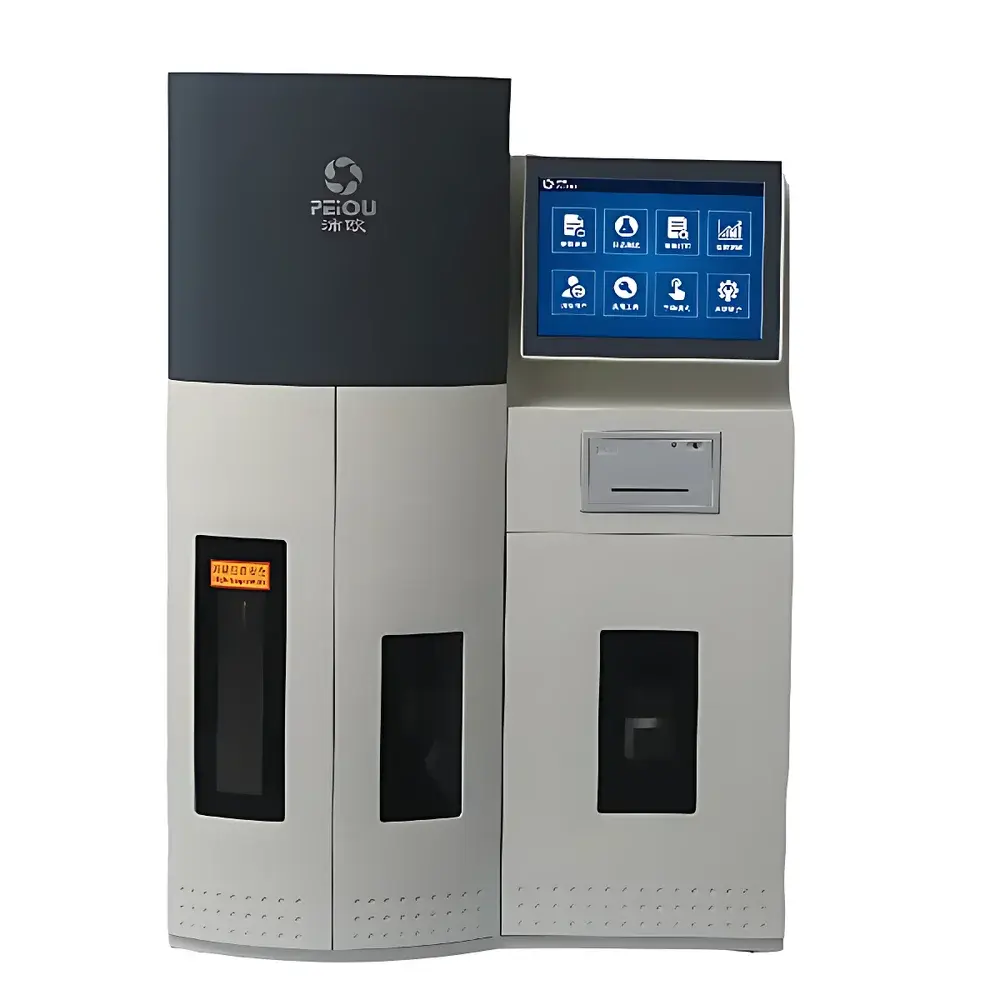
Peiou SKD-1800 Fully Automated Kjeldahl Nitrogen Determinator
| Brand | Peiou |
|---|---|
| Origin | Shanghai, China |
| Model | SKD-1800 |
| Instrument Type | Kjeldahl Nitrogen Determinator |
| Automation Level | Fully Automated |
| Nitrogen Determination Range | 0.1–240 mg |
| Distillation Time per Sample | 3–8 min |
| Repeatability (RSD) | ≤0.5% |
| Sample Weight Capacity | ≤5 g (solid) or ≤15 mL (liquid) |
| Nitrogen Recovery Rate | ≥99.5% |
| Power Consumption | 750–1500 W |
| Dimensions (L×W×H) | 370 × 300 × 680 mm |
| Linearity Range | 0.1–240 mg nitrogen |
Overview
The Peiou SKD-1800 Fully Automated Kjeldahl Nitrogen Determinator is an integrated analytical system engineered for precise, reproducible quantification of total nitrogen content in diverse solid and liquid matrices via the classical Kjeldahl digestion–distillation–titration methodology. This instrument implements a fully automated workflow grounded in standardized wet-chemistry principles: sample digestion (performed externally), followed by alkaline distillation to liberate ammonium ions as ammonia gas, quantitative steam distillation into boric acid trapping solution, and endpoint detection via photometric colorimetric titration. Designed for routine high-throughput laboratories in food safety, agricultural testing, feed quality control, environmental analysis, and chemical manufacturing, the SKD-1800 delivers traceable, auditable results compliant with internationally recognized reference methods including ISO 8968-1 (milk), ISO 1871 (cereals), AOAC 981.10 (protein in foods), and USP (residual solvents—where nitrogenous impurities are assessed indirectly). Its architecture prioritizes operational robustness, minimal operator intervention, and method consistency across shifts and users.
Key Features
- Fully automated sequence execution: acid addition, alkali dosing, diluent delivery, steam distillation, back-titration with standardized HCl, post-run rinsing, and waste disposal—all under programmable protocol control.
- High-fidelity colorimetric endpoint detection using a calibrated optical sensor aligned to ASTM E169–20 and ISO 9277 spectral response standards; eliminates subjective visual interpretation and ensures consistent titration precision.
- Intuitive 7-inch full-color LCD touchscreen interface with multilingual support (English, Spanish, French, Chinese), preloaded method templates, and real-time status monitoring of reagent levels, temperature, pressure, and cycle progress.
- Optimized thermal management system enabling rapid heating and stable distillation temperature control (±1 °C), contributing to RSD ≤0.5% across replicate analyses (n ≥ 10, certified reference material CRM NIST SRM 8414).
- Modular reagent reservoir design with level sensors and leak-resistant quick-connect fittings; supports up to 4 independent reagent lines (H2SO4, NaOH, boric acid, HCl) for method flexibility and cross-contamination prevention.
- Integrated safety interlocks: overpressure relief valve, dry-run protection, acid/alkali spill containment tray, and emergency stop circuit meeting IEC 61010-1:2010 requirements for laboratory electrical equipment.
Sample Compatibility & Compliance
The SKD-1800 accommodates a broad spectrum of sample types requiring nitrogen quantification—including but not limited to cereal grains, dairy powders, meat homogenates, fish meal, soil extracts, fertilizer slurries, wastewater digests, and polymer additives. Solid samples up to 5 g and liquids up to 15 mL are processed without manual dilution or transfer steps. All wet chemistry steps adhere strictly to the procedural constraints defined in ISO 5983-1:2009 and AOAC Official Method 960.52. Data integrity is reinforced through built-in audit trail functionality compliant with FDA 21 CFR Part 11 (electronic records and signatures), supporting GLP and GMP environments. Instrument calibration verification is traceable to NIST-traceable nitrogen standards (e.g., ammonium sulfate CRMs), and routine performance qualification includes recovery testing against certified reference materials per ISO/IEC 17025:2017 Clause 7.7.
Software & Data Management
The embedded firmware supports user-defined method creation, parameter locking for SOP enforcement, and automatic generation of raw data files (CSV, PDF reports) with timestamps, operator ID, instrument serial number, and full process logs. Optional PC-based software (SKD-Link v3.2) enables centralized instrument fleet management, remote diagnostics, LIMS integration via ASTM E1384-compliant HL7 or CSV export, and advanced statistical reporting (Shewhart control charts, ANOVA, trend analysis). All electronic records include immutable metadata, electronic signature fields, and revision-controlled method versions—fully satisfying regulatory expectations for data governance in regulated industries.
Applications
- Protein content calculation in food and feed products (using standard nitrogen-to-protein conversion factors: 6.25 for cereals, 6.38 for dairy, 5.70 for wheat gluten).
- Quality assurance of nitrogen fertilizers and slow-release urea formulations.
- Environmental monitoring of total Kjeldahl nitrogen (TKN) in municipal sludge, compost, and agricultural runoff per EPA Method 351.2.
- Pharmaceutical excipient purity assessment where residual ammonium salts must be quantified.
- Research applications in soil science, biochemistry, and polymer degradation kinetics requiring accurate baseline nitrogen load determination.
FAQ
What digestion equipment is compatible with the SKD-1800?
The SKD-1800 is designed to accept pre-digested samples only; it does not include digestion functionality. Users must employ external block digesters or microwave systems compliant with ISO 11047:1999 and equipped with reflux condensers and fume extraction.
Can the instrument be validated for GMP compliance?
Yes—full IQ/OQ/PQ documentation packages are available, including factory-verified performance tests, installation checklists, operational boundary mapping, and periodic verification protocols aligned with Annex 15 and USP .
Is method transfer supported between different SKD-series instruments?
Method parameters (distillation time, reagent volumes, titrant concentration) are exportable/importable via USB or network, ensuring consistent operation across SKD-1800, SKD-2000, and SKD-2100 platforms when configured with identical hardware modules.




