
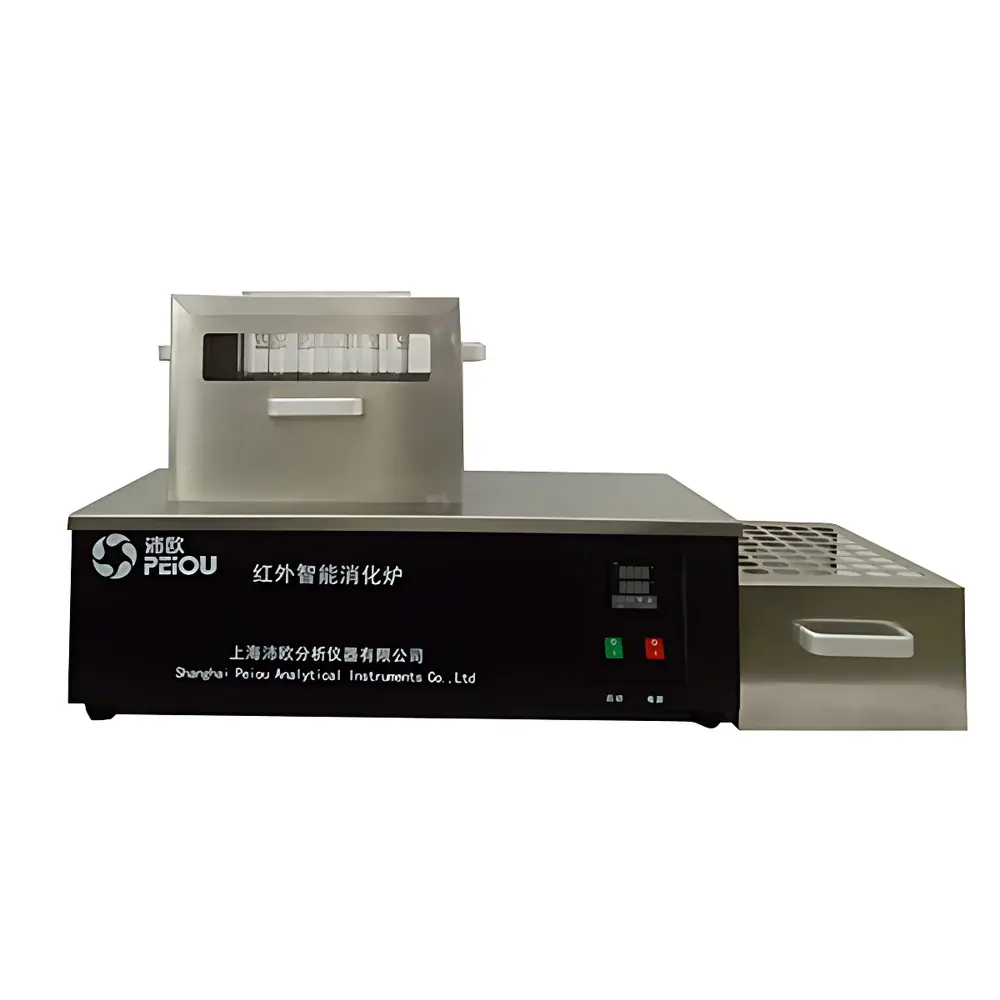
Peiou SKD-18S2 Infrared Quartz Digestion Furnace
| Brand | Peiou |
|---|---|
| Origin | Shanghai, China |
| Model | SKD-18S2 |
| Heating Method | Infrared radiation via quartz tubes |
| Number of Digestion Ports | 18 |
| Temperature Range | Ambient to 680 °C |
| Temperature Stability | ±1 °C |
| Ramp Time to 400 °C | 15 min |
| Dual Insulation | Ceramic fiber (silica-alumina) + air gap |
| Power Supply | AC 220 V |
| Rated Power | 1600 W |
| Digestion Tube Dimensions | Ø25 mm × 300 mm |
| Control System | Digital PID with 64-step programmable ramping and timer |
| Safety Features | Over-temperature, over-current, and over-pressure protection |
| Exhaust System | Stainless steel fume duct with integrated SO₂ absorption path |
| Optional Accessories | 5000-program touchscreen controller, SF-100 acid gas neutralization system, explosion-proof sample covers |
Overview
The Peiou SKD-18S2 Infrared Quartz Digestion Furnace is an engineered solution for high-throughput, reproducible open-vessel wet digestion of organic and inorganic matrices under controlled thermal conditions. Designed for laboratories requiring compliance with standardized digestion protocols—including AOAC 985.27, EPA Method 3050B, ISO 11466, and GB/T 5009 series—the SKD-18S2 employs a dual-mode infrared heating architecture: radiant energy is delivered through high-purity fused quartz tubes, ensuring uniform spectral transmission across the mid-infrared range (2–6 µm), which maximizes absorption by common digestion reagents (e.g., HNO₃, H₂SO₄, HClO₄, and H₂O₂). Unlike conventional ceramic or metal-heated blocks, quartz-based irradiation minimizes thermal lag, eliminates hot-spot formation, and prevents reagent condensation (“wall hanging”) on digestion tube interiors—thereby improving recovery accuracy for trace metals (e.g., Cd, Pb, As, Cr) and reducing inter-sample variability. Its ambient-to-680 °C operating envelope supports both low-temperature charring (e.g., for plant tissue) and high-temperature sulfation (e.g., for refractory silicates), while the 18-position configuration balances throughput with benchtop footprint.
Key Features
- Infrared quartz heating module with certified CE-compliant electromagnetic emission profile and chemical resistance to concentrated mineral acids and alkalis
- 64-stage programmable temperature ramping with independent time/temperature setpoints per segment, enabling method replication per ISO/IEC 17025 calibration requirements
- Dual-layer thermal insulation: high-density silica-alumina ceramic fiber blanket combined with an air-gap barrier, achieving surface temperature <45 °C at ambient conditions
- Stainless steel exhaust manifold integrated with water-trap fume scrubbing; compatible with external vacuum pumps (≤−0.08 MPa) and optional SF-100 alkaline neutralization unit for SO₂, NOₓ, and Cl₂ abatement
- Independent power and heating circuit switches—enabling safe maintenance, emergency cutoff, and energy-efficient standby mode
- PID-controlled digital thermostat with ±0.5 °C setpoint repeatability and real-time deviation logging for GLP audit trails
- Corrosion-resistant chassis: electrophoretically coated steel frame with PTFE-sealed fasteners and acid-resistant stainless-steel digestion rack and cooling station
Sample Compatibility & Compliance
The SKD-18S2 accommodates standard borosilicate or quartz digestion tubes (Ø25 mm × 300 mm), supporting sample masses up to 2.0 g for solid matrices (soil, feed, botanicals) and up to 10 mL for liquid samples (wastewater, digestates). It meets mechanical and electrical safety criteria under IEC 61010-1:2010 and EN 61326-1:2013 for laboratory equipment. Its digestion performance aligns with validation parameters specified in USP <231>, ASTM D3682-22 (for ash content), and ISO 14851 (for heavy metal leaching). When paired with certified reference materials (CRMs) such as NIST SRM 1573a (Tomato Leaves) or BCR-601 (Contaminated Soil), the furnace demonstrates RSDs <4.2% (n=6) for Cu, Zn, and Mn recoveries across three independent runs.
Software & Data Management
The optional 7-inch capacitive touchscreen controller provides full method lifecycle management: storage of up to 5,000 multi-step digestion programs with user-defined naming, timestamped execution logs, and exportable CSV reports (including actual vs. target temperature profiles, dwell times, and fault codes). All data entries are time-stamped and non-erasable, satisfying FDA 21 CFR Part 11 requirements for electronic records when deployed with role-based access control (administrator/operator modes) and audit trail activation. Firmware supports firmware versioning, backup/restore via USB 2.0, and remote diagnostics via RS-485 Modbus RTU protocol.
Applications
- Environmental labs: Total metal quantification in sediments, sludges, and airborne particulates (PM₁₀/PM₂.₅ filters)
- Agricultural testing: Nitrogen, phosphorus, and micronutrient profiling in fertilizers, composts, and crop tissues
- Food safety: Lead, cadmium, and arsenic screening in infant formula, seafood, and spices per EU Commission Regulation (EC) No 1881/2006
- Geochemical analysis: Rare earth element (REE) release from monazite and bastnäsite ores prior to ICP-MS measurement
- Pharmaceutical QC: Residual catalyst (e.g., Pd, Pt) determination in active pharmaceutical ingredients (APIs) following ICH Q2(R2)
FAQ
What digestion tube material is recommended for use with the SKD-18S2?
Borosilicate glass (e.g., Pyrex-type) or high-purity quartz tubes with wall thickness ≥1.2 mm are validated for repeated use under H₂SO₄/HNO₃ mixtures at 450–600 °C.
Can the SKD-18S2 be integrated into an automated sample preparation line?
Yes—its RS-485 interface supports handshake protocols with robotic arms and autosamplers compliant with SECS/GEM standards; custom API integration is available upon request.
Is the exhaust system sufficient for perchloric acid digestion?
No—perchloric acid requires dedicated fume hoods with wash-down systems; the SKD-18S2’s exhaust is rated for HNO₃/H₂SO₄/HCl only.
How often does the quartz heating tube require replacement?
Under typical usage (≤8 hrs/day, 5 days/week), service life exceeds 12,000 operational hours; visual inspection for microfractures or clouding is recommended every 6 months.
Does the instrument support GLP-compliant calibration verification?
Yes—built-in calibration mode allows verification using NIST-traceable thermocouples (Type K or S); calibration certificates and uncertainty budgets are generated automatically.



