
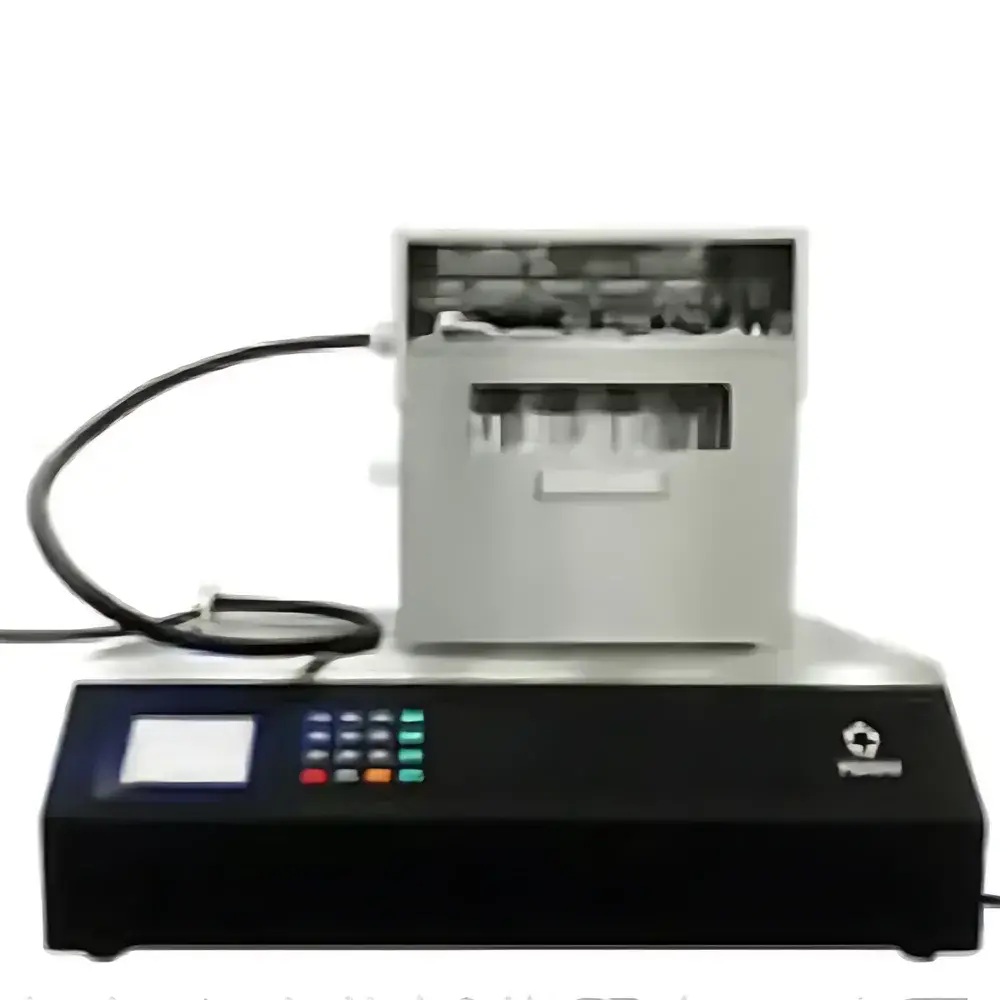
Peiou SKD-20S3 Infrared Quartz Digestion Furnace
| Brand | Peiou |
|---|---|
| Origin | Shanghai, China |
| Model | SKD-20S3 |
| Heating Method | Infrared radiation via quartz tubes |
| Number of Digestion Ports | 20 |
| Temperature Range | Ambient to 680 °C |
| Temperature Stability | ±1 °C |
| Programmable Control | LCD display with timer and multi-stage ramp/soak programming |
| Ramp Time | ≤20 min to 400 °C |
| Insulation | Dual-layer (ceramic fiber + air gap) |
| Voltage | AC 220 V |
| Power Rating | 1.95 kW |
| Digestion Tube Dimensions | Ø30 × 42 mm (quartz) |
| Safety Features | Overcurrent protection, earth leakage protection, dual independent power switches (main power + heating module), integrated stainless-steel fume hood with exhaust port for SO₂ and acid vapors |
Overview
The Peiou SKD-20S3 Infrared Quartz Digestion Furnace is a precision-controlled, laboratory-grade sample preparation instrument engineered for open-vessel wet digestion of organic and inorganic matrices under controlled thermal conditions. It operates on the principle of direct infrared radiation transfer through high-purity quartz heating modules, enabling rapid, uniform, and reproducible thermal energy delivery to digestion tubes. Unlike conductive heating systems (e.g., aluminum block or graphite), the SKD-20S3 employs non-contact radiant heating—minimizing thermal lag, eliminating cold spots, and ensuring consistent temperature profiles across all 20 digestion positions. This architecture supports quantitative decomposition of complex samples—including plant tissues, seeds, feedstuffs, food products, soils, sediments, and geological specimens—prior to elemental analysis by ICP-OES, ICP-MS, AAS, or colorimetric assays. Its operational envelope (ambient to 680 °C) satisfies standard AOAC, EPA, ISO 11047, and GB/T 5009 digestion protocols requiring high-temperature mineralization of refractory carbon matrices.
Key Features
- Infrared quartz heating modules: High-transmittance fused quartz tubes emit broadband IR radiation (2–6 µm), delivering rapid, controllable thermal input with negligible thermal inertia—enabling precise ramp rates and accurate hold temperatures.
- 20-position digestion platform with uniform thermal distribution: Each port maintains ≤±1 °C deviation at setpoint, verified per ASTM E220 calibration standards; large surface-area exposure ensures complete tube wall coverage and eliminates localized overheating or “wall adhesion” (i.e., sample charring or splattering).
- Multi-stage programmable controller: LCD interface supports up to n-step temperature ramps and soaks, with real-time graphical display of actual vs. target temperature curves—critical for optimizing digestion kinetics of heterogeneous biological or environmental samples.
- Dual-layer thermal insulation: Combines high-density ceramic fiber blanket (≥1260 °C rated) with an engineered air-gap barrier, reducing external surface temperature to 25% versus single-layer designs.
- Integrated fume management system: Includes corrosion-resistant stainless-steel exhaust hood, vertical lift support arm, and acid-resistant PTFE-coated drip tray—designed to channel SO₂, NOₓ, and HCl vapors directly to an external aspiration pump or central lab exhaust network.
- Electrical safety architecture: Dual-pole isolation switch separates main power from heating circuitry; combined overcurrent, residual-current (30 mA), and short-circuit protection complies with IEC 61000-4-5 and EN 61010-1 requirements.
Sample Compatibility & Compliance
The SKD-20S3 accommodates standard Ø30 × 42 mm quartz digestion tubes—chemically inert to concentrated H₂SO₄, HNO₃, HClO₄, and H₂O₂ mixtures used in Kjeldahl, total phosphorus, heavy metal, and trace element digestions. Its design conforms to GLP-aligned workflows: temperature logs (via optional RS232/USB data export) support audit trails compliant with FDA 21 CFR Part 11 when paired with validated software. The furnace meets CE marking requirements (EMC Directive 2014/30/EU and LVD Directive 2014/35/EU) and supports method validation per ISO/IEC 17025:2017 Clause 7.2.2 (method selection and verification). It is routinely deployed in accredited environmental labs (per ISO/IEC 17025) and food testing facilities (per ISO 22000) for sample prep prior to regulatory reporting.
Software & Data Management
While the SKD-20S3 operates as a standalone unit with embedded firmware, its RS232 serial interface enables integration with third-party LIMS or ELN platforms via ASCII protocol. Temperature setpoints, ramp durations, soak times, and real-time sensor readings can be logged externally using configurable time-stamped CSV output. Optional PC-based configuration utility (Windows 10/11 compatible) permits batch method storage, password-protected parameter locking, and electronic signature capture—supporting ALCOA+ data integrity principles. All firmware updates are delivered via signed binary packages with SHA-256 hash verification.
Applications
- Protein quantification via Kjeldahl nitrogen determination in cereals, dairy, and meat products
- Total phosphorus and potassium extraction from soil and plant tissue for agronomic analysis
- Heavy metal (Pb, Cd, As, Hg) solubilization from contaminated sediments and sludge per EPA Method 3050B
- Organic carbon matrix destruction in coal, biomass, and polymer composites prior to ash content measurement (ASTM D3174)
- Routine digestion of fish tissue, shellfish, and seaweed for marine contaminant monitoring (EU Regulation 836/2011)
- Preparation of geological reference materials (e.g., NIST SRM 2710a) for certified elemental profiling
FAQ
What distinguishes infrared quartz heating from aluminum-block or graphite digestion systems?
Infrared quartz heating delivers energy directly to the digestion tube via electromagnetic radiation—eliminating thermal mass delays and inter-port thermal coupling. This results in faster ramp rates (<20 min to 400 °C), tighter temperature uniformity (±1 °C), and superior control over exothermic reactions—reducing risk of sample loss or incomplete oxidation.
Can the SKD-20S3 be used for perchloric acid digestion?
Yes—when operated inside a certified fume hood with appropriate acid-rated exhaust and using quartz tubes rated for HClO₄, the SKD-20S3 supports low-volume (≤5 mL) perchloric acid digestions per ASTM D5172 guidelines. Always observe strict procedural controls for oxidizer handling.
Is temperature calibration traceable to national standards?
Each unit ships with a factory calibration certificate referencing NIST-traceable RTD sensors. Users may perform in-house verification using Class A platinum resistance thermometers per ISO/IEC 17025 Clause 6.6.
Does the furnace support unattended overnight operation?
Yes—the programmable controller includes automatic shutdown after final soak phase, and safety interlocks prevent restart after power interruption without manual reset.
What maintenance is required for long-term reliability?
Quartz modules require no scheduled replacement; periodic inspection for surface haze or microfractures is recommended. Ceramic insulation integrity should be verified annually; exhaust ducts must be cleaned quarterly to maintain airflow performance.



