
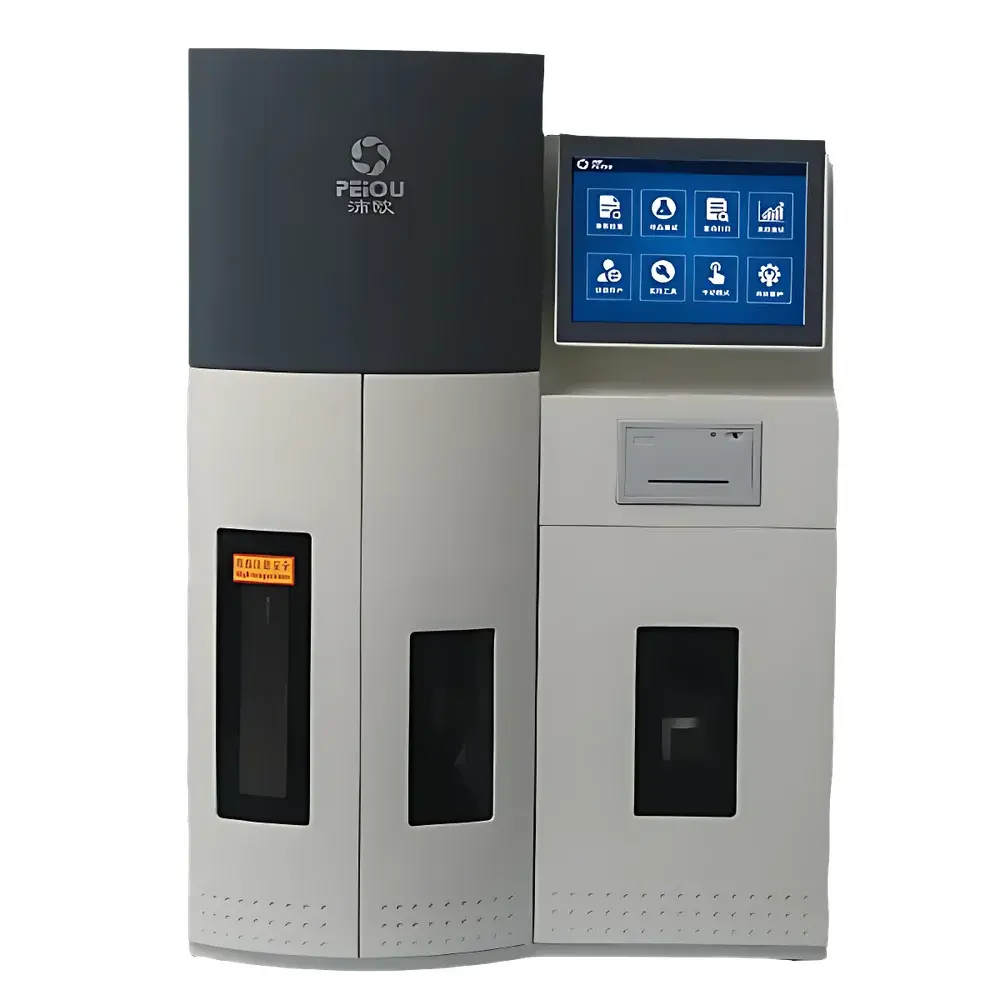
Peiou SKD-3600 Fully Automated Cation Exchange Capacity (CEC) Analyzer for Soil
| Brand | Peiou |
|---|---|
| Origin | Shanghai, China |
| Model | SKD-3600 |
| Instrument Type | Multi-Function Soil Analyzer |
| Measurement Principle | Distillation–Acid–Base Titration with Colorimetric Endpoint Detection |
| Nitrogen Determination Range | 0.1–240 mg N (equivalent to 0.07–140 cmol<sub>c</sub>/kg soil) |
| Precision | RSD < 0.5% |
| Recovery Rate | >99.5% |
| Titration Resolution | 0.8 µL/step (intelligently adjusted per standard acid concentration) |
| Steam Flow Control | Adjustable (15–30 mL/min) |
| Distillation Time | 3–8 min/sample (configurable up to 30 min) |
| Data Storage Capacity | 1,000,000 test records |
| Safety Features | Dual-level water level monitoring, real-time steam chamber temperature sensing, coolant flow/pressure monitoring, safety door & digestion tube presence detection |
| Compliance Support | Designed for GLP-compliant workflows |
Overview
The Peiou SKD-3600 Fully Automated Cation Exchange Capacity (CEC) Analyzer is an integrated, laboratory-grade system engineered for precise, high-throughput quantification of cation exchange capacity in soil and sediment matrices. CEC is a fundamental soil fertility parameter reflecting the total negative charge on clay colloids and organic matter—primarily arising from isomorphic substitution in phyllosilicate lattices and deprotonated carboxyl/phenolic groups in humic substances. The SKD-3600 implements a standardized distillation–titration methodology aligned with ISO 11260, ASTM D4373, and USDA-NRCS Method 10A, wherein exchangeable cations (e.g., Ca²⁺, Mg²⁺, K⁺, Na⁺, NH₄⁺, H⁺, Al³⁺) are first displaced via ammonium acetate (pH 7.0) or barium chloride–triethanolamine extraction, followed by quantitative recovery of displaced NH₄⁺ as NH₃ gas under alkaline steam distillation. The evolved ammonia is trapped in boric acid solution and titrated using standardized sulfuric or hydrochloric acid. The SKD-3600 automates this entire sequence—including reagent dosing, timed alkaline addition, steam generation, condensate collection, colorimetric endpoint detection, and result calculation—eliminating manual variability while maintaining metrological traceability.
Key Features
- Precision colorimetric endpoint detection: Triple-channel RGB photometric sensor continuously monitors the methyl red–bromocresol green indicator system during titration; real-time spectral curves and acid consumption profiles are displayed on the 7-inch capacitive touchscreen, enabling visual validation of reaction kinetics and endpoint stability.
- Intelligent micro-dosing architecture: High-accuracy syringe pump delivers titrant in increments as low as 0.8 µL/step, dynamically scaling resolution based on acid molarity to maintain stoichiometric fidelity across wide concentration ranges (0.01–0.1 mol/L).
- Continuous steam distillation: Patented dual-reservoir steam generator maintains uninterrupted vapor flow during auto-refill cycles; adjustable power output (200–1200 W) ensures optimal NH₃ recovery for both low-CEC sandy soils and high-CEC clays or organic-rich substrates.
- Robust thermal and fluidic safety interlocks: Integrated PT100 temperature sensors monitor distillation chamber and condenser block; pressure transducers verify coolant flow integrity; dual float switches prevent dry-heating; mechanical door and digestion tube presence sensors halt operation upon unsafe access.
- Modular reagent handling: Corrosion-resistant PTFE/PFA fluid paths and chemically inert ABS housing ensure ≥3-year service life under routine use with strong alkalis (NaOH), acids (H₂SO₄), and chelating agents (EDTA).
Sample Compatibility & Compliance
The SKD-3600 accepts standard 300 mL and 550 mL digestion tubes and accommodates air-dried, sieved (<2 mm) soil samples ranging from 0.5 g to 5.0 g—automatically adjusting reagent volumes and distillation duration based on pre-loaded sample weight and expected CEC range. It supports sequential analysis of up to 20 samples per batch without operator intervention. All analytical steps adhere to internationally recognized protocols: ISO 11260 (soil CEC by ammonium acetate), ISO 13536 (determination of exchangeable bases), and AOAC Official Method 981.10 (total nitrogen by Kjeldahl distillation). Raw data—including timestamps, reagent lot IDs, operator logins, and full titration curves—are stored with cryptographic hashing to satisfy GLP audit requirements and facilitate 21 CFR Part 11 compliance when interfaced with validated laboratory information management systems (LIMS).
Software & Data Management
The embedded Linux-based control software provides intuitive Chinese/English bilingual navigation via a responsive GUI. Preconfigured method templates—including US EPA Region IV CEC protocol, FAO Harmonized World Soil Database settings, and custom user-defined workflows—are stored in non-volatile memory (1 GB internal flash). Each analysis generates a structured XML metadata file containing instrument ID, calibration history, environmental conditions (ambient T/RH), and raw sensor outputs. USB 2.0 host port enables direct export of CSV reports; optional Wi-Fi module supports secure TLS 1.2 transmission to networked servers. All data entries include immutable audit trails: timestamped operator actions, parameter modifications, and error logs—with automatic backup to external SSD upon completion.
Applications
- Quantitative assessment of soil fertility status in agronomic and ecological surveys
- Monitoring CEC changes following long-term fertilizer application, liming, or organic amendment trials
- Characterizing contaminant retention capacity (e.g., heavy metals, radionuclides) in remediation site assessments
- Supporting regulatory submissions under EU Soil Thematic Strategy and US NRCS Soil Survey Field and Laboratory Methods Manual
- Method development and validation in certified reference material (CRM) laboratories
FAQ
What extraction methods are compatible with the SKD-3600?
The analyzer supports ammonium acetate (pH 7.0), barium chloride–triethanolamine, and sodium acetate–acetic acid extractions; users manually prepare extracts prior to loading into the distillation stage.
Can the SKD-3600 measure total nitrogen alongside CEC?
Yes—when configured with Kjeldahl digestion modules (sold separately), the system quantifies total N via steam distillation, enabling concurrent reporting of CEC and N content for nutrient balance modeling.
Is remote diagnostics supported?
Field-service engineers may initiate secure SSH sessions via optional Ethernet/Wi-Fi connectivity for firmware updates, calibration verification, and real-time sensor diagnostics.
How is traceability ensured for regulatory audits?
Every analysis record includes digital signatures, hardware-generated serial numbers, and SHA-256 checksums; all metadata conforms to ASTM E2887-22 for electronic record integrity.
What maintenance intervals are recommended?
Daily: rinse cycle and optical window cleaning; quarterly: pump calibration and sensor verification; annually: full fluid path inspection and steam generator descaling per manufacturer’s SOP-CEC-004.
Related Products







