
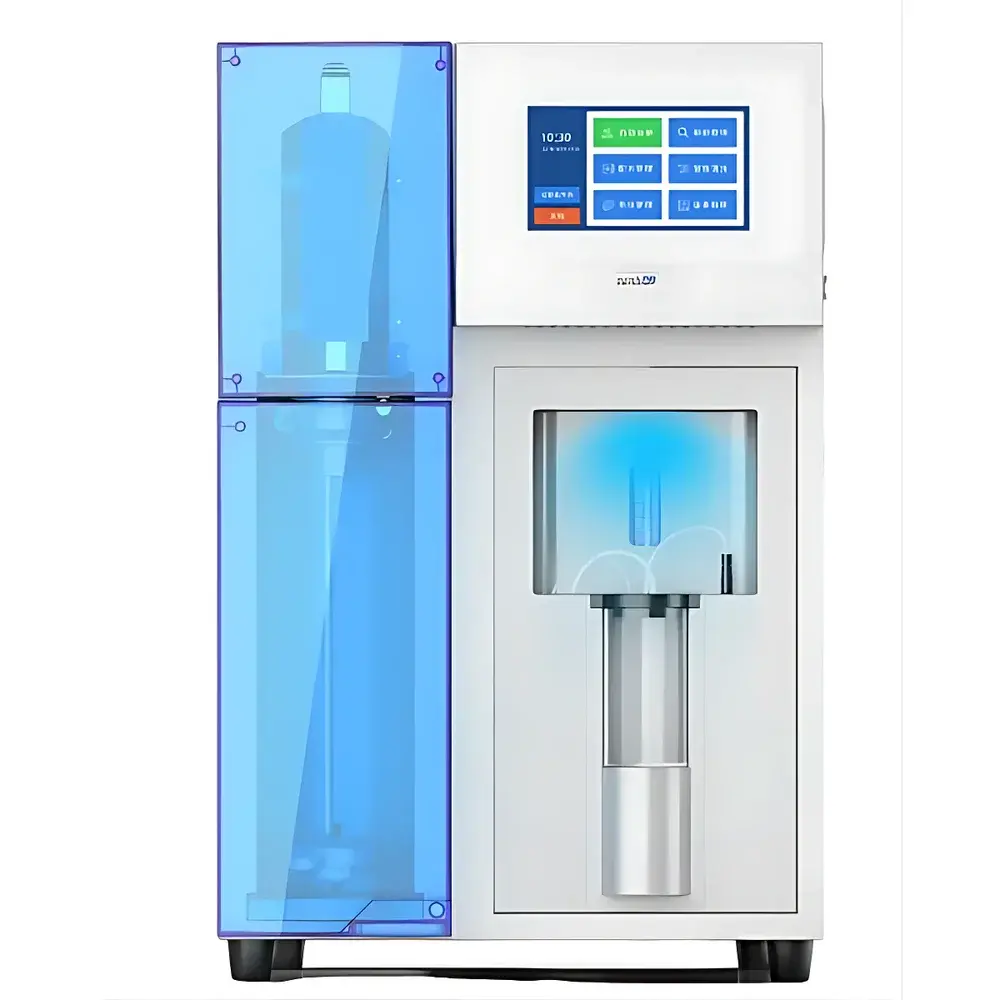
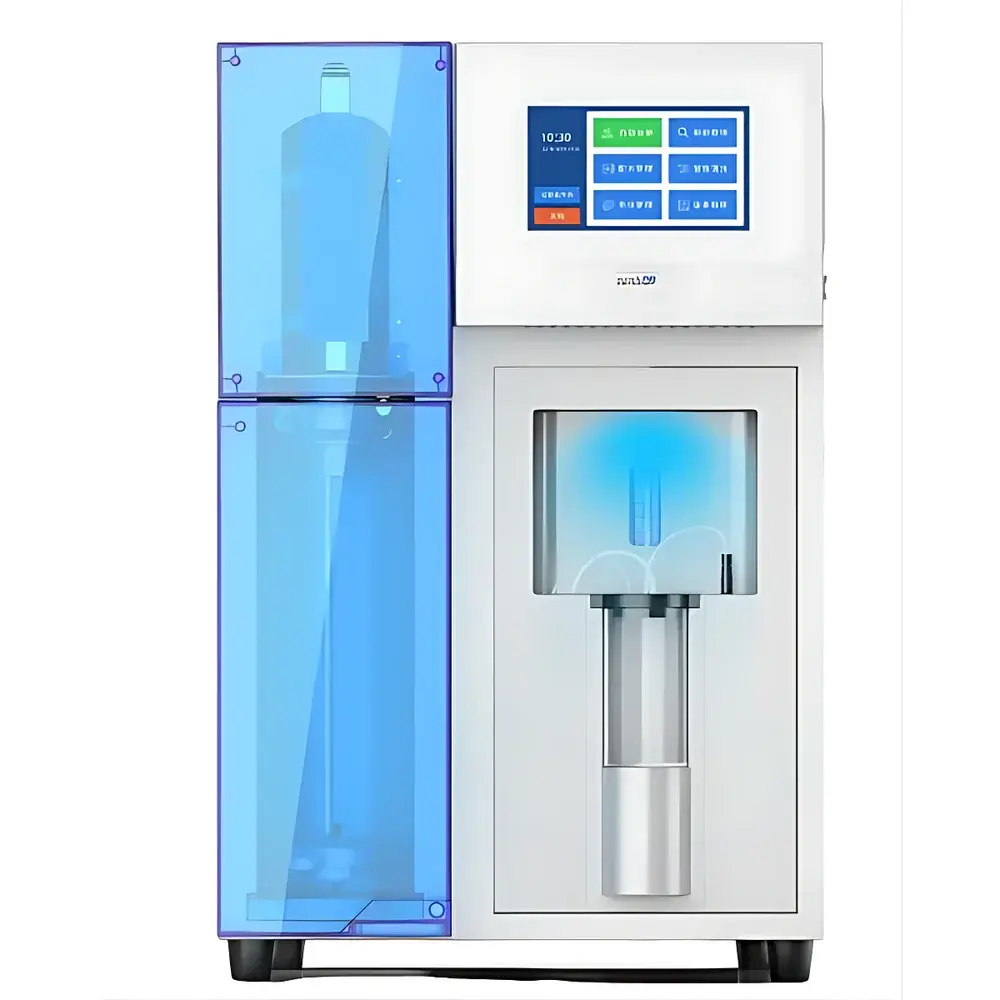
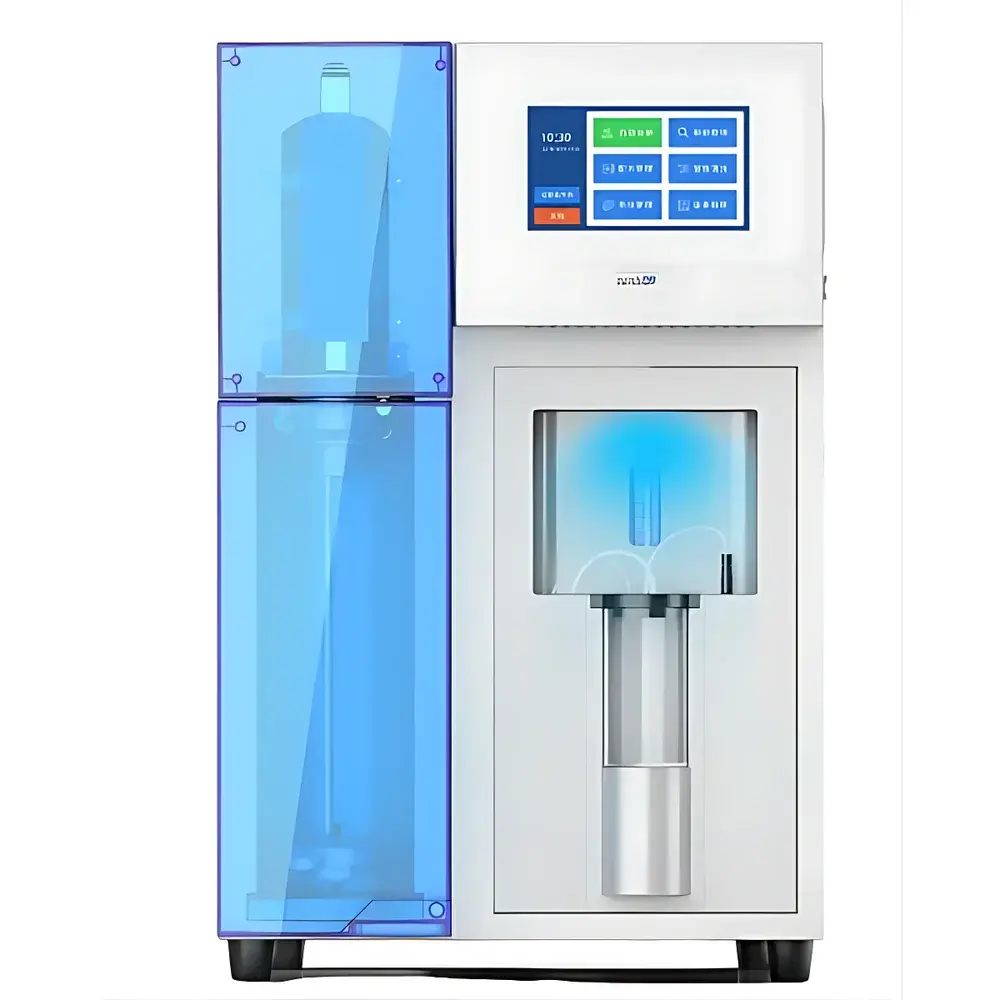
Peiou SKD-3800 Fully Automated Kjeldahl Nitrogen Analyzer
| Brand | Peiou |
|---|---|
| Origin | Shanghai, China |
| Model | SKD-3800 |
| Instrument Type | Quartz Glass Distillation Apparatus |
| Heating Method | Electric heating (stainless steel heating element) |
| Cooling Method | Recirculating water cooling |
| Distillation Rate | 15–30 mL/min (adjustable) |
| Heating-up Time | 10–15 min |
| End-point Control | Quantitative volume-based automatic termination |
| Steam Power | 750–1500 W (adjustable) |
| Dimensions | ~370 × 300 × 680 mm |
| Housing Material | Acid- and alkali-resistant ABS |
| Nitrogen Detection Range | 0.1–210 mg per sample |
| Sample Capacity | ≤5 g solid or ≤15 mL liquid per run |
| Distillation Time per Sample | 3–9 min |
| RSD | ≤0.5% |
| Recovery Rate | ≥99.5% |
| Reagent Dispensing Accuracy | ±0.05 mL |
| Titration Range | 0–99 mL standard acid (with 10× acid replacement capability) |
| Display | 10.1-inch touchscreen with Chinese UI |
| Data Output | Thermal printer + USB export + LIMS-compatible interface |
| Safety Features | Dry-run protection for steam generator, condensate flow & temperature monitoring, reagent level sensing, safety door & digestion tube presence detection, condensate interruption shutdown |
Overview
The Peiou SKD-3800 Fully Automated Kjeldahl Nitrogen Analyzer is an integrated, benchtop analytical system engineered for precise and reproducible total nitrogen determination via the classical Kjeldahl method. It implements a three-stage workflow—digestion (performed externally), distillation, and titration—within a single automated platform. The instrument operates on the principle of alkaline steam distillation: after acid digestion converts organic nitrogen to ammonium sulfate, the digest is mixed with sodium hydroxide to liberate ammonia gas, which is swept by controlled steam into a boric acid trapping solution. The captured ammonia is then quantified by potentiometric or colorimetric titration. Designed for compliance with internationally recognized standard methods—including AOAC Official Method 984.13, ISO 5983-1:2009, GB/T 6423–2021, and USP —the SKD-3800 delivers trace-level accuracy (detection limit: 0.1 mg N) and high throughput across diverse matrices such as cereals, dairy products, feedstuffs, soil extracts, fertilizers, and biological tissues.
Key Features
- Fully automated reagent handling: sequential, programmable addition of NaOH, boric acid, diluent, and distilled water with ±0.05 mL volumetric precision
- Adjustable steam generation: 750–1500 W power range enables optimization for low- or high-boiling samples; rapid thermal ramp (10–15 min to operating temperature)
- Dual-mode distillation: supports both standard and accelerated protocols with real-time flow control (15–30 mL/min, adjustable in 1 mL increments)
- Quantitative endpoint detection: volumetric measurement of distillate ensures consistent reaction completion independent of sample matrix variability
- Open-view titration cell: transparent chamber allows visual verification of colorimetric endpoint and bubble formation during titration
- Modular safety architecture: includes dry-heater protection, condensate flow/temperature sensors, reagent reservoir level monitoring, mechanical interlock for safety door and digestion tube positioning, and automatic emergency shutdown upon coolant interruption
Sample Compatibility & Compliance
The SKD-3800 accommodates solid samples up to 5 g and liquid samples up to 15 mL per run, supporting routine analysis of heterogeneous materials including ground grains, homogenized tissue, slurry-based fertilizers, and digested soil extracts. Its quartz-glass distillation assembly resists corrosion from concentrated alkalis and acidic vapors generated during high-salt or high-fat sample processing. Regulatory alignment extends to GLP-compliant environments: audit-trail-enabled data logging, user-access controls, electronic signature support (via optional LIMS integration), and full traceability of method parameters, reagent lots, operator ID, and timestamped results satisfy requirements under FDA 21 CFR Part 11 and ISO/IEC 17025. Validation documentation—including IQ/OQ/PQ templates—is provided for laboratory accreditation readiness.
Software & Data Management
Controlled via a 10.1-inch capacitive touchscreen running embedded Linux OS, the SKD-3800 features intuitive Chinese-language navigation with multi-user profile management and password-protected method editing. Up to 100 customizable analysis programs can be stored locally, each defining distillation time, steam power, reagent volumes, titrant concentration, and endpoint criteria. All raw and processed data—including titration curves, volume logs, and pass/fail flags—are timestamped and retained with metadata (sample ID, operator, date/time, method version). Export options include thermal printouts (with QR-coded report headers) and encrypted USB transfer in CSV and PDF formats. Native API support enables bidirectional communication with enterprise LIMS platforms, ensuring seamless integration into centralized QA/QC workflows and automated report generation.
Applications
The SKD-3800 serves as a primary nitrogen quantification tool in food safety laboratories (protein content estimation in milk powder, meat analogs, and plant-based proteins), agricultural testing centers (N-content in compost, manure, and synthetic fertilizers), contract research organizations performing AOAC-certified assays, and university core facilities conducting nutritional biochemistry studies. Its robustness in handling high-salt, high-lipid, or viscous digests—combined with dual-distillation capability for method validation or parallel sample processing—makes it suitable for both routine QC and regulatory submission testing. The system’s compatibility with external digestion modules (e.g., infrared quartz or graphite block digesters) further streamlines end-to-end sample preparation without manual transfer.
FAQ
What digestion systems are compatible with the SKD-3800?
The analyzer accepts standard 250–500 mL Kjeldahl digestion tubes and integrates seamlessly with Peiou’s IR quartz program-controlled digesters and graphite heating blocks. Tube geometry and height specifications are documented in the Installation Qualification manual.
Does the SKD-3800 support ASTM D5133 or ISO 1871 methods?
While optimized for nitrogen quantification per AOAC and ISO 5983, the instrument’s adjustable steam power, precise reagent delivery, and programmable distillation timing allow method adaptation for volatile nitrogen species under ASTM D5133 (lubricating oils) and ISO 1871 (milk powders), subject to lab-specific validation.
Can the system operate unattended overnight?
Yes—equipped with automatic post-run cleaning, waste drainage, and standby mode activation, the SKD-3800 supports batch runs of up to 24 samples with no operator intervention, provided reagent and coolant reservoirs are adequately filled and ambient temperature remains within 15–30°C.
Is calibration verification required before each analysis series?
Per ISO 5983-2:2022, daily calibration verification using certified ammonium sulfate reference standards (e.g., NIST SRM 2000) is recommended; the SKD-3800 includes built-in calibration check routines with pass/fail reporting and deviation logging.
What maintenance intervals are specified for the quartz distillation unit?
Quartz components require visual inspection after every 100 runs; cleaning with 10% nitric acid followed by deionized water rinse is advised weekly. Full preventive maintenance—including steam generator descaling and condenser coil inspection—is scheduled every 6 months or 500 cycles, whichever occurs first.



