
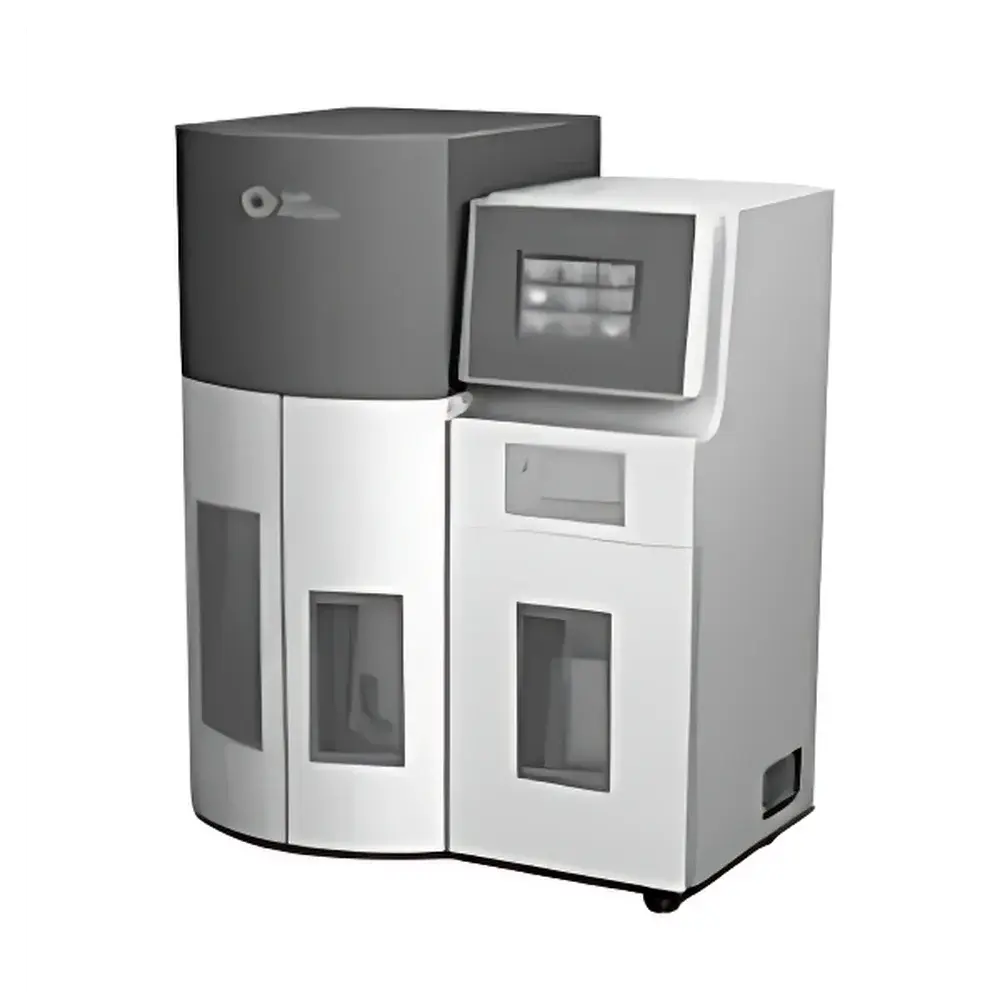
Peiou SKD-5000 Fully Automated Kjeldahl Nitrogen Determinator
| Brand | Peiou |
|---|---|
| Origin | Shanghai, China |
| Model | SKD-5000 |
| Instrument Type | Fully Automated Kjeldahl Nitrogen Determinator |
| Nitrogen Determination Range | 0.1–500 mg N per sample |
| Cation Exchange Capacity (CEC) Range | 1–100 cmol/kg |
| Sample Weight | Solid (e.g., soil): 0.5–10 g |
| Liquid | 1–100 mL |
| Distillation Time | 2–5 min per sample |
| Repeatability | ≤±0.2% for nitrogen |
| Recovery Rate | ≥99.8% for nitrogen |
| Linear Range | 0.1–500 mg N |
| Linearity Error at 4× Nitrogen Load | ≤±0.5% |
| Compatible Standard Acid Concentration | 0.01–1.5 mol/L HCl or H₂SO₄ |
| Power Consumption | ~2000 W |
| Dimensions (L×W×H) | ~550×500×650 mm |
| Titration Resolution | 0.8 µL/step |
| Pump Accuracy | RSD <0.002 µL/step |
| Repeatability (RSD) | <0.5% |
| Delay Time Setting | 0–1800 s |
| Digestion Tube Compatibility | 300 mL and 650 mL tubes |
| Dual-Mode Operation | Manual & Automatic |
| Distillation Power | Adjustable |
| Safety Features | Real-time distillation cup temperature monitoring, condenser water flow/pressure auto-detection, acid/alkali/boric acid/diluent level sensors, door-closed status verification, dry-burn prevention via dual liquid-level modeling |
Overview
The Peiou SKD-5000 Fully Automated Kjeldahl Nitrogen Determinator is an integrated analytical platform engineered for precise, traceable, and high-throughput quantification of total nitrogen and cation exchange capacity (CEC) in diverse matrices—including soils, fertilizers, foodstuffs, feed, and environmental samples. Based on classical Kjeldahl digestion followed by steam distillation and colorimetric titration, the SKD-5000 implements a rigorously validated wet-chemistry workflow compliant with ISO 5983-1:2009, AOAC Official Method 984.13, and EPA Method 350.1. Unlike semi-automated systems, it executes the entire sequence—acid addition, alkalization, dilution, distillation, endpoint detection, rinsing, and data reporting—without manual intervention. Its core innovation lies in optical endpoint recognition: a tri-color (RGB) photometric sensor replaces conventional pH electrodes or single-wavelength photometers, enabling robust discrimination of the methyl red–bromocresol green transition under variable ambient lighting. This eliminates electrode drift, calibration dependency, and spectral interference from colored digests—critical for heterogeneous soil extracts and turbid biological digests.
Key Features
- Full automation of digestion-derived analysis: acid dosing, NaOH addition, diluent delivery, steam distillation, back-titration with standardized acid, post-run system cleaning, and result calculation—all governed by embedded microprocessor logic.
- Real-time RGB colorimetric titration: high-stability optical sensor with dynamic baseline compensation ensures reproducible endpoint detection independent of sample turbidity or ambient light exposure.
- Dual-mode distillation control: adaptive power modulation maintains optimal steam generation across low-concentration (e.g., leaf tissue) and high-nitrogen (e.g., manure) samples, maximizing recovery while preventing bumping or incomplete volatilization.
- Comprehensive safety architecture: integrated dry-burn prevention via dual-level distillation flask monitoring; real-time condenser water flow and pressure validation; automatic shutdown on reagent depletion (H₂SO₄, NaOH, boric acid, distilled water); and interlocked front-door position sensing.
- Thermal management: PID-controlled heating of the distillation block with continuous temperature feedback ensures consistent steam output and minimizes thermal lag between samples.
- Modular reagent handling: peristaltic pumps with 1-mL incremental precision deliver acids, alkalis, and diluents within ±0.5% volumetric accuracy; programmable delay (0–1800 s) supports sequential nitrate/nitrite correction protocols.
Sample Compatibility & Compliance
The SKD-5000 accommodates solid samples (0.5–10 g, e.g., air-dried soils, ground cereals, powdered feeds) and liquids (1–100 mL, e.g., digest filtrates, wastewater extracts, milk supernatants). Its 300 mL and 650 mL digestion tube compatibility enables direct integration with standard block digesters. For CEC determination, the instrument supports ammonium acetate (pH 7.0) and barium chloride–triethanolamine extraction protocols per USDA Soil Survey Laboratory Handbook and ISO 11260:1994. All operational parameters—including reagent volumes, distillation duration, titrant concentration, and endpoint thresholds—are user-configurable and stored with timestamped metadata. The system meets GLP documentation requirements: audit trails log operator ID, method version, run start/end times, reagent lots, and all parameter modifications. Data export complies with FDA 21 CFR Part 11 when paired with validated LIMS software.
Software & Data Management
The SKD-5000 runs on an embedded Linux-based OS with a 7-inch capacitive color touchscreen and intuitive Chinese/English bilingual GUI. Methods are defined via hierarchical templates—global defaults, matrix-specific presets (soil, grain, dairy), and custom protocols. Each analysis generates a structured CSV report containing raw titrant volume, calculated N/CEC values, recovery percentages, instrument status flags, and QC metrics (e.g., blank correction, linearity check at 4× load). Optional RS232/USB interfaces support direct balance integration (auto-import tare/net mass) and wireless data transmission to laboratory networks. Raw sensor waveforms and titration curves are archived for retrospective review. Firmware updates preserve historical method integrity through version-controlled configuration snapshots.
Applications
- Agricultural soil testing labs: routine quantification of total N and CEC for fertility assessment and lime recommendation models.
- Food and feed quality control: protein content verification per AOAC 981.10 and ISO 8968-1, including dairy, meat, and plant-based products.
- Environmental monitoring: nitrogen speciation in sludge, compost, and leachates; regulatory compliance with EU Nitrates Directive reporting thresholds.
- Research laboratories: method development for non-protein nitrogen (NPN) correction, isotopic nitrogen tracer studies (when coupled with ¹⁵N-labeled standards), and kinetic optimization of digestion efficiency.
- Educational institutions: teaching core principles of wet-chemical elemental analysis with full process transparency and error-flagging diagnostics.
FAQ
What digestion equipment is compatible with the SKD-5000?
The instrument accepts standard 300 mL and 650 mL Kjeldahl digestion tubes; no adapter required. It is designed to interface with common block digesters (e.g., VELP, Gerhardt, Foss) using standard tube racks.
Does the SKD-5000 support USP <281> or Ph. Eur. 2.5.23 compliance?
Yes—its colorimetric endpoint detection, traceable reagent delivery, and electronic audit trail satisfy the instrumental equivalence criteria outlined in both monographs for nitrogen assay in pharmaceutical excipients and active ingredients.
Can CEC be reported in both cmolc/kg and meq/100g units?
Yes—unit conversion is configurable in software; default output is cmolc/kg per ISO 11260, with optional meq/100g display enabled via method settings.
Is external PC software required for data archiving?
No—internal flash storage retains ≥10,000 test records with full metadata. Optional PC software (provided) enables batch export, statistical summary, and PDF certificate generation.
What maintenance intervals are recommended for long-term reliability?
Daily: visual inspection of tubing, waste container, and reagent levels. Quarterly: calibration of color sensor using certified neutral-density filters; pump tubing replacement. Annually: full system performance verification against NIST-traceable nitrogen standards (e.g., glycine, ammonium sulfate).
Related Products




