
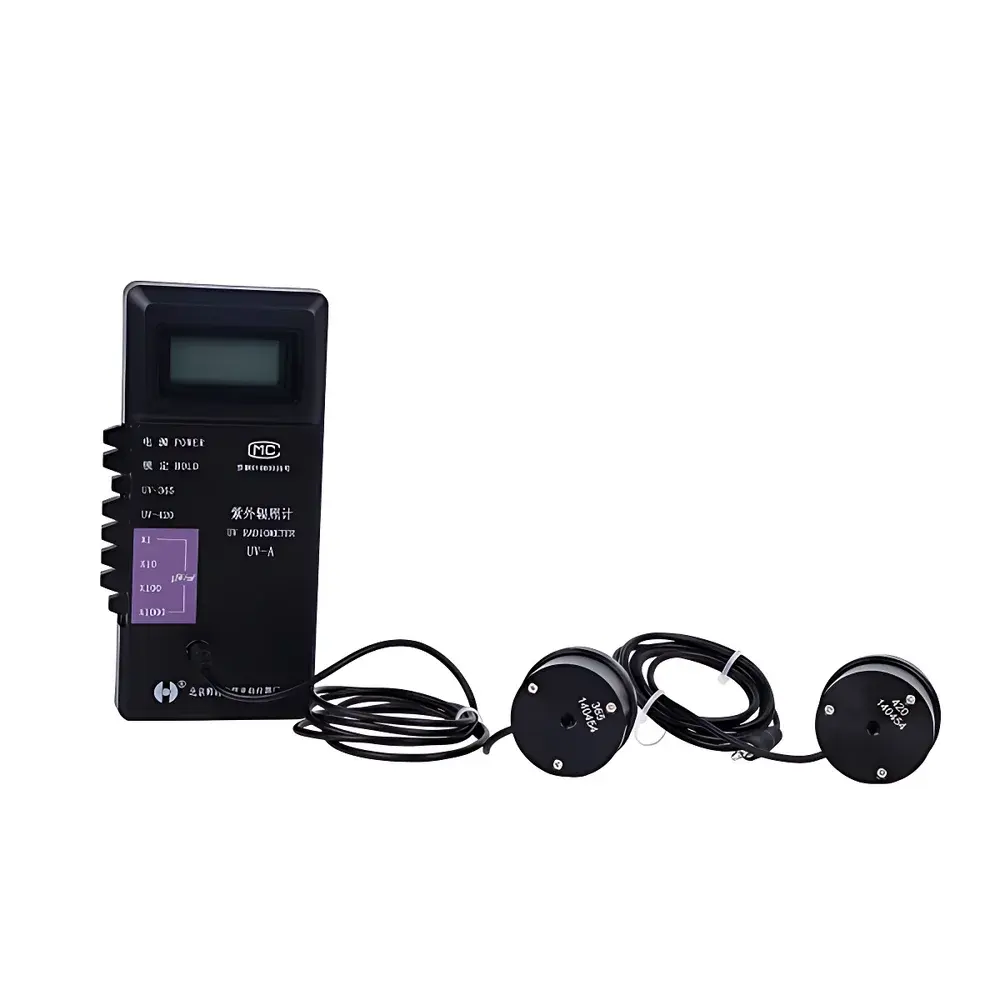
PerfectLight FZ-A Portable Photometric Radiometer for Visible Light Irradiance Measurement
| Brand | PerfectLight |
|---|---|
| Origin | Beijing, China |
| Model | FZ-A |
| Wavelength Range | 400–1000 nm |
| Irradiance Range | 0.1–1.999×10⁵ µW/cm² |
| Accuracy | ±5% (vs. NIM reference standard) |
| Cosine Error | f₂ ≤ 4% |
| Response Time | 1 s |
| Operating Temperature | 0–40 °C |
| Relative Humidity | <85% RH |
| Dimensions | 160 × 78 × 43 mm |
| Weight | 0.2 kg |
| Power Supply | 9 V alkaline battery (6F22) or USB 5 V adapter |
| Detector Diameter | 27 mm |
| Sensing Aperture | 7 mm |
| Detector Height | 21.5 mm |
| Compliance | Meets Chinese National Class I Illuminance Meter Standard (JJG 245–2005) |
Overview
The PerfectLight FZ-A Portable Photometric Radiometer is a precision-engineered instrument designed for quantitative measurement of visible-light irradiance in photochemical and photocatalytic research environments. It operates on the principle of photodiode-based spectral integration, calibrated against the National Institute of Metrology (NIM) traceable standards under tungsten-lamp illumination. Its spectral response (400–1000 nm) is optimized to approximate the AM1.5G solar spectrum—making it particularly suitable for evaluating light sources used in solar-simulated photocatalysis, LED-driven reaction systems, and UV–vis photoreactor characterization. Unlike broadband radiometers with uncorrected spectral mismatch, the FZ-A detector undergoes rigorous angular (cosine) and spectral responsivity calibration, ensuring high reproducibility across varying incidence angles and emitter types (e.g., halogen, xenon arc, white LEDs). The device features automatic range switching, low-power SMT architecture, and a streamlined ergonomic housing—enabling reliable field deployment and benchtop integration without compromising metrological integrity.
Key Features
- Automatically ranging irradiance measurement from 0.1 to 1.999×10⁵ µW/cm² with single-button operation
- High-fidelity silicon photodiode detector with NIM-traceable calibration across 400–1000 nm
- Optimized cosine correction (f₂ ≤ 4%) validated per JJG 245–2005 requirements for angular uniformity
- Sub-1-second real-time response time, enabling dynamic monitoring of pulsed or modulated light sources
- Dual power configuration: standalone operation via 9 V alkaline battery (6F22) or continuous use via USB 5 V adapter (power consumption < 0.1 VA)
- Compact form factor (160 × 78 × 43 mm; 0.2 kg) with IP54-rated enclosure for lab and glovebox compatibility
- Integrated probe design featuring 7 mm active aperture and 27 mm diameter diffuser for uniform spatial averaging
Sample Compatibility & Compliance
The FZ-A radiometer is intended for non-contact irradiance quantification of planar or quasi-diffuse light fields incident upon flat surfaces—commonly applied to photoreactor windows, catalyst-coated substrates, or optical filters. It is not designed for collimated beam profiling, laser power measurement, or UV-C (<280 nm) or NIR (>1000 nm) spectral regions. The instrument complies fully with the Chinese National Verification Regulation JJG 245–2005 for Class I illuminance meters, including specifications for linearity, zero drift, temperature coefficient, and cosine error. While not certified to ISO/IEC 17025 or NIST-traceable calibration certificates by default, its factory calibration report includes uncertainty budgets referenced to NIM primary standards. For GLP-compliant workflows, users may request optional annual recalibration services with documented traceability and certificate of conformance.
Software & Data Management
The FZ-A operates as a standalone meter with no embedded firmware or proprietary software dependency. All measurements are displayed directly on its high-contrast LCD screen with four-digit resolution and auto-zero functionality. For data logging, the device supports analog voltage output (0–2 V DC proportional to irradiance) and optional USB-to-serial interface modules (sold separately), enabling integration into LabVIEW, MATLAB, or Python-based acquisition platforms. When paired with third-party DAQ hardware, timestamped irradiance series can be archived in CSV or HDF5 formats—supporting audit trails required under FDA 21 CFR Part 11 when configured with electronic signature and user access controls. No cloud connectivity or remote firmware updates are implemented, preserving system determinism and minimizing cybersecurity exposure in regulated lab environments.
Applications
- Quantitative normalization of photon flux in heterogeneous photocatalysis experiments (e.g., TiO₂, g-C₃N₄, MOFs)
- Calibration and verification of solar simulators (Class AAA, AB, or B) against AM1.5G reference spectra
- LED array uniformity mapping across reactor illumination zones
- Time-resolved irradiance monitoring during photocycle kinetics studies
- Validation of optical filters, diffusers, and light guides in photoreactor design
- Teaching laboratories for hands-on radiometry fundamentals and spectral weighting concepts
FAQ
Is the FZ-A suitable for measuring UV-B or UV-C irradiance?
No. Its spectral response is limited to 400–1000 nm and does not cover UV-B (280–315 nm) or UV-C (100–280 nm). Use dedicated UV radiometers with quartz optics and solar-blind detectors for those ranges.
Can the FZ-A be used inside nitrogen-purged gloveboxes?
Yes—the sealed housing and low outgassing materials allow safe operation in inert-atmosphere gloveboxes; ensure probe window remains clean and free of condensation.
Does the instrument require periodic recalibration?
Yes. Annual recalibration is recommended for applications requiring metrological continuity. PerfectLight offers accredited recalibration services with NIM-traceable documentation.
What is the maximum permissible operating temperature?
The specified operating range is 0–40 °C. Prolonged exposure above 40 °C may induce thermal drift in the photodiode’s dark current and responsivity.
How is cosine error characterized and verified?
Cosine error (f₂) is measured per JJG 245–2005 using a collimated source at incidence angles from 0° to 75°, with deviation from ideal cos(θ) response quantified as f₂ = max|E(θ)/E(0)·cos(θ) − 1| × 100%.



