
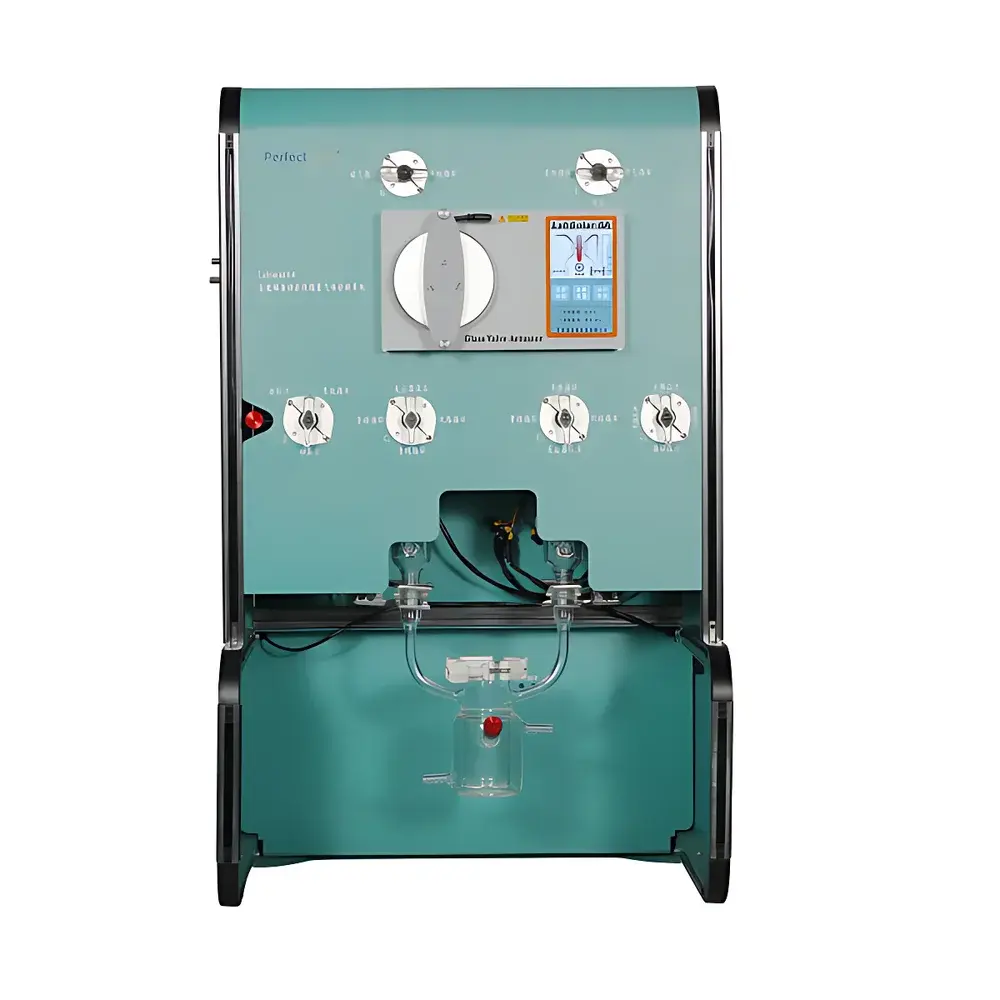
PerfectLight Labsolar-6A Catalytic Evaluation System
| Brand | PerfectLight |
|---|---|
| Origin | Beijing, China |
| Manufacturer Type | Authorized Distributor |
| Country of Origin | China |
| Model | Labsolar-6A |
| Reactor Volume | 150 mL (excl. reactor cavity) |
| Construction Material | Borosilicate glass |
| Operating Pressure Range | 0 kPa to atmospheric pressure |
| Ultimate Vacuum | ≤1.5 kPa (absolute) |
| Vacuum Leakage Rate | ≤1 μmol O₂/24 h |
| Gas Mixing Time | <10 min (H₂, O₂, CH₄, CO) |
| Quantitative Loop Options | 0.6 mL or 2 mL |
| Circulation Line ID | 3 mm |
| Total System Dead Volume | 65 mL |
| Temperature Control Range | Ambient to 200 °C (10-segment programmable, ±0.1 °C accuracy) |
| Detection Limits (� | mol): H₂: 0.05 |
| O₂ | 0.1 |
| CH₄/CO | 0.0005 |
| Repeatability (RSD) | <3% (n=4) |
| Linearity (R²) | >0.9995 (H₂: 100 μL–10 mL) |
| Displacement per Cycle | 6 mL |
| Pump Type | Passive magnetic-drive piston pump (wire-free, no electrolytic H₂ interference) |
Overview
The PerfectLight Labsolar-6A Catalytic Evaluation System is a modular, vacuum-tight gas-phase reaction platform engineered for quantitative assessment of catalytic activity under controlled photochemical, photoelectrochemical, thermocatalytic, and electrocatalytic conditions. It operates on the principle of closed-loop gas circulation with real-time sampling and chromatographic analysis—enabling precise measurement of low-concentration gaseous products (e.g., H₂, O₂, CH₄, CO) generated during heterogeneous catalysis. The system integrates borosilicate glass fluidics, passive magnetic-drive actuation, and programmable thermal management to eliminate electrical hazards in hydrogen-rich environments while ensuring chemical inertness, minimal adsorption, and long-term vacuum integrity. Designed specifically for intrinsic kinetic studies, it suppresses secondary reactions caused by product re-adsorption through rapid gas homogenization (<10 min mixing time) and unidirectional flow architecture—critical for accurate determination of turnover frequency (TOF), quantum yield (AQY), and selectivity in photocatalytic water splitting, CO₂ reduction, and HER/OER/CO₂RR investigations.
Key Features
- Borosilicate glass manifold with precision-lapped glass valves (7 total), sealed using Dow Corning high-vacuum grease (−40 °C to 200 °C operating range, low vapor pressure, chemical resistance)
- Passive magnetic-drive piston pump: zero electrical wiring in gas path, eliminating spark risk and electrolytic H₂ generation; integrated check-valve design ensures unidirectional circulation
- Modular reactor compatibility: supports interchangeable glass reactors for photocatalysis, PEC, photothermal, and electrocatalytic configurations—including custom geometries
- Programmable temperature control: 10-segment ramping across circulation lines and injection paths (±0.1 °C stability up to 200 °C); optional cold trap for low-boiling-point condensate separation
- Quantitative loop sampling via multi-port glass valve (0.6 mL or 2 mL selectable); non-chromatographic, fixed-volume injection minimizes dead volume and carryover
- Integrated safety architecture: real-time pressure monitoring, vacuum leak detection, automatic vacuum grease replacement alerts, and dual-level software encryption for method configuration
Sample Compatibility & Compliance
The Labsolar-6A accommodates liquid-phase slurries, powder catalysts, and immobilized photoelectrodes in standardized or user-defined reactor vessels. Its all-glass fluidic path meets ISO 8573-1 Class 0 purity requirements for trace gas analysis and complies with ASTM E2912 (standard practice for gas chromatography of light hydrocarbons) and USP guidelines for system suitability testing. The ≤1 μmol O₂/24 h leakage rate satisfies stringent photolytic O₂ evolution assays per ISO 15312-1. Vacuum integrity and material inertness ensure adherence to GLP principles for data traceability and audit readiness. No metallic components contact process gases—eliminating catalytic artifacts from metal leaching or surface oxidation.
Software & Data Management
The system runs on a dedicated 32-bit embedded control platform with a 4.5-inch TFT color touchscreen interface. Software modules automate valve sequencing, GC trigger signals, vacuum pump duty cycling (with anti-backflow solenoid protection), and thermal ramp profiles. All operational states—including valve position feedback, absolute pressure, ambient temperature, and pump runtime—are logged with timestamped metadata. Audit trails comply with FDA 21 CFR Part 11 requirements via electronic signatures and role-based access control. Raw chromatographic data export is supported in CSV and CDF formats compatible with OriginLab, MATLAB, and ChemStation. Secondary debugging mode (password-protected) enables advanced users to modify timing logic, sensor calibration offsets, and alarm thresholds.
Applications
- Photocatalytic overall water splitting and half-reaction quantification (H₂/O₂ evolution stoichiometry validation)
- Photoelectrochemical (PEC) efficiency mapping under AM 1.5G illumination with simultaneous gas evolution monitoring
- CO₂ photoreduction selectivity profiling (CH₄, CO, C₂H₄ yields) under controlled partial pressures
- Absolute quantum yield (AQY) determination at monochromatic irradiation wavelengths (254–450 nm)
- Photothermal catalysis under sub-atmospheric and ambient pressure conditions
- Electrocatalytic gas evolution kinetics (HER, OER, CO₂RR) using three-electrode cells coupled to the gas manifold
FAQ
What reactor types are compatible with the Labsolar-6A?
Standard configurations include top-irradiated quartz photoreactors (e.g., 50–150 mL capacity), side-illuminated PEC cells, and electrochemical H-cell adapters. Custom reactors can be integrated via standardized Swagelok-to-glass transition fittings.
Can the system operate under inert atmosphere without vacuum cycling?
Yes—the pressure control module maintains setpoints from 0 kPa (gauge) to atmospheric pressure; continuous N₂/Ar purging is supported alongside vacuum-assisted degassing protocols.
How is calibration performed for quantitative gas analysis?
Calibration uses certified standard gas mixtures (NIST-traceable) injected via the same 0.6/2 mL loop; linear regression (R² > 0.9995) is validated across 100 μL–10 mL H₂ range prior to each experimental campaign.
Is remote monitoring or network connectivity supported?
The embedded controller supports Ethernet-based data streaming to local servers; however, cloud upload or IoT integration is not implemented to preserve data sovereignty and cybersecurity compliance in regulated labs.
What maintenance intervals are recommended for vacuum integrity?
Vacuum grease replacement is advised every 6 months under continuous operation; system self-diagnosis monitors seal degradation via real-time leakage rate trending and triggers maintenance alerts when deviation exceeds ±15% of baseline.



