
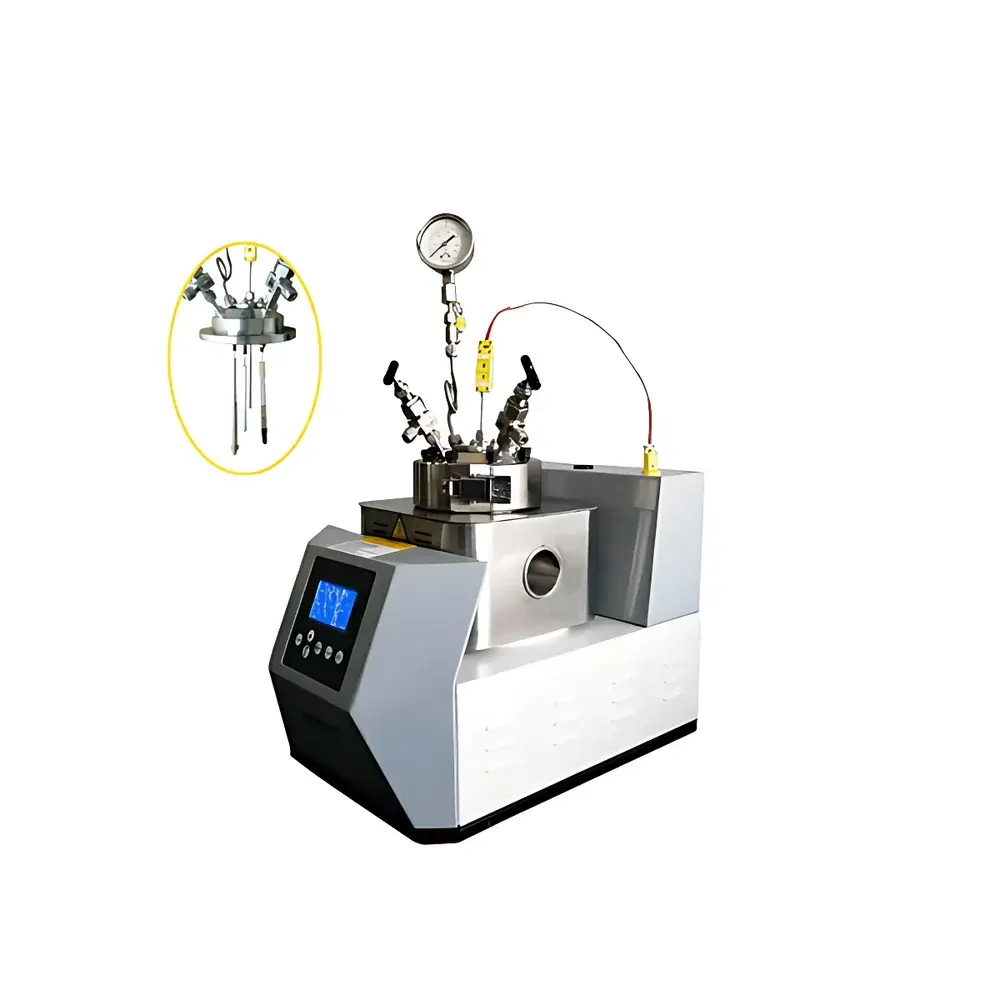
PerfectLight LC-D Sapphire Photoelectrochemical High-Pressure Reactor
| Brand | PerfectLight |
|---|---|
| Origin | Beijing, China |
| Manufacturer Type | Authorized Distributor |
| Country of Origin | China |
| Model | LC-D Sapphire |
| Instrument Category | High-Pressure Reactor |
| Usable Volume | 500 mL |
| Vessel Material | Hastelloy C-276 |
| Optical Window Material | Sapphire |
| Maximum Operating Pressure | 10 MPa (Burst Disc: 12.5 MPa, Pressure Gauge Range: 0–16 MPa) |
| Temperature Range | Ambient to 150 °C (internal) |
| Heating Power | 1.2 kW Modular Electric Heater |
| Stirring Options | Internal Magnetic Stirring or Paddle-Type Mechanical Stirring |
| Stirring Speed | 0–1200 rpm, Continuously Adjustable |
| Control System | MRSC-LC-D V1.06 with LCD Display (Temperature, RPM, Elapsed Time), Dual-Direction Rotation, Timed Hold/Operation Mode, Audible & Visual Alarm |
| Vacuum Capability | Not Specified |
| Compliance | Designed for GLP-compliant photoelectrochemical research under elevated T/P conditions |
Overview
The PerfectLight LC-D Sapphire Photoelectrochemical High-Pressure Reactor is an integrated benchtop platform engineered for simultaneous illumination and electrochemical biasing under rigorously controlled high-temperature and high-pressure environments. It operates on the principle of coupled photoexcitation and electrochemical charge transfer—enabling precise investigation of reaction kinetics, interfacial carrier dynamics, and catalytic mechanisms in heterogeneous photocatalysis and electrocatalysis. Unlike conventional photoreactors or electrochemical cells, the LC-D integrates a robust pressure-rated vessel with optical-grade sapphire viewport, precision temperature regulation, and configurable electrode feedthroughs, allowing real-time spectroscopic monitoring and potentiostatic/galvanostatic control during pressurized operation. Its modular architecture supports both sealed batch-mode experiments and continuous-flow adaptations via standardized Swagelok-compatible ports.
Key Features
- Optically transparent sapphire viewport (≥85% transmittance from 190–5500 nm) rated for sustained operation up to 10 MPa, enabling in situ UV-Vis, Raman, or FTIR spectroscopy without compromising pressure integrity.
- Hastelloy C-276 reactor body provides exceptional resistance to chloride-induced stress corrosion cracking and oxidation at elevated temperatures—critical for aqueous and corrosive electrolyte systems used in CO2 reduction or VOC degradation studies.
- Dual-mode agitation system: high-torque magnetic coupling (up to 1200 rpm) for low-viscosity media; optional mechanical paddle stirrer with ceramic shaft for viscous slurries or solid-catalyst suspensions.
- MRSC-LC-D V1.06 control system features PID-regulated heating, real-time digital display of internal temperature, rotational speed, and elapsed time, programmable hold cycles, bidirectional stirring logic, and dual-stage audible/visual alarm triggers for over-temperature, over-pressure, or motor stall events.
- Standardized electrical feedthroughs (3× hermetic SMA or BNC connectors) accommodate working, reference, and counter electrodes; optional quartz fiber optic ports support laser irradiation or emission coupling.
Sample Compatibility & Compliance
The LC-D reactor accommodates heterogeneous catalytic systems including powdered semiconductors (e.g., TiO2, g-C3N4, perovskites), supported metal nanoparticles, gas-diffusion electrodes, and slurry-based photoanodes/cathodes. It supports liquid-phase, gas-liquid, and three-phase (solid–liquid–gas) reaction configurations. All wetted components comply with ASTM B575 and ASME BPVC Section VIII Division 1 design standards. The sapphire window meets ISO 10110-3 surface quality specifications. The control system architecture supports audit-trail logging and user-access-level management—facilitating alignment with GLP documentation requirements and preparatory workflows for FDA 21 CFR Part 11–aligned data governance in regulated development labs.
Software & Data Management
While the LC-D operates natively via its embedded MRSC-LC-D V1.06 firmware, optional RS485/USB communication interface enables integration with third-party data acquisition platforms (e.g., LabVIEW, MATLAB, or Python-based control scripts). Temperature and RPM logs are timestamped and exportable as CSV files. Custom firmware updates—available through PerfectLight’s technical support portal—include enhanced alarm hysteresis settings, multi-step ramp-soak profiles, and configurable electrode potential offset compensation for long-duration chronoamperometric experiments.
Applications
- Photocatalytic CO2 hydrogenation to CH4, CH3OH, or C2H4 under 1–10 MPa CO2/H2 partial pressures and 25–150 °C.
- Electro-assisted photodegradation of persistent organic pollutants (e.g., PFAS, pharmaceuticals) in wastewater matrices under UV/visible irradiation and applied bias.
- High-pressure photoelectrochemical nitrogen fixation (N2 → NH3) using plasmonic or defect-engineered catalysts.
- In situ mechanistic studies of sulfur capture and conversion (e.g., SO2 → elemental S or sulfate) under simulated flue-gas conditions.
- Development and screening of tandem photoelectrodes for solar fuel generation in pressurized alkaline or acidic electrolytes.
FAQ
Can the LC-D reactor be used for continuous-flow photoelectrochemical experiments?
Yes—standard 1/4″ Swagelok ports allow integration with HPLC-grade tubing, mass flow controllers, and back-pressure regulators for steady-state flow-through operation.
Is the sapphire viewport compatible with UV-C (200–280 nm) irradiation?
Yes—single-crystal sapphire exhibits >70% transmission down to 190 nm, making it suitable for deep-UV photoactivation studies.
What electrode configurations are supported out-of-the-box?
The base configuration includes three isolated feedthroughs for standard three-electrode electrochemical setups; custom multi-electrode arrays or rotating disk electrode (RDE) mounts are available upon request.
Does the system meet explosion-proof certification requirements for solvent-based reactions?
The reactor itself is not intrinsically safe certified; however, when operated within designated fume hoods and paired with external spark-proof controllers, it complies with OSHA 1910.106 and IEC 60079-0 guidelines for laboratory-scale hazardous environment use.
How is temperature uniformity validated across the reaction volume?
PerfectLight provides calibration certificates verifying ±1.5 °C axial and radial uniformity within the 500 mL active zone at 120 °C, measured per ASTM E220 methodology using embedded Pt100 sensors.



