
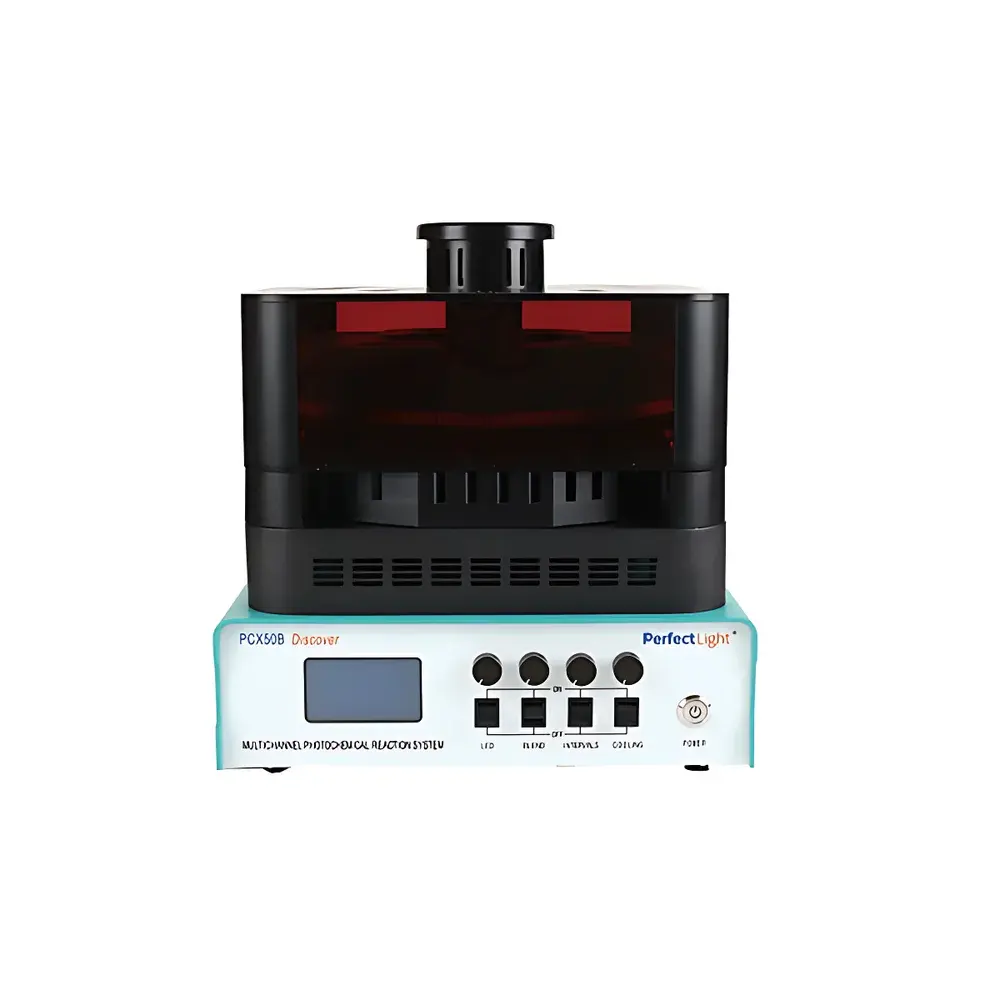
PerfectLight PCX50B Discover Multi-Channel Parallel Photocatalytic Reaction System
| Brand | PerfectLight |
|---|---|
| Origin | Beijing, China |
| Manufacturer Type | Authorized Distributor |
| Product Origin | Domestic (China) |
| Model | PCX50B Discover |
| Reaction Units | 9 |
| Reaction Volume | 50 mL (standard) |
| Light Source Power | 5 W × 9 |
| Wavelength Options | 365, 385, 420, 450, 485, 520, 535, 595, 620, 630, 760, 880, 940 nm (customizable combinations) |
| Illumination Geometry | Bottom-incident, quartz-bottom vials |
| Temperature Control | Integrated high-speed turbine air cooling, ≤ ambient + 5 °C |
| Stirring Speed | 0–500 rpm (synchronized across all positions) |
| Vial Pressure Rating | 0.05 MPa |
| Input Voltage | 220 VAC / 50 Hz |
Overview
The PerfectLight PCX50B Discover is an engineered multi-channel parallel photocatalytic reaction system designed for high-throughput screening and quantitative kinetic studies in heterogeneous and homogeneous photocatalysis. It operates on the principle of controlled bottom-incident illumination—where monochromatic or polychromatic light is delivered vertically through optical-grade fused quartz vial bottoms—to ensure uniform photon flux distribution across all nine reaction positions. This geometry eliminates optical path length variation caused by curved sidewalls and maximizes photon utilization via integrated reflective cup structures beneath each vial. The system supports both liquid-phase and gas-phase reactions under programmable atmospheres (vacuum, inert, or reactive), enabling rigorous experimental replication under ISO/IEC 17025-aligned laboratory conditions. Its architecture complies with fundamental requirements for GLP-compliant photoreactor validation, including spatial irradiance homogeneity, thermal stability, and mechanical synchronization of agitation.
Key Features
- 9-position parallel reaction platform with fixed vial alignment for reproducible sampling (gas/liquid) and minimal positional bias;
- Optical-grade quartz-bottom vials (standard 50 mL; optional 1.5–10 mL variants) ensuring >92% UV–NIR transmission and consistent optical path length;
- Modular LED lamp disk with individually collimated optics: each emitter features a precision-matched lens to lock focal plane position, minimizing inter-channel irradiance deviation;
- Circular rotational motion of the irradiation module compensates for inherent LED output variance, achieving <±3% irradiance uniformity (measured per ASTM E2628-20);
- Synchronized magnetic stirring driven by microcontroller–mechanical coupling, maintaining identical rotational speed (0–500 rpm) across all positions with ±2 rpm repeatability;
- Integrated high-velocity air-cooling system maintains temperature stability within ±0.5 °C of ambient, eliminating need for external chillers or cryogenic interfaces;
- Configurable sealing caps (B1–B4) supporting degradation studies, single/dual-port sampling, atmosphere control integration, and small-volume reaction formats.
Sample Compatibility & Compliance
The PCX50B Discover accommodates diverse sample matrices including aqueous suspensions of TiO₂, g-C₃N₄, or MOF-based photocatalysts; organic dye solutions (e.g., RhB, MB); CO₂-saturated electrolytes; and VOC-laden gas streams. All wetted components comply with USP Class VI biocompatibility standards. Quartz vials meet ASTM F799-21 specifications for optical clarity and thermal shock resistance. The system supports method validation per ISO 10678:2010 (photocatalytic activity measurement) and enables quantum yield determination via actinometry (using potassium ferrioxalate or Aberchrome 540). When paired with optional AC1000 or PLA-MAC1005 atmosphere controllers, it satisfies OSHA PEL and EPA Method TO-17 requirements for trace gas handling.
Software & Data Management
While the base PCX50B Discover operates via front-panel digital interface, it is fully compatible with PerfectLight’s optional PLA-ControlSuite™ software (v3.2+), which provides time-stamped logging of irradiance intensity (via integrated photodiode array), temperature, stirring speed, and user-defined protocol sequences. Audit trails conform to FDA 21 CFR Part 11 requirements when deployed with electronic signatures and role-based access control. Raw irradiance data export supports post-hoc spectral weighting calculations (e.g., AM1.5G, CIE photopic), facilitating direct comparison with literature-reported apparent quantum efficiencies (AQE).
Applications
- Quantitative evaluation of H₂/O₂ evolution rates in water splitting systems (ASTM D1976-22 compliant setup);
- CO₂ photoreduction to CH₄, CO, or C₂H₄ under tunable visible/NIR excitation;
- Kinetic modeling of organic pollutant degradation (e.g., phenol, nitrobenzene) using pseudo-first-order rate constants;
- Benchmarking of photocatalyst stability via cyclic irradiation–dark interval testing;
- High-throughput optimization of co-catalyst loading, pH, sacrificial agent concentration, and light intensity;
- Photoinduced isomerization and redox-mediated polymerization initiation studies.
FAQ
Can the PCX50B Discover be used for gas-phase photocatalysis?
Yes—equipped with B3 dual-port caps and connected to an optional PLA-MAC1005 multi-gas controller, it supports continuous-flow or batch-mode gas-phase reactions (e.g., NOₓ abatement, formaldehyde oxidation).
Is spectral irradiance calibration included?
No—calibration requires external NIST-traceable spectroradiometer (e.g., Ocean Insight HDX). PerfectLight provides recommended measurement protocols per ISO/IEC 17025 Annex A.
What is the maximum operating pressure inside the vials?
0.05 MPa absolute—suitable for near-ambient photoelectrochemical studies but not high-pressure hydrogenation.
Are replacement lamp disks field-swappable?
Yes—modular design allows full lamp disk exchange in <90 seconds without tools or realignment.
Does the system support automated sampling?
Yes—PLA-GPA1000 robotic autosampler integrates via RS-485 and synchronizes with illumination cycles for time-resolved product analysis.



