
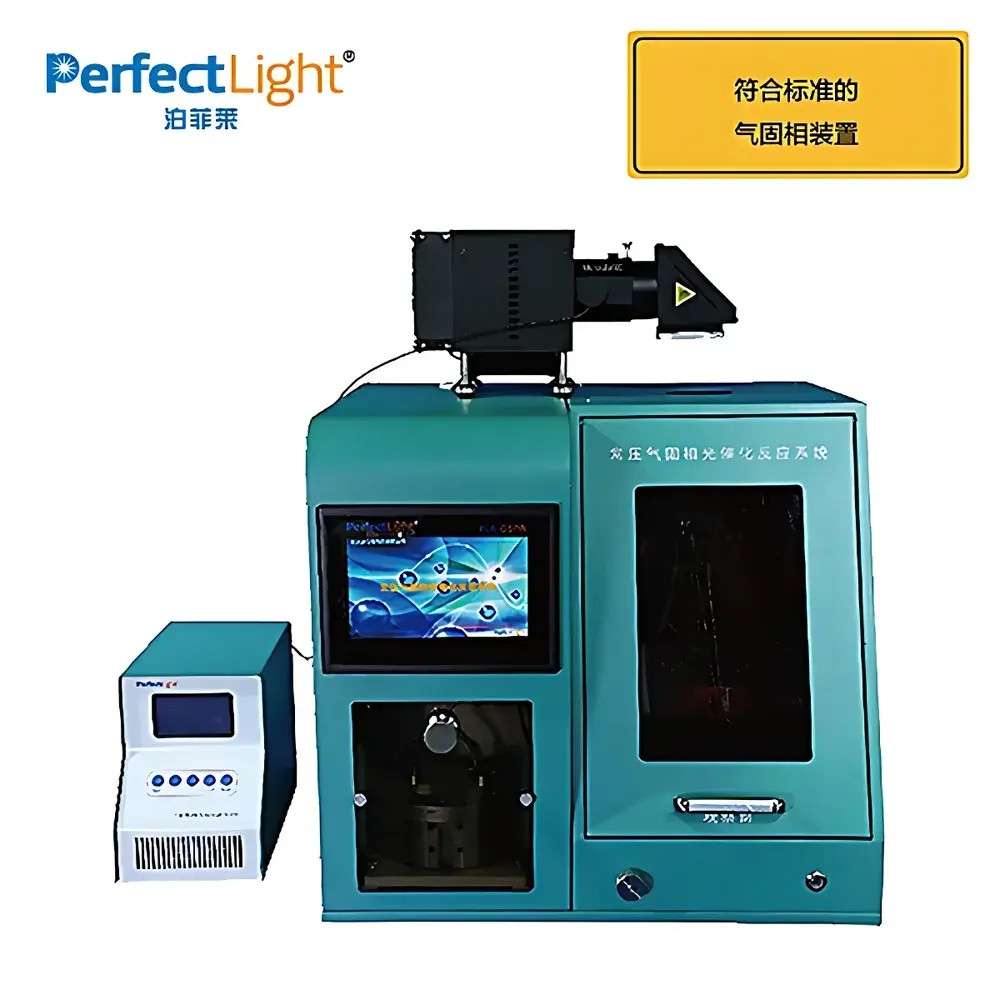
PerfectLight PLR-GSPR Ambient-Pressure Gas-Solid Phase Photocatalytic Reaction System
| Brand | PerfectLight |
|---|---|
| Origin | Beijing, China |
| Model | PLR-GSPR |
| Humidity Control Range | 5–95% RH (±3% RH accuracy) |
| Reactor Dimensions | 250 × 120 × 40 mm³ |
| Gas Flow Control | 4 independent mass flow channels (expandable to 8), ±1% F.S. accuracy |
| Display | 8.5-inch LED touchscreen interface |
| Temperature Monitoring Resolution | 0.01°C |
| Pressure Detection Range | 1–200 kPa (±0.2 kPa) |
| Light Window | Quartz glass, 50 × 100 mm² active area |
| Cooling | Integrated bottom-mounted water-cooled thermal control |
| Compliance | Designed in alignment with GB/T 39716–2020 for photocatalytic air purification performance testing |
Overview
The PerfectLight PLR-GSPR Ambient-Pressure Gas-Solid Phase Photocatalytic Reaction System is an engineered platform for controlled, reproducible investigation of heterogeneous photocatalytic processes under ambient pressure conditions. It operates on the principle of gas-phase reactant diffusion to a solid photocatalyst surface under irradiation—enabling quantitative study of reaction kinetics, mass transfer limitations, and humidity-dependent mechanistic pathways. Specifically designed for CO₂ photoreduction, VOC degradation (e.g., formaldehyde, NOₓ, SOₓ), and general low-temperature photochemical transformations, the system integrates precision gas conditioning, real-time environmental monitoring, and thermally stabilized reactor architecture. Unlike batch or slurry-based systems, the PLR-GSPR employs a continuous-flow, closed-loop gas circulation mode with forced convection—ensuring uniform catalyst exposure, minimized boundary layer resistance, and high interfacial collision frequency between gaseous reactants and active sites.
Key Features
- Precision Humidity Feedback Control: Dual-sensor configuration (inlet and optional outlet) enables real-time monitoring of temperature, relative humidity (5–95% RH, ±1% RH accuracy), and pressure (1–200 kPa, ±0.2 kPa). A dedicated humidification column with programmable liquid feed and vapor equilibration ensures stable, traceable moisture delivery—critical for probing water’s dual role as reactant and deactivation agent in CO₂ reduction.
- Optimized Mass Transfer Architecture: The flat-panel reactor (50 × 100 × 5 mm³ reaction volume for membrane substrates; 50 × 100 × 10 mm³ for porous media) reduces diffusion path length from bulk gas to catalyst surface by >60% compared to cylindrical configurations. Combined with through-gas flow design and integrated recirculation pump, it achieves near-uniform velocity distribution and eliminates stagnant zones.
- Modular Gas Delivery & Sensing: Four independently controlled mass flow controllers (MFCs), each calibrated to ±1% F.S. with repeatability of ±0.5% F.S., support multi-component gas blending (e.g., CO₂/N₂/H₂/O₂ mixtures). Optional expansion to eight standard gas channels accommodates complex stoichiometric studies. All MFCs operate within 4–100% F.S. range with ≤3.5 kPa pressure drop at 1 L/min.
- Thermal Stability & Optical Integration: Bottom-mounted water-jacketed cooling maintains reactor temperature within ±0.5°C across operating ranges (5–95°C). Quartz optical window (50 × 100 mm², UV–Vis transparent) allows collimated or focused irradiation from external light sources (Xe, LED, or solar simulators) without spectral attenuation.
- Intuitive Human-Machine Interface: An 8.5-inch industrial-grade LED touchscreen provides full system supervision—including real-time sensor trends, stepwise protocol execution, alarm logging, and manual override. Software is built on a ROM-based embedded framework supporting deterministic sensor feedback loops and audit-trail-capable operation logs.
Sample Compatibility & Compliance
The PLR-GSPR supports three primary catalyst formats: (1) thin-film membranes (100 × 50 × 5 mm³, deposited on glass or quartz substrates), (2) monolithic blocks (100 × 50 × 1–10 mm³), and (3) powder-loaded filter media (pressed onto 100 × 50 mm² supports). Reactor chamber materials include corrosion-resistant alloy (standard) and PTFE-lined variants (optional) for aggressive halogenated or acidic environments. The system was utilized as a reference apparatus during development of GB/T 39716–2020, the national standard for photocatalytic air purification performance evaluation—specifically for NOₓ removal quantification. While not certified to ISO/IEC 17025 or GLP, its sensor calibration traceability, data logging integrity, and parameter reproducibility align with pre-validation requirements for academic and industrial R&D laboratories conducting ASTM E2912-compliant photocatalytic activity assessments.
Software & Data Management
Control firmware implements a deterministic real-time loop architecture with sub-second sensor polling intervals. All analog inputs (humidity, temperature, pressure, flow) are digitized at 16-bit resolution and timestamped using internal RTC synchronized to UTC via optional NTP. Data export is supported in CSV and HDF5 formats, preserving metadata (sensor IDs, calibration coefficients, user-defined experiment tags). The software enforces write-once logging for critical parameters—supporting retrospective analysis and partial compliance with FDA 21 CFR Part 11 principles (electronic signatures and audit trails require external identity management integration). Remote monitoring is achievable via Ethernet-connected industrial gateway (not included), enabling integration into centralized lab informatics platforms.
Applications
- Quantitative investigation of H₂O co-reactant effects on CO₂ photoreduction selectivity (CO vs. CH₄ vs. C₂H₄) and quantum yield.
- Structure–activity relationship studies of TiO₂-, g-C₃N₄-, or MOF-based photocatalysts under industrially relevant gas compositions and humidity profiles.
- Accelerated aging tests of photocatalytic filters under cyclic humidity and pollutant loading (e.g., formaldehyde + NOₓ mixtures).
- Method development for in situ product analysis—compatible with downstream GC-TCD/FID (for CO, CO₂, CH₄), IC (for NO₃⁻, NH₄⁺), and PAS (for ppb-level NO, SO₂).
- Validation of computational fluid dynamics (CFD) models for gas–solid photocatalytic reactors, leveraging its well-characterized geometry and boundary conditions.
FAQ
What types of light sources can be coupled with the PLR-GSPR?
The system accepts external illumination via its standardized quartz window. Compatible sources include 300–800 nm LED arrays, 150–300 W Xe arc lamps with AM1.5G filters, and collimated solar simulators. No internal lamp housing is provided.
Is the humidity control system validated against gravimetric standards?
Yes—factory calibration includes NIST-traceable chilled-mirror hygrometer cross-checks across the 5–95% RH range. Certificate of calibration is supplied with each unit.
Can the system operate under vacuum or elevated pressure?
No. The PLR-GSPR is strictly rated for ambient-pressure operation (100 ± 5 kPa absolute). Sealing integrity is verified to ≤1 × 10⁻⁴ mbar·L/s He leak rate.
How is catalyst deactivation monitored during long-term runs?
By correlating time-resolved outlet gas composition (via optional inline GC/IC) with concurrent humidity, temperature, and flow stability metrics—enabling discrimination between kinetic decay and physical fouling.
Does the software support custom protocol scripting?
Yes—Python-based macro scripting is available via RS-232/USB serial interface, allowing conditional logic (e.g., “if RH drifts >±2%, adjust liquid feed rate by X%”) and automated multi-step experiments.



