
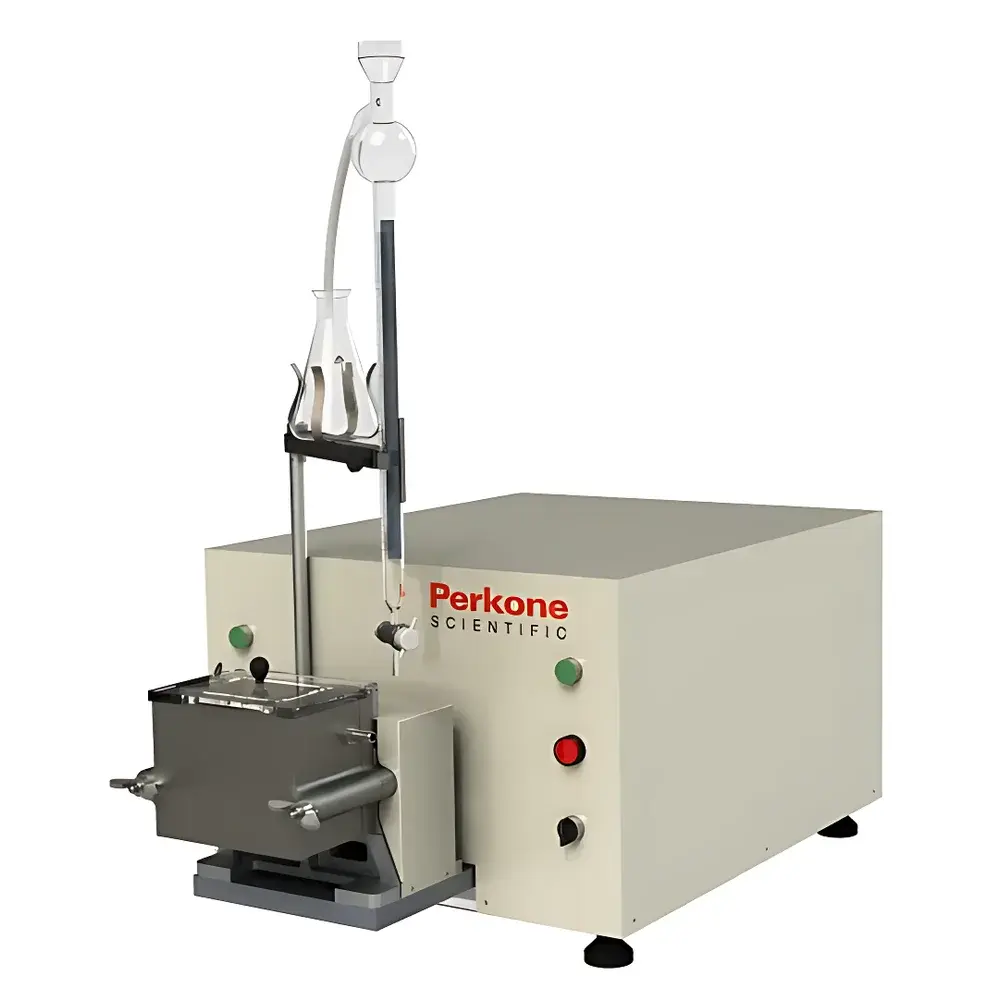
Perkone PF-E Electronic Farinograph
| Brand | Perkone |
|---|---|
| Origin | Zhejiang, China |
| Manufacturer Type | Authorized Distributor |
| Country of Origin | China |
| Model | PF-E |
| Price Range | USD 7,000 – 14,000 |
| Mixing Bowl Capacity | 300 g |
| Torque Range | 0–1000 FU |
| Torque Accuracy | ≤0.5% of full scale |
| Torque Measurement | Electronic transducer |
| Main Mixer Blade Speed | 63 rpm |
| Auxiliary Mixer Blade Speed | 94.5 rpm |
| Mixing Bowl & Blades | German-sourced hardened stainless steel (corrosion- and wear-resistant, >10-year service life) |
| Dropper Tip Material | PTFE |
| Interchangeable Mixing Heads | Yes |
| Includes | Farinograph主机, thermal printer, water supply unit, thermostatic water bath (±0.2°C stability), dual calibrated burettes, proprietary farinogram analysis software |
Overview
The Perkone PF-E Electronic Farinograph is a precision-engineered instrument designed for standardized rheological assessment of wheat flour dough during controlled hydration and mixing. Based on the internationally recognized Brabender farinograph principle—measuring torque resistance of dough under defined mechanical shear—the PF-E delivers reproducible farinograms that quantify key functional parameters including water absorption, dough development time, stability, mixing tolerance index (MTI), and degree of softening. Engineered for compliance with ISO 5530-1, AACC Method 54-21, and ICC Standard No. 115, the PF-E supports routine quality control in flour mills, bakery R&D labs, grain inspection agencies, and feed formulation centers where consistent dough behavior prediction is critical to process optimization and product specification adherence.
Key Features
- High-stability dual-blade mixing system: main blade rotates at 63 rpm, auxiliary blade at 94.5 rpm—mimicking industrial spiral mixers while ensuring uniform shear distribution across the 300 g sample mass.
- Electronic torque transduction with ±0.5% full-scale accuracy over 0–1000 FU range—enabling detection of subtle rheological transitions during dough formation and breakdown.
- Corrosion- and wear-resistant mixing bowl and blades fabricated from vacuum-melted, heat-treated German stainless steel—validated for >10 years of continuous operation under high-salt, high-protein flour matrices.
- PTFE-coated burette tips ensure precise, non-reactive titration of water addition—eliminating adsorption artifacts and supporting trace-level repeatability.
- Real-time foreign object intrusion detection coupled with instantaneous torque anomaly response—automatically halting rotation if resistance exceeds programmable thresholds, meeting IEC 61000-6-2 EMC and EN 61000-6-4 safety requirements.
- Modular head design allows rapid interchange of mixing geometries—including standard Brabender-type, high-shear, and low-volume configurations—for method flexibility across wheat classes, gluten-free blends, and composite flours.
Sample Compatibility & Compliance
The PF-E accommodates all milled cereal-based materials compliant with ISO 27971 (flour sampling) and ISO 712 (moisture determination). It supports testing of hard/soft red/white wheats, durum semolina, rye, spelt, oat, and fortified or enzymatically modified flours. Instrument validation protocols align with GLP documentation standards, and raw torque data output meets FDA 21 CFR Part 11 requirements for electronic records and signatures when used with audit-trail-enabled software configuration. All electrical components carry CE marking per Directive 2014/30/EU (EMC) and 2014/35/EU (LVD).
Software & Data Management
The bundled FarinoSoft™ v3.2 application provides automated farinogram acquisition, baseline correction, peak identification, and parameter extraction per AACC/ISO definitions. Data export supports CSV, XML, and PDF formats—with embedded metadata (operator ID, timestamp, ambient RH/temp, calibration certificate ID). Version-controlled method templates enable lab-wide standardization; user permission levels support role-based access (e.g., analyst vs. QA supervisor). Software logs all parameter changes, manual overrides, and calibration events with tamper-proof timestamps—fully auditable for ISO/IEC 17025 accreditation assessments.
Applications
- Flour mill QC: real-time release testing against contractual water absorption and stability limits.
- Bakery R&D: screening cultivars for dough strength retention during extended fermentation or frozen storage.
- Ingredient supplier qualification: verifying enzyme (e.g., xylanase, glucose oxidase) dose-response curves via MTI modulation.
- Regulatory compliance: generating evidence for national grain grading systems (e.g., China GB/T 1355, USW Grain Standards).
- Academic research: correlating farinograph profiles with SDS-PAGE glutenin subunit patterns or NIR-predicted protein quality indices.
FAQ
What standards does the PF-E comply with for official flour testing?
The PF-E conforms to ISO 5530-1:2021, AACC International Method 54-21.02, and ICC Standard No. 115, and supports method validation per ISO/IEC 17025:2017 Annex B.
Can the PF-E be integrated into a LIMS environment?
Yes—via configurable ODBC drivers and HL7-compliant XML schema export, enabling bidirectional data exchange with major laboratory information management systems.
Is routine calibration required, and what documentation is provided?
A factory-issued calibration certificate traceable to NIM (China National Institute of Metrology) is supplied; annual recalibration using certified torque standards (e.g., Fluke 4040) is recommended and supported by Perkone’s global service network.
How is temperature stability maintained during long-duration tests?
The integrated thermostatic water bath maintains ±0.2°C stability across 25–40°C operating range, verified per ASTM E2251-18 Annex A1 for thermal uniformity in dough rheology instrumentation.
Does the software support multi-language interfaces?
FarinoSoft™ v3.2 includes English, Spanish, French, German, and Simplified Chinese UI options—configured at installation without additional licensing.





