
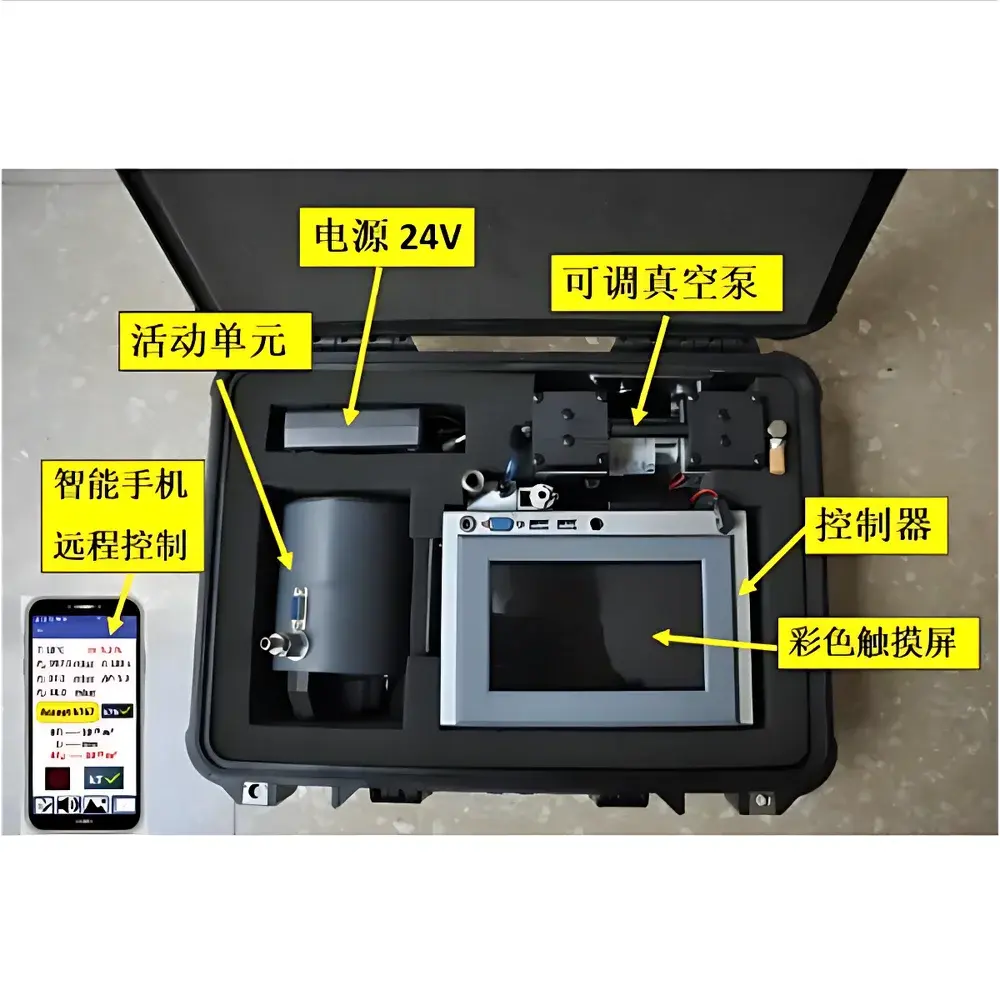
PermeaTORR AC+ Air Permeability Coefficient Tester for Concrete Surfaces
| Brand | Controls (Europe) |
|---|---|
| Origin | Germany |
| Model | PermeaTORR AC+ |
| Power Supply | 24 Vdc / 3 Adc |
| Weight (pump + case) | 10 kg |
| Data Storage | ≥1000 test records (internal microSD) |
| Interface | Touchscreen display + Bluetooth-enabled mobile remote control |
| Vacuum Source | Integrated oil-free miniature vacuum pump |
| Hose Length | Fixed-length flexible hose up to 5 m |
| Compliance | GB/T 50082–2024, SIA 261/1:2019, ASTM C1202, EN 12390-8, Cembureau O₂ permeability protocol |
Overview
The PermeaTORR AC+ Air Permeability Coefficient Tester is an engineered field and laboratory instrument designed to quantify the air permeability coefficient (kT) of near-surface concrete in accordance with standardized gas diffusion principles. It operates on a controlled-pressure differential method: a defined vacuum is applied across a sealed test cell placed directly on the concrete surface, and the resulting airflow rate under steady-state conditions is measured to calculate kT (in µm² or m²). This non-destructive, in-situ technique provides rapid assessment of near-surface pore structure connectivity — a critical indicator of long-term durability against chloride ingress, carbonation, freeze-thaw degradation, and moisture transport. Unlike destructive core sampling or time-intensive lab-based gas permeability tests, the PermeaTORR AC+ delivers repeatable, operator-independent measurements within minutes per location, making it suitable for quality assurance during construction, forensic evaluation of existing structures, and service-life modeling of heritage buildings.
Key Features
- Active Cell (AC+) architecture: All pressure regulation, valve actuation, and equilibrium monitoring occur inside the sealed test cell — eliminating external hose compliance errors and ambient pressure drift.
- High-fidelity dual-pressure sensing: Simultaneous measurement of inlet pressure (Pi) and exhaust pressure (Pe) enables precise correction for compressibility effects and improves kT calculation accuracy by >15% compared to single-point pressure systems.
- Integrated oil-free miniature vacuum pump: Ensures consistent vacuum generation without lubricant contamination, stable performance across temperature ranges (−10 °C to +40 °C), and maintenance-free operation over ≥50,000 cycles.
- Fixed-length, low-compliance hose (up to 5 m): Minimizes volumetric expansion artifacts and eliminates calibration dependency on variable hose routing.
- 24 Vdc / 3 Adc power architecture: Complies with IEC 61000-6-4 emission standards and supports safe operation in wet or confined environments without risk of electric shock.
- 10.1-inch capacitive touchscreen interface: Displays real-time pressure curves, kT trend plots, pass/fail status per SIA 261/1:2019 thresholds, and embedded guidance prompts.
- Bluetooth 5.0 + dedicated mobile app: Enables single-operator remote initiation, live data streaming, voice-tagged annotations, and photo/video documentation synchronized with test metadata.
- Internal microSD card (≥32 GB): Stores ≥1000 full test records including timestamps, GPS coordinates (when enabled), environmental parameters (T, RH), operator ID, and raw sensor logs.
Sample Compatibility & Compliance
The PermeaTORR AC+ is validated for use on cast-in-place, precast, and repaired concrete surfaces with compressive strengths from 20 to 80 MPa and surface moisture contents ≤5% by mass. Its sealed-cell geometry accommodates uneven substrates up to 3 mm peak-to-valley roughness. The system also supports testing of other low-permeability porous media including fired clay bricks, natural stone (e.g., limestone, sandstone), ceramic tiles, and stabilized earth blocks — provided surface planarity permits reliable gasket sealing. Regulatory alignment includes: GB/T 50082–2024 (China’s standard for long-term performance and durability testing of concrete), SIA 261/1:2019 (Swiss structural design code specifying maximum allowable kT values for exposure classes XD3/XF4), ASTM C1202 (for correlation with chloride ion penetration), EN 12390-8 (water permeability), and Cembureau-recommended O2 permeability protocols. All firmware and calibration routines are traceable to NIST-traceable pressure standards.
Software & Data Management
Data acquisition and reporting conform to GLP-compliant workflows. Each test record contains audit-trail metadata: user login (PIN or RFID), device serial number, firmware version, calibration certificate expiry date, ambient temperature/humidity (via integrated sensors), and digital signature of test completion. Export formats include CSV (for statistical analysis in Minitab or Python), PDF reports (with embedded test images and pass/fail flags per project-specific limits), and XML (compatible with BIM-integrated asset management platforms such as Bentley Systems ProjectWise or Autodesk Construction Cloud). Firmware updates are delivered via encrypted USB stick or OTA (over-the-air) through the mobile app — all updates undergo SHA-256 integrity verification prior to installation. No cloud storage is mandatory; local data sovereignty is preserved unless explicitly configured by the user.
Applications
- Quality control of new concrete placements: Verification of curing effectiveness, admixture impact on near-surface densification, and compliance with specification-defined kT thresholds before formwork removal.
- Service-life prediction of aging infrastructure: Correlation of kT gradients with carbonation depth profiles and chloride concentration maps to feed probabilistic deterioration models (e.g., fib Model Code 2020).
- Heritage conservation diagnostics: Non-invasive assessment of repair mortar compatibility, consolidation treatment efficacy, and long-term exposure history of historic masonry-concrete hybrids.
- Research validation: Benchmarking of novel supplementary cementitious materials (SCMs), nanosilica treatments, and hydrophobic impregnations under accelerated weathering protocols.
- Third-party certification: Supporting ISO/IEC 17025-accredited laboratories in delivering accredited kT test reports for EN 1504-9 compliance declarations.
FAQ
What physical principle does the PermeaTORR AC+ use to determine air permeability?
It applies Darcy’s law for compressible gas flow through porous media under transient pressure decay, corrected for Knudsen diffusion effects at low permeabilities (<10−16 m²), using simultaneous Pi/Pe measurement and active cell equilibrium control.
Is calibration required before each test?
No — the system performs automatic zero-drift compensation and internal reference pressure validation at startup; full recalibration is recommended every 12 months or after 2000 test cycles, traceable to NIST SRM 2810.
Can the device be used on vertical or overhead surfaces?
Yes — the magnetic base and vacuum-assisted seal enable stable adhesion on clean, ferromagnetic substrates; non-magnetic surfaces require optional mechanical clamping fixtures.
Does the software support multi-user role-based access?
Yes — administrator, technician, and reviewer roles are configurable with separate password policies and editable permissions for data export, report generation, and calibration logging.
How is measurement uncertainty quantified?
Combined standard uncertainty (k=2) is ±8.3% for kT values between 1×10⁻¹⁶ and 5×10⁻¹⁵ m², derived from Type A (repeatability) and Type B (pressure sensor accuracy, temperature drift, seal integrity) components per GUM (JCGM 100:2008).



