
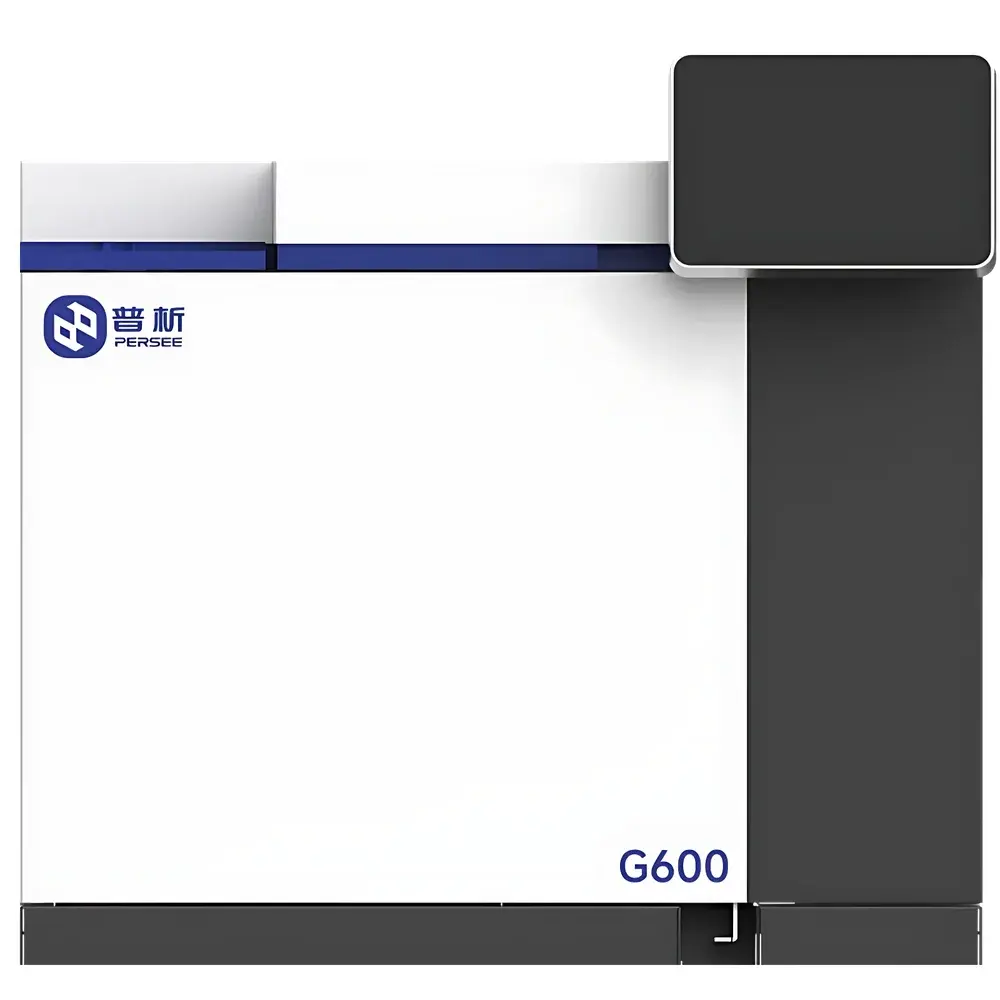
Persee G600 Laboratory Gas Chromatograph
| Brand | Persee |
|---|---|
| Origin | Beijing, China |
| Manufacturer Type | Direct Manufacturer |
| Instrument Type | Benchtop Laboratory Gas Chromatograph |
| Model | G600 |
| Temperature Control Range | 7 °C above ambient to 400 °C |
| Oven Ramp Rate | 0.1–40 °C/min (adjustable in 0.1 °C increments) |
| Maximum Injector Temperature | 450 °C |
| Injector Configuration | Up to three independently configurable inlets |
| Column Oven Cooling | Forced-air active cooling |
| Detector Options | FID, TCD, ECD, PID (field-selectable) |
| Compliance | GLP/GMP-ready software audit trail, 21 CFR Part 11–compatible data handling |
Overview
The Persee G600 is a modular, benchtop gas chromatograph engineered for precision, reproducibility, and method flexibility in academic research laboratories, quality control environments, and industrial R&D settings. Based on classical capillary and packed-column gas chromatography principles, the G600 separates volatile and semi-volatile compounds via differential partitioning between a mobile phase (carrier gas—typically helium, hydrogen, or nitrogen) and a stationary phase coated inside fused-silica capillary columns. Its thermally stable oven architecture, coupled with high-fidelity temperature ramping (0.1–40 °C/min), enables robust retention time reproducibility across complex multi-component mixtures—critical for applications ranging from catalytic reaction monitoring to ultra-trace impurity profiling in high-purity gases.
Key Features
- Triple-inlet configuration: Supports simultaneous installation of up to three independent injection ports—including split/splitless, cool-on-column, and programmable temperature vaporizer (PTV) options—enabling method parallelization and cross-validation without hardware reconfiguration.
- High-temperature column oven: Operates from 7 °C above ambient to 400 °C with forced-air cooling, achieving <3.5 min cooldown from 400 °C to 50 °C—significantly reducing cycle time for high-throughput screening.
- Intelligent touchscreen interface: 7-inch capacitive color display with intuitive icon-driven navigation; supports method template import/export, real-time chromatogram overlay, and embedded diagnostic logs.
- Microfluidic flow switching module: Integrated pressure-controlled valve manifold minimizes dead volume and carrier gas leakage, ensuring baseline stability and retention time repeatability (RSD < 0.05% over 24 h).
- Detector modularity: Hot-swappable detector bays accommodate flame ionization (FID), thermal conductivity (TCD), electron capture (ECD), and photoionization (PID) detectors—all with factory-calibrated response factors traceable to NIST SRMs.
Sample Compatibility & Compliance
The G600 accommodates gaseous, liquid, and solid samples via headspace, purge-and-trap, or direct injection protocols. It has been validated for analysis of light hydrocarbons (C₁–C₄), permanent gases (H₂, O₂, N₂, CO, CO₂, CH₄), and catalytic effluents including ethylene, acetylene, and ethane—common in photocatalytic CO₂ reduction studies and high-purity hydrogen certification workflows. All hardware and firmware comply with IEC 61000-6-3 (EMC) and IEC 61010-1 (safety). The chromatography data system (CDS) implements full 21 CFR Part 11 compliance: electronic signatures, role-based access control, immutable audit trails, and automated backup verification—fully auditable for GLP and GMP-regulated environments.
Software & Data Management
The Persee ChromaSuite™ workstation provides multi-channel acquisition (up to 8 analog inputs), real-time spectral deconvolution, and customizable reporting templates. It supports ISO/IEC 17025-aligned calibration workflows, including multi-point external standard curves, internal standard normalization, and area-normalized relative response factor (RRF) tables. Data processing includes negative peak inversion, dynamic baseline correction (adaptive polynomial fitting), spectral overlay with delta-Rt alignment, and automated peak integration using valley-to-valley and tangent skim algorithms. Reports are exportable in PDF, CSV, and XML formats—with bilingual (English/Chinese) layout options and configurable metadata fields for instrument, operator, and sample traceability.
Applications
- Photocatalysis research: Quantification of gaseous products (H₂, O₂, CO, CO₂, C₂H₄, CH₄) in solar-driven CO₂ reduction reactors.
- High-purity gas certification: Detection and quantitation of ppm-level impurities (O₂+Ar, N₂, CO, CO₂, CH₄) in semiconductor-grade H₂ per SEMI F63 and ISO 8573-8.
- Petrochemical QA/QC: Hydrocarbon group-type analysis (PIONA), sulfur compound profiling (mercaptans, sulfides), and benzene/toluene/xylenes (BTX) determination in reformate streams.
- Environmental monitoring: EPA Method 8021B-compliant analysis of volatile organic compounds (VOCs) in ambient air and soil headspace.
- Pharmaceutical residual solvent testing: USP compliant analysis of Class 1–3 solvents (e.g., chloroform, acetone, ethanol) in drug substances.
FAQ
What carrier gases are supported, and how is flow controlled?
Helium, hydrogen, and nitrogen are fully supported. Electronic pressure control (EPC) modules regulate inlet pressure, column head pressure, and detector make-up gas with ±0.01 psi accuracy and real-time feedback compensation.
Can the G600 be integrated into a LIMS environment?
Yes—ChromaSuite™ supports ASTM E1578-compliant LIMS connectivity via HL7 and ASTM E2500-07 data exchange protocols, including structured result transmission and bidirectional sample ID synchronization.
Is method transfer possible from other GC platforms?
Method translation tools support import of Agilent ChemStation (.msd), Thermo Xcalibur (.raw), and Shimadzu GCMSsolution (.qgd) methods, automatically mapping temperature programs, detector parameters, and integration events.
What maintenance intervals are recommended for routine operation?
Injector liner replacement every 200 injections; column trimming every 500 runs; detector cleaning every 1,000 hours of operation; annual calibration verification against certified gas standards per ISO/IEC 17025 Annex A.3.
Does the system support unattended overnight operation?
Yes—the G600 features built-in power-loss recovery, auto-shutdown after final run completion, and remote status monitoring via Ethernet or optional Wi-Fi module with SNMP v3 support.






