
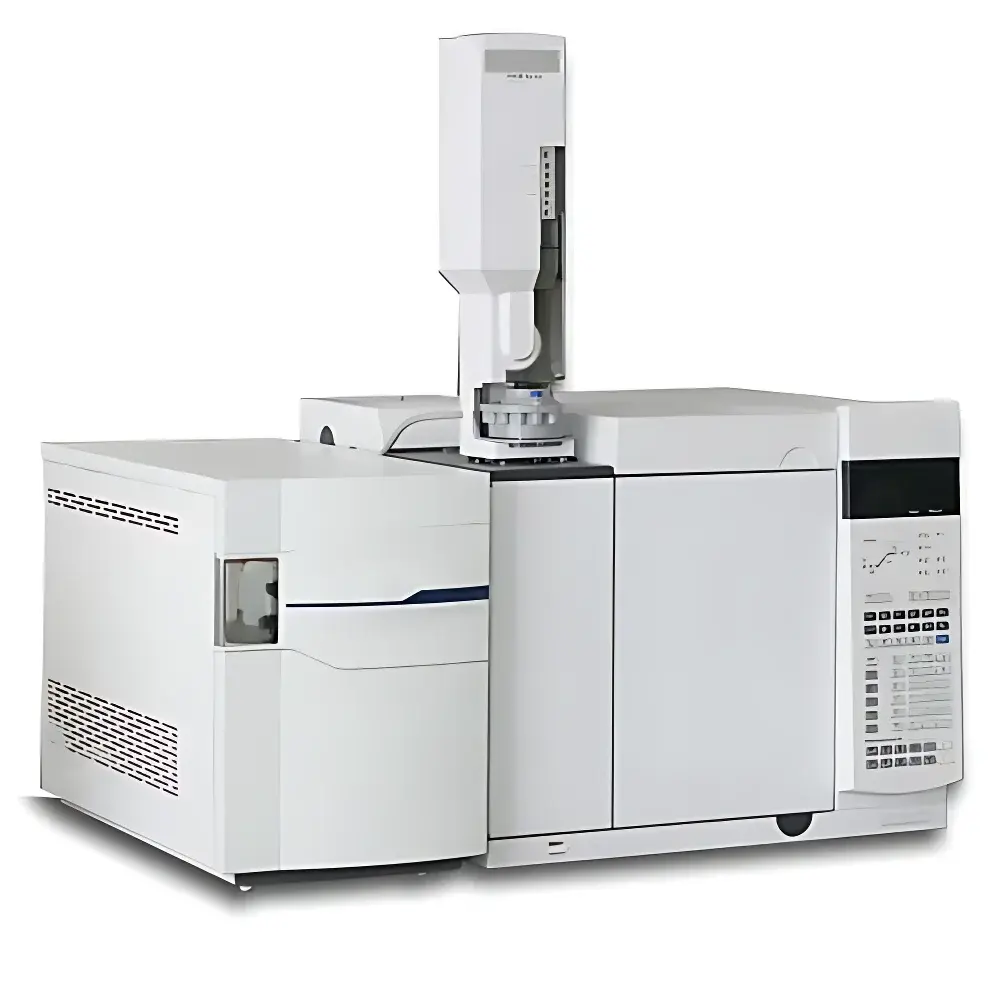
Persee M6 Single Quadrupole Gas Chromatography-Mass Spectrometer
| [Brand | Persee |
|---|---|
| Origin | Beijing, China |
| Manufacturer Type | OEM Manufacturer |
| Instrument Type | Single Quadrupole GC-MS |
| GC Platform | Agilent 7890A |
| Mass Range | 1.5–1050 amu |
| Mass Accuracy | ±0.1 amu |
| Resolution | Unit Mass Resolution (R = 1000, W₁/₂ < 1 amu) |
| S/N (EI) | ≥150:1 RMS (5 pg OFN full scan, m/z 272 |
| Mass Stability | ±0.1 amu over 48 h |
| Max Scan Speed | 10,000 amu/s |
| Vacuum System | Dual-stage — GLD-N201 forepump (4 L/s) + Pfeiffer TMH071P (60 L/s) or TMH262P (210 L/s) turbomolecular pump |
| Ion Source | Heated EI source, 350 °C max, 10–100 eV electron energy, 200 µA emission current |
| Detector | High-voltage conversion dynode electron multiplier with composite I/V amplifier |
| Control Interface | 100 Mbps Ethernet, 32-bit embedded real-time OS |
| Software | Persee ChemStation v3.x (NIST08 library integrated)] |
Overview
The Persee M6 Single Quadrupole Gas Chromatography-Mass Spectrometer (GC-MS) is a benchtop analytical platform engineered for routine qualitative and quantitative analysis of volatile and semi-volatile organic compounds. It integrates a purpose-built single quadrupole mass spectrometer with the industry-standard Agilent 7890A gas chromatograph, delivering robust performance in regulated and research laboratory environments. The system operates on electron ionization (EI) principles, where analyte molecules eluting from the GC column are ionized by controlled electron bombardment, and resulting ions are mass-filtered through a precision metal quadrupole mass analyzer before detection. This architecture ensures high reproducibility, long-term mass stability, and compatibility with established regulatory workflows—including those governed by EPA Method 8270, ASTM D5845, and ISO 17993—when configured with appropriate method validation protocols.
Key Features
- Modular vacuum architecture: Dual-stage vacuum system comprising a GLD-N201 oil-sealed rotary vane forepump (4 L/s) and either a Pfeiffer TMH071P (60 L/s) or TMH262P (210 L/s) magnetically levitated turbomolecular pump. Enables rapid pump-down, low background noise, and minimized memory effects.
- Thermally stabilized EI ion source: Independently heated to 350 °C, with adjustable electron energy (10–100 eV), programmable emission current (up to 200 µA), and tool-free insertion/removal for maintenance.
- High-fidelity quadrupole mass analyzer: Precision-machined metal rods with integrated pre-filter quadrupole operated under dynamic voltage compensation, improving ion transmission efficiency and reducing contamination of the main mass filter.
- Low-noise detection system: Electron multiplier with high-voltage conversion dynode stage and custom composite I/V signal amplification circuitry, achieving ≥150:1 RMS signal-to-noise ratio in both full-scan and selected-ion monitoring (SIM) modes.
- Digital control infrastructure: 32-bit embedded real-time operating system with 100 Mbps Ethernet interface, supporting remote instrument operation, multi-user network access, and audit-ready event logging.
Sample Compatibility & Compliance
The M6 GC-MS accepts standard 0.25–0.53 mm ID fused-silica capillary columns and supports common stationary phases (e.g., DB-5ms, HP-5MS, Rxi-5Sil MS). It accommodates liquid samples via Agilent 7683 autosampler (optional) and is compatible with derivatization workflows for polar or thermally labile analytes. From a compliance standpoint, the system’s software architecture supports user-level permission controls, electronic signature capability, and configurable audit trails—enabling alignment with FDA 21 CFR Part 11 requirements when deployed under documented SOPs. While not pre-certified, its hardware design and measurement traceability pathways conform to ISO/IEC 17025 technical competence criteria for testing laboratories.
Software & Data Management
Persee ChemStation v3.x provides a unified, Chinese- and English-language interface covering instrument control, real-time data acquisition, peak integration, spectral deconvolution, and NIST08 library searching. The software implements automatic retention time locking, adaptive baseline correction, and customizable report templates compliant with GLP documentation standards. Raw data files adhere to ANDI/NetCDF format for cross-platform interoperability. All processing parameters—including integration events, calibration curves, and library match thresholds—are stored with metadata tags and versioned automatically. Audit trail functionality records operator actions, method changes, and data modifications with timestamps and user identifiers—supporting retrospective review during internal audits or regulatory inspections.
Applications
- Environmental analysis: PAHs, PCBs, chlorinated pesticides, and volatile organic compounds (VOCs) in soil, water, and air matrices per EPA SW-846 methods.
- Food safety screening: Residue analysis of organophosphorus insecticides, mycotoxins, and flavor compounds in fruits, grains, and dairy products.
- Pharmaceutical impurity profiling: Identification and quantification of genotoxic impurities and residual solvents in APIs and finished dosage forms (aligned with ICH Q3C/Q5C).
- Polymer additive characterization: Detection of plasticizers (e.g., phthalates), antioxidants, and flame retardants in polymeric materials.
- Forensic toxicology: Rapid confirmation of drugs of abuse and metabolites in biological fluids using validated SIM methods.
FAQ
What GC systems are compatible with the M6 mass spectrometer?
The M6 is factory-integrated with the Agilent 7890A GC platform. Retrofitting to other GC models (e.g., Thermo ISQ, Shimadzu GC-2010) is not supported due to proprietary interface electronics and timing synchronization requirements.
Is the M6 compliant with FDA 21 CFR Part 11?
The instrument and ChemStation software provide foundational features required for Part 11 compliance—including electronic signatures, audit trails, and role-based access—but formal validation must be performed by the end user in accordance with their quality management system.
Can the M6 perform tandem mass spectrometry (MS/MS)?
No. The M6 is a single quadrupole instrument designed for full-scan, SIM, and SCAN/SIM switching modes only. It does not support collision-induced dissociation (CID) or multiple reaction monitoring (MRM).
What maintenance intervals are recommended for the vacuum system?
The forepump oil should be changed every 6 months or after 2000 hours of operation. Turbomolecular pump performance is monitored continuously via the cold cathode gauge; scheduled inspection is advised at 12-month intervals or after exposure to high-moisture or corrosive samples.
Does the system support external calibration standards?
Yes. The ChemStation supports external calibration via standard solutions (e.g., FC43, perfluorotributylamine), with automated mass axis calibration using two-point adjustment across the full 1.5–1050 amu range.





