
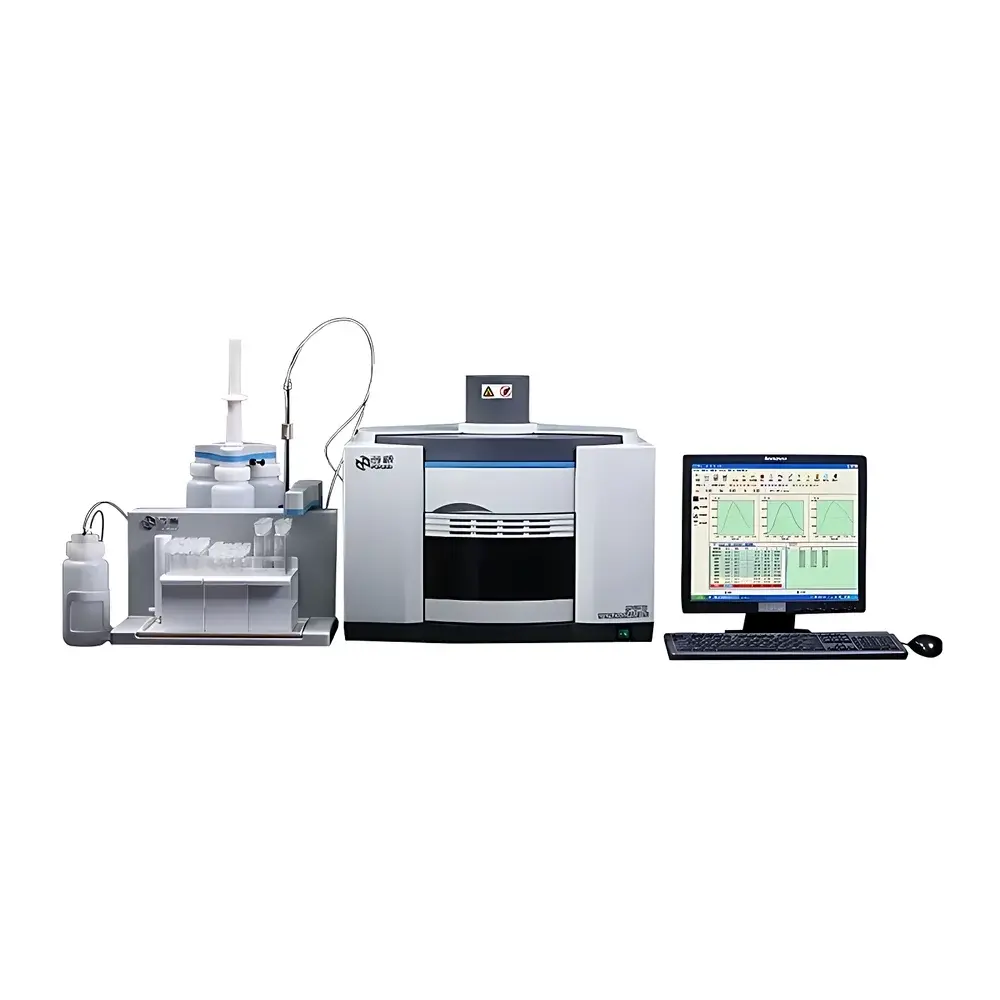
Persee PF3 Series Atomic Fluorescence Spectrometer
| Brand | Persee |
|---|---|
| Origin | Beijing, China |
| Manufacturer | Persee General Instrument Co., Ltd. |
| Type | Multi-channel Atomic Fluorescence Spectrometer |
| Sample Introduction | Dual Sequential Injection Pumps |
| Waste Disposal | Gravity-driven |
| Sample Introduction Mode | Vapor Generation / Hydride Generation |
| Gas Flow Control | Mass Flow Controller |
| Detectable Elements | As, Se, Pb, Bi, Sb, Te, Sn, Hg, Cd, Ge, Zn |
| Relative Standard Deviation (RSD) | <1% (for As, Sb, Bi, Hg) |
| Linear Dynamic Range | >3 orders of magnitude |
| Detection Limits | ≤0.01 ng/mL (As, Sb, Bi) |
| Photomultiplier Tube | Hamamatsu R7154, spectral response range 160–320 nm |
| Atomizer Temperature Control Range | Ambient to 400 °C |
Overview
The Persee PF3 Series Atomic Fluorescence Spectrometer is a high-performance, multi-channel hydride generation atomic fluorescence instrument engineered for trace and ultra-trace quantification of hydride-forming elements in environmental, food safety, pharmaceutical, and geological laboratories. It operates on the principle of atomic fluorescence spectroscopy (AFS), where analyte elements—reduced in situ to volatile hydride species (e.g., AsH₃, SbH₃, Hg⁰ vapor)—are swept into a quartz furnace atomizer, atomized at controlled temperatures (ambient to 400 °C), and excited by a high-intensity hollow cathode lamp. The resulting element-specific fluorescence emission is detected via a low-noise, wide-spectral-range photomultiplier tube (Hamamatsu R7154, 160–320 nm). Unlike conventional AAS or ICP-MS, AFS delivers exceptional sensitivity for Group V and VI elements with minimal spectral interference, making it the method-of-choice per ISO 17294-2, EPA Method 1631E, and GB/T 22105.2–2008 for arsenic, mercury, antimony, and bismuth analysis.
Key Features
- Dual Sequential Injection Flow System: Enables precise, reproducible reagent and sample metering using water-based carrier fluid—eliminating corrosion of precision syringes by acidic or alkaline media, thereby extending pump lifetime and maintaining volumetric accuracy over extended operation.
- Auto-Optimized Atomizer Positioning: Quartz furnace height is motorized and calibrated to the optimal excitation zone; no manual visual alignment required, ensuring consistent atomization efficiency and inter-day repeatability.
- Double-Beam Single-Detector Architecture: A reference beam monitors lamp intensity in real time, compensating for source drift during measurement cycles—critical for long-duration batch analysis under GLP-compliant workflows.
- Integrated Gas-Liquid Separation & Needle Cleaning: A reflux-type gas-liquid separator achieves >99.5% water vapor and microbubble removal in a single stage; coupled with gas-displacement-assisted dual-wall rinsing of the sampling probe, this minimizes carryover between high- and low-concentration standards (RSD <0.8% observed across 100–1000 ng/L As gradients).
- Closed-Loop Exhaust & Waste Management: Reaction gases are channeled through activated carbon adsorption before outdoor venting; waste liquid is stored in sealed, level-monitored reservoirs with overflow alarm—fully compliant with OSHA 1910.1200 and local laboratory ventilation safety codes.
Sample Compatibility & Compliance
The PF3 accommodates aqueous matrices including drinking water, soil extracts (EPA 3050B), rice flour digests (GB 5009.11), and seafood tissue homogenates. Its hydride generation interface supports direct coupling to optional accessories: a speciation module (for As(III)/As(V)/MMA/DMA separation per USP ), a large-volume injection kit (up to 5 mL sample loop for sub-ng/L detection), and a micro-sampling adapter (10–100 µL range for precious clinical or isotopic samples). All firmware and data handling comply with FDA 21 CFR Part 11 requirements—including electronic signature support, audit trail logging, and user-access tiering—validated per IQ/OQ protocols. Instrument performance meets or exceeds ISO/IEC 17025:2017 clause 5.9 for analytical system validation.
Software & Data Management
Persee AFS Control Suite v3.2 provides intuitive method setup, real-time signal visualization, and automated calibration (single-point standard addition, multi-level dilution series, spike recovery). Raw fluorescence intensities are processed using weighted linear regression (1/x² weighting) across a dynamic range exceeding 10³. Data files adhere to ASTM E1382-compliant .csv and .xml formats; integrated LIMS export supports direct upload to LabVantage, Thermo Fisher SampleManager, or custom SQL databases. All acquisition parameters—including lamp current, PMT voltage, reaction coil temperature, and gas flow rates—are timestamped and archived with spectra, satisfying full traceability for ISO 17025 internal audits.
Applications
- Regulatory monitoring of inorganic arsenic in rice and infant cereals (EU Commission Regulation (EU) No 2023/915)
- Mercury speciation in fish tissue following EPA Method 1631 revision D
- Bio-monitoring of urinary antimony in occupational health screening (ACGIH BEIs)
- Leachate analysis from electronic waste landfills per TCLP (EPA Method 1311)
- Quality control of herbal medicines for heavy metal impurities (Chinese Pharmacopoeia ChP 2020, Section IV)
FAQ
What hydride-forming elements can the PF3 quantify with certified detection limits?
The PF3 delivers validated detection limits per ISO 11929:2019 for As, Sb, Bi ≤0.01 ng/mL and Hg ≤0.001 ng/mL in 2% HCl matrix, using recommended KBH₄ concentration and optimized Ar flow (150 mL/min).
Does the system support compliance with FDA 21 CFR Part 11 for electronic records?
Yes—audit trails record all user actions (login/logout, method edits, result approvals), with digital signature capability and immutable storage of raw spectra and processed reports.
Can the PF3 be upgraded for elemental speciation analysis?
Yes—the optical and fluidic architecture includes standardized HPLC interface ports and synchronized timing signals to integrate with Persee’s AS-2000 speciation module for HPLC-AFS coupling.
How is lamp alignment handled during routine maintenance?
The PF3 employs pre-aligned, plug-and-play hollow cathode lamps with mechanical registration pins; no collimation or azimuth adjustment is required after replacement—lamp positional repeatability is ±0.05 mm.
What preventive maintenance intervals are recommended for the sequential injection system?
Persee recommends syringe calibration every 200 runs and PTFE tubing replacement every 6 months under continuous use; the system logs cumulative actuation counts and alerts users prior to scheduled service.





