
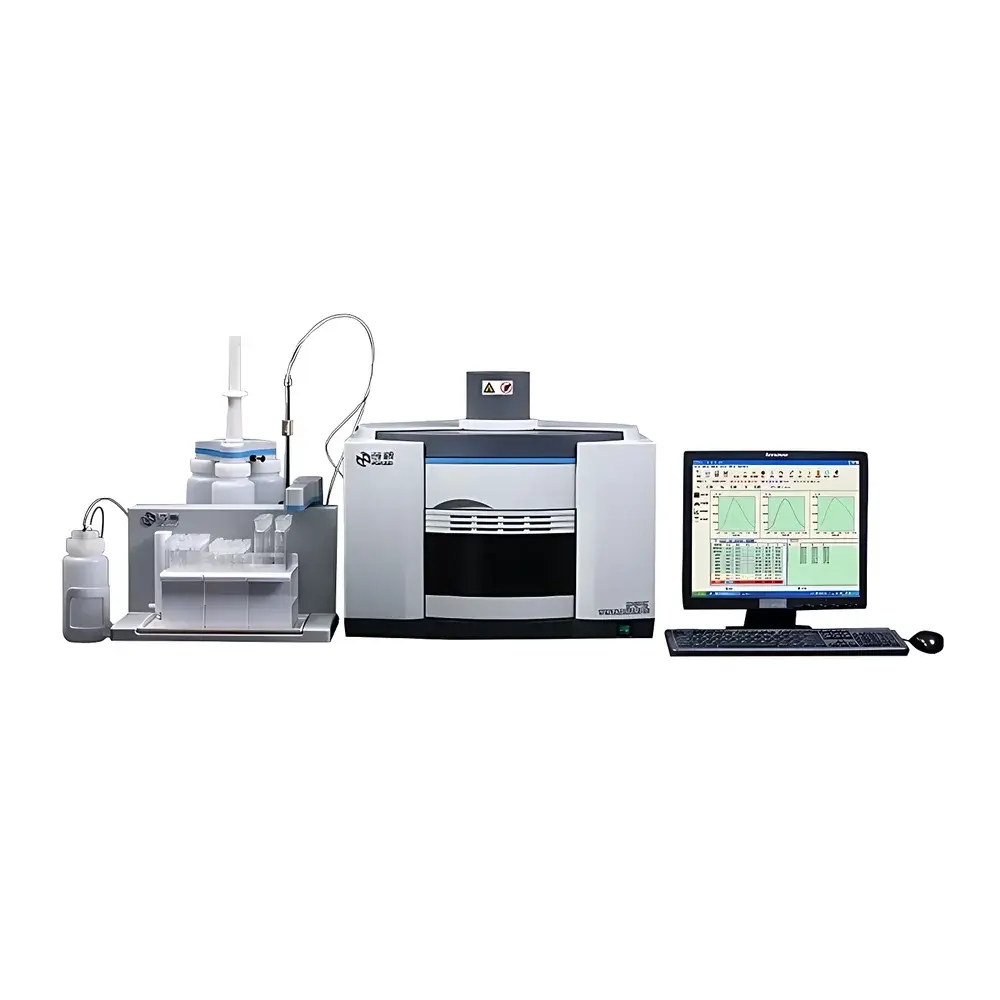
Persee PF5 Series Atomic Fluorescence Spectrometer
| Brand | Persee |
|---|---|
| Origin | Beijing, China |
| Manufacturer Type | Direct Manufacturer |
| Regional Classification | Domestic (China) |
| Model | PF5 |
| Instrument Type | Multi-channel Atomic Fluorescence Spectrometer |
| Sample Introduction | Dual Sequential Injection Pump |
| Waste Liquid Discharge | Gravity-driven (Static) |
| Sample Introduction Mode | Vapor Generation / Hydride Generation |
| Gas Flow Control | Mass Flow Controller |
| Detectable Elements | As, Se, Pb, Bi, Sb, Te, Sn, Hg, Cd, Ge, Zn |
| Relative Standard Deviation (RSD) | <1% for representative elements (As, Sb, Bi, Hg) |
| Linear Dynamic Range | >3 orders of magnitude |
| Detection Limits | ≤0.01 ng/mL for As, Sb, Bi |
| Photomultiplier Tube (PMT) | R7154, spectral response range 160–320 nm |
| Atomizer Temperature Control Range | Ambient to 400 °C |
Overview
The Persee PF5 Series Atomic Fluorescence Spectrometer is a high-performance, multi-channel hydride generation atomic fluorescence (HG-AFS) instrument engineered for trace and ultra-trace elemental analysis in environmental, food safety, pharmaceutical, and geological laboratories. It operates on the principle of atomic fluorescence spectroscopy: analyte elements (e.g., As, Hg, Sb, Bi, Se) are chemically reduced to volatile hydride species or cold vapor (for Hg), atomized in a quartz furnace at precisely controlled temperatures (ambient to 400 °C), and excited by a high-intensity hollow cathode lamp. The resulting element-specific fluorescence emission—measured at right angles to the excitation beam—is detected by a low-noise R7154 photomultiplier tube (160–320 nm). The PF5’s dual sequential injection pump system enables precise, reproducible reagent and sample delivery without mechanical wear, while its pneumatic flow architecture eliminates peristaltic pump degradation and acid/alkali corrosion—ensuring long-term baseline stability and minimal maintenance.
Key Features
- Pneumatic Sequential Injection Flow System: Fully automated, wear-free gas-pressure-driven fluid handling with dual independent injection pumps; eliminates tubing fatigue, flow pulsation, and chemical degradation of metering components.
- Plug-and-Play Hollow Cathode Lamps: Pre-aligned, factory-optimized lamps require zero manual adjustment upon replacement—ensuring consistent optical coupling and inter-lamp measurement reproducibility.
- Auto-Positioned Quartz Atomizer: Motorized vertical positioning ensures optimal alignment of the quartz tube within the excitation/detection zone—removing subjective visual calibration and improving thermal uniformity across runs.
- Dual-Beam Single-Detector Optical Architecture: Real-time background correction via reference beam subtraction compensates for source intensity drift and power fluctuations—critical for extended Hg stability and low-drift multi-hour analyses.
- Vortex-Type Gas-Liquid Separator with Active Cooling: Integrated thermoelectric cooling and mechanical agitation enhance phase separation efficiency, reduce water vapor interference, and improve signal-to-noise ratio—directly contributing to sub-ppt detection limits.
- Closed-Loop Exhaust & Waste Management: Exhaust gases are routed through activated carbon adsorption before external venting; waste liquid is stored in sealed, level-monitored reservoirs with overflow alarm—fully compliant with ISO 14001 and OSHA laboratory ventilation guidelines.
Sample Compatibility & Compliance
The PF5 supports diverse sample matrices—including drinking water, soil extracts, biological tissues, rice flour, seafood digests, and pharmaceutical excipients—following standardized preparation protocols (e.g., EPA Method 1631E for mercury, GB/T 22105.2–2008 for arsenic in soils). Its hydride generation interface is compatible with both conventional acid digestion (HNO₃–HCl–KBr–KBH₄) and microwave-assisted procedures. All operational parameters—including lamp current, PMT voltage, atomizer temperature, and reaction coil residence time—are programmable and audit-trail enabled, supporting full compliance with GLP, GMP, and FDA 21 CFR Part 11 requirements when integrated with validated software modules. Certificate of Conformance includes traceability to NIST SRM 1640a (trace elements in natural water) and internal QC checks per ISO/IEC 17025 Annex A.2.
Software & Data Management
PF5 is operated via Persee’s AFS-Control v3.2 software—a Windows-based platform supporting method development, sequence scheduling, real-time signal visualization, and automated calibration curve fitting (linear, quadratic, or weighted least-squares). Raw data files (.afsd) store full acquisition metadata—including lamp ID, gas flow setpoints, temperature logs, and detector gain history—for retrospective forensic review. Export formats include CSV, PDF analytical reports, and XML for LIMS integration. Software validation documentation (IQ/OQ/PQ templates) and electronic signature workflows meet regulatory expectations for regulated laboratories. Audit trails record all user actions, parameter changes, and result modifications with timestamp, operator ID, and reason-for-change fields.
Applications
- Regulatory monitoring of inorganic arsenic in rice and infant cereals (EU Commission Regulation (EU) No 2023/915)
- Ultra-trace mercury quantification in fish tissue and sediment cores (EPA 1631 Revision E)
- Speciation-ready platform: seamless integration with Persee AS-3000形态分析单元 for As(III)/DMA/MMA/As(V) separation via HPLC-AFS coupling
- High-sensitivity analysis of bismuth and antimony in catalyst residues and metallurgical slags
- Method development for zinc and cadmium in fortified nutritional supplements under USP <233>
- Multi-element screening of Se, Te, and Sn in semiconductor-grade chemicals per SEMI F57 standards
FAQ
What hydride-forming elements does the PF5 support out-of-the-box?
The PF5 is factory-configured for As, Se, Pb, Bi, Sb, Te, Sn, Hg, Cd, Ge, and Zn—covering all 11 elements specified in Chinese National Standard GB 5009.11–2014 and GB 5009.17–2021.
Can the PF5 be used for mercury cold-vapor analysis without hydride reagents?
Yes—the instrument supports dedicated cold-vapor mode for Hg using SnCl₂ reduction, with optimized dwell time and atomization temperature profiles preloaded in the method library.
Is the PF5 compatible with third-party autosamplers or chromatography systems?
It features RS-232, USB, and Ethernet interfaces for hardware synchronization; HPLC-AFS coupling is validated only with Persee AS-3000 and Agilent 1260/1290 systems due to timing-critical trigger signal requirements.
How is calibration verification performed during routine operation?
The software enforces bracketing standard checks every 10 samples; drift correction is applied using a mid-level standard, and failure triggers automatic re-calibration or operator alert—configurable per SOP.
What maintenance intervals are recommended for the pneumatic flow system?
No scheduled maintenance is required for the gas-driven flow path; annual PM includes PMT dark-current verification, lamp energy output check, and atomizer quartz tube inspection—documented in the included Maintenance Logbook (per ISO/IEC 17025 clause 6.4.8).




