
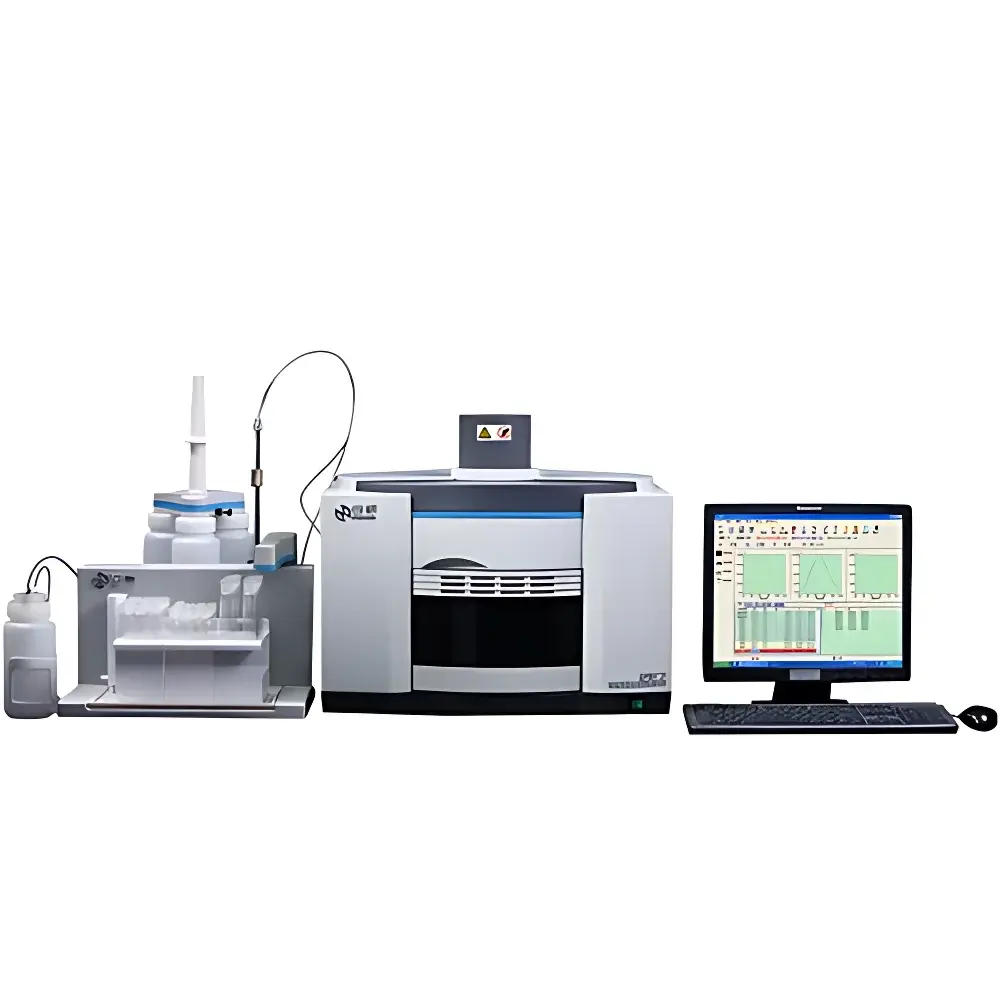
Persee PF7 Series Atomic Fluorescence Spectrometer
| [Brand | Persee |
|---|---|
| Origin | Beijing, China |
| Manufacturer Type | Direct Manufacturer |
| Instrument Type | Multi-channel Atomic Fluorescence Spectrometer |
| Sample Introduction Mode | Dual Sequential Injection Pump |
| Waste Liquid Disposal | Gravity-driven (Static) |
| Hydride Generation Mode | Vapor Generation / Hydride Generation |
| Gas Flow Control | Mass Flow Controller (MFC) |
| Detectable Elements | As, Se, Pb, Bi, Sb, Te, Sn, Hg, Cd, Ge, Zn |
| Relative Standard Deviation (RSD) | <1% for As, Sb, Bi, Hg |
| Linear Dynamic Range | >3 orders of magnitude |
| Detection Limits | ≤0.01 ng/mL for As, Sb, Bi |
| Photomultiplier Tube (PMT) | Hamamatsu R7154, spectral response range 160–320 nm |
| Atomizer Temperature Control Range | Ambient to 400 °C] |
Overview
The Persee PF7 Series Atomic Fluorescence Spectrometer is a high-performance, multi-channel analytical instrument engineered for trace and ultra-trace quantification of hydride-forming elements in environmental, food safety, pharmaceutical, geological, and clinical laboratories. It operates on the principle of atomic fluorescence spectroscopy (AFS), where analyte elements—after hydride generation or cold vapor formation—are atomized in a quartz furnace or flameless graphite tube, then excited by a high-intensity hollow cathode lamp (HCL) or electrodeless discharge lamp (EDL). The resulting element-specific fluorescence emission is detected at right angles to the excitation beam using a high-sensitivity photomultiplier tube (PMT), enabling exceptional signal-to-noise ratios and low background interference. Designed with rigorous attention to metrological stability and operational robustness, the PF7 integrates pneumatic sequential injection (PSI) fluidics, dual-beam optical compensation, and intelligent thermal management to meet ISO/IEC 17025-compliant routine testing requirements.
Key Features
- Pneumatic Sequential Injection (PSI) Fluidics: Replaces traditional peristaltic pumps with a wear-free, corrosion-resistant air-pressure-driven flow system. Eliminates tubing fatigue, flow pulsation, and acid/alkali-induced degradation—ensuring long-term volumetric accuracy and zero maintenance over extended operation cycles.
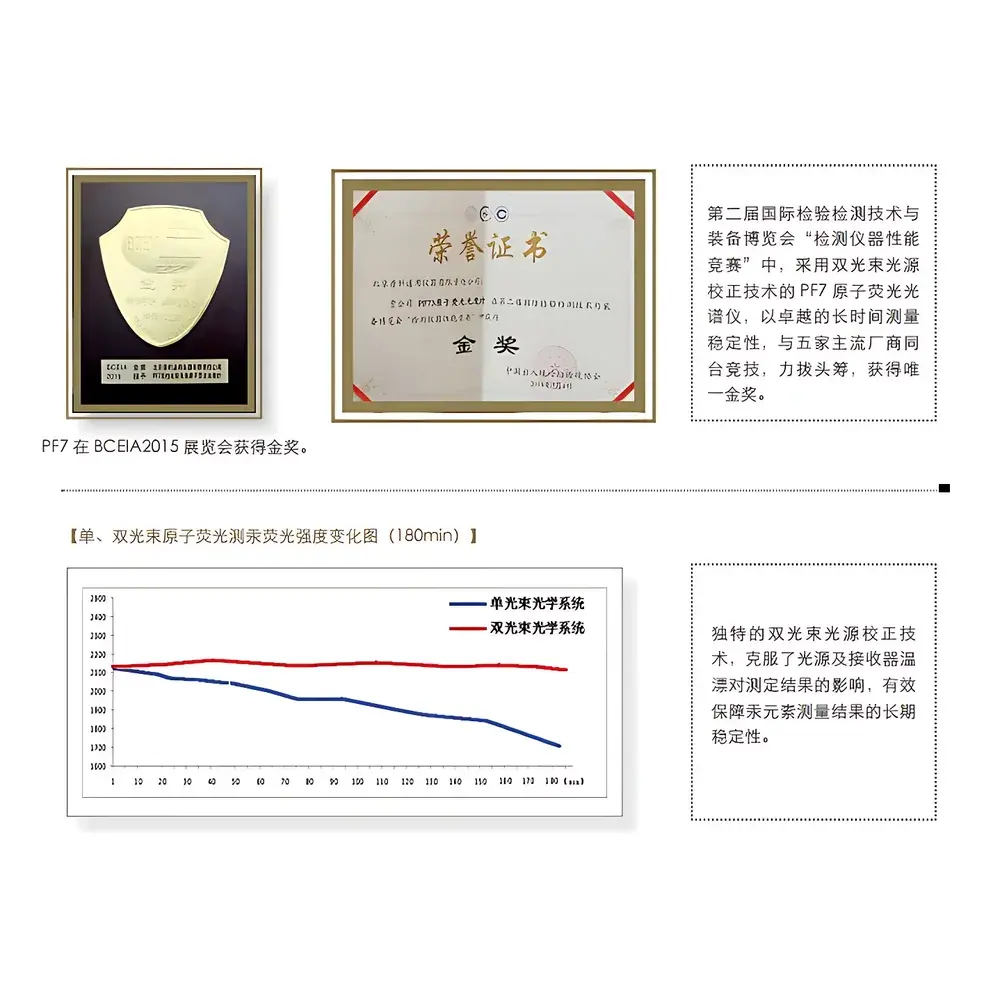
- Dual-Beam Single-Detector Optical Architecture: Compensates in real time for source intensity drift and lamp aging by splitting the excitation beam into sample and reference paths. Enhances measurement reproducibility—particularly critical for mercury analysis where thermal and electronic instability commonly degrade precision.
- Auto-Positioning Quartz Furnace Atomizer: Motorized vertical adjustment ensures optimal alignment between the atomization zone and optical axis. Pre-calibrated height positioning eliminates manual visual alignment, reducing operator dependency and inter-user variability.
- Plug-and-Play Hollow Cathode Lamps: Integrated lamp recognition and auto-focusing mechanism guarantees consistent spatial positioning across lamp changes—preserving calibration integrity without recalibration or manual fine-tuning.
- Integrated Vapor-Liquid Separator with Active Cooling: Features thermoelectric cooling and mechanical agitation to maximize hydride transfer efficiency while minimizing water vapor carryover—directly contributing to improved sensitivity and reduced baseline noise.
- Closed-Loop Exhaust & Waste Management: All reaction gases are routed through activated carbon adsorption before external venting; waste liquid is retained in sealed reservoirs with overflow-level detection—supporting OSHA and EU Directive 2004/37/EC occupational exposure compliance.
Sample Compatibility & Compliance
The PF7 supports aqueous matrices across wide concentration ranges—from sub-ng/L environmental monitoring to mg/L industrial process control—via optional accessories including large-volume micro-sampling modules and low-volume (≤100 µL) capillary introduction kits. Its hydride generation interface is compatible with standard EPA Method 1632 (Hg), ASTM D5847-20 (As, Se), and GB/T 223.72–2008 (Chinese national standard for As/Bi/Sb/Hg). The system architecture supports audit-ready data handling per FDA 21 CFR Part 11 when paired with optional fingerprint login and barcode-based sample tracking modules. Full traceability—including method parameters, lamp usage logs, gas flow records, and temperature ramp profiles—is maintained in accordance with GLP/GMP documentation frameworks.
Software & Data Management
Controlled via Persee’s AFS-Studio v3.x software suite, the PF7 provides intuitive workflow-driven operation—from method setup and calibration curve generation to QC charting and report export (PDF, CSV, XML). The software implements automated drift correction, peak integration with baseline subtraction algorithms, and built-in uncertainty estimation per GUM (JCGM 100:2008). Audit trail functionality logs all user actions, parameter modifications, and instrument status events with timestamped, non-erasable entries. Optional network deployment enables centralized instrument monitoring and remote diagnostics across multi-lab environments compliant with ISO/IEC 27001 information security standards.
Applications
- Regulatory testing of arsenic, mercury, and cadmium in drinking water (EPA 200.9, ISO 17294-2)
- Heavy metal speciation in rice and seafood following coupling with HPLC-AFS interfaces
- Quality control of pharmaceutical excipients per USP /
- Soil and sediment analysis under ISO 11466 and GB 15618–2018
- Monitoring of catalyst leaching in battery recycling streams
- Reference material certification in NMIs and accredited reference labs
FAQ
What hydride-forming elements can the PF7 quantify?
The PF7 is validated for As, Se, Pb, Bi, Sb, Te, Sn, Hg, Cd, Ge, and Zn—covering all elements specified in major international regulatory methods for hydride-generation AFS.
Does the PF7 support compliance with FDA 21 CFR Part 11?
Yes—when configured with optional biometric authentication and electronic signature modules, the system meets electronic record and signature requirements for regulated pharmaceutical and clinical labs.
How does the dual-beam optical design improve measurement stability?
It continuously monitors and subtracts fluctuations in excitation source intensity, effectively decoupling detector signal variation from lamp aging or power supply ripple—critical for achieving RSD <1% in routine multi-hour analyses.
Can the PF7 be integrated with HPLC for elemental speciation?
Yes—the instrument features standardized analog/digital I/O ports and TTL-triggered synchronization protocols for seamless interfacing with commercial HPLC systems to construct an HPLC-AFS hyphenated platform.
What is the typical lifetime of the R7154 PMT under continuous operation?
When operated within its specified spectral range (160–320 nm) and maintained per manufacturer guidelines—including regular dark-current calibration and avoidance of overexposure—the Hamamatsu R7154 PMT exhibits stable gain characteristics for ≥20,000 hours of cumulative use.





