
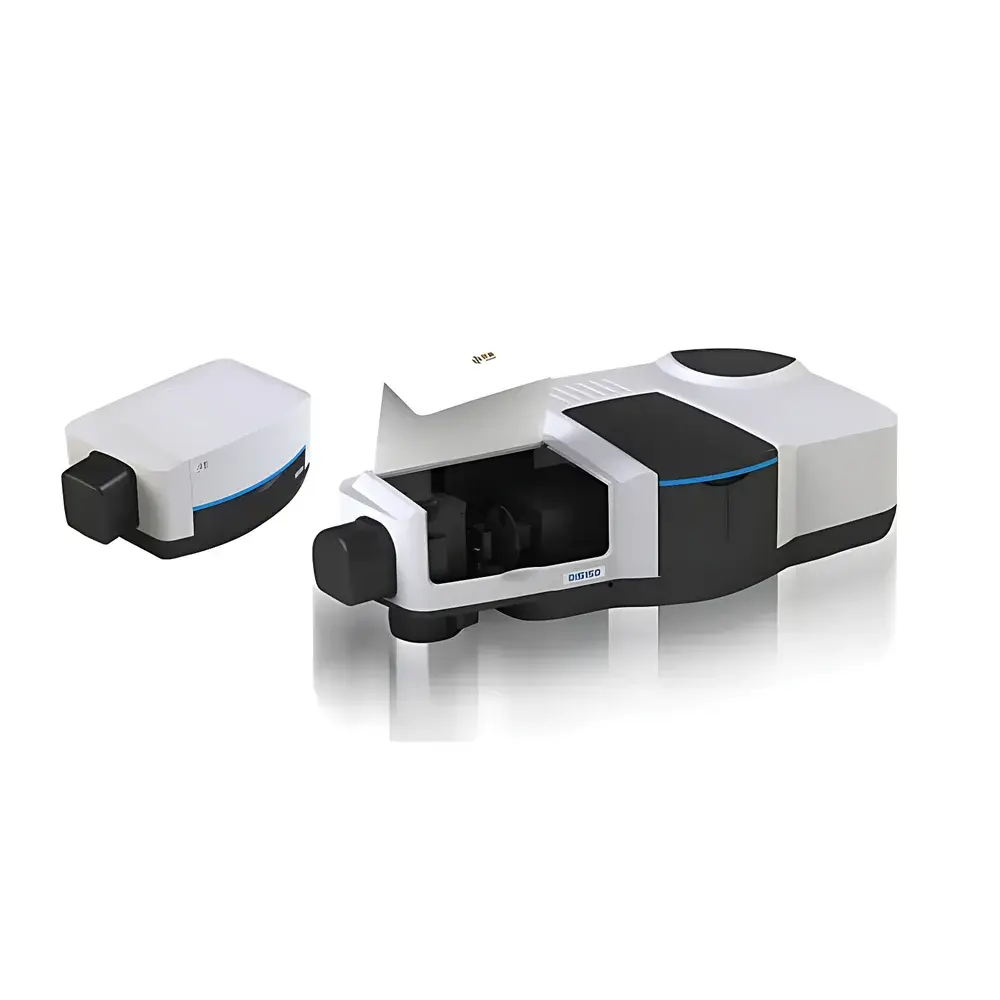
Persee Solid Sample Testing Solution for UV-Vis Spectrophotometry
| Brand | Persee |
|---|---|
| Origin | Beijing, China |
| Manufacturer Type | Direct Manufacturer |
| Product Category | Domestic |
| Model | Solid Sample Testing Solution |
| Price Range | USD 14,000 – 21,000 (FOB) |
| Optical Architecture | Dual-Wavelength Configuration |
| Detector | Photomultiplier Tube (PMT) |
| Wavelength Scanning Mode | Automatic |
| Stray Light | < 0.0004% (4 × 10⁻⁴ %) |
| Compatible Accessories | 150 mm Integrating Sphere (Standard), 60 mm Integrating Sphere (Standard), Eyewear-Specific Measurement Fixture |
| Sample Types | Opaque/Translucent Solids, Powders, Turbid Liquids |
| Measurement Modes | Diffuse Reflectance, Specular Reflectance, Total Transmittance, Diffuse Transmittance |
Overview
The Persee Solid Sample Testing Solution is a purpose-engineered UV-Vis spectrophotometric platform designed to extend conventional absorbance and reflectance measurement capabilities beyond homogeneous liquid samples. Built upon the T10 series dual-wavelength optical architecture, this system integrates high-stability PMT detection with ultra-low stray light optics (< 0.0004%), enabling reliable quantification of scattering-dominant and heterogeneous solid-phase specimens. Unlike standard cuvette-based configurations, the solution employs modular integrating sphere technology—specifically calibrated 60 mm and 150 mm spheres—to normalize path-length variability and angular dependence inherent in powdered, granular, or irregularly shaped materials. Its core optical design adheres to fundamental principles of Kubelka-Munk theory for diffuse reflectance conversion and ASTM E308–22 for colorimetric data derivation, ensuring traceable correlation between spectral response and material-specific optical properties.
Key Features
- Ultra-low stray light performance (< 0.0004%) achieved through optimized monochromator baffling, double-beam referencing, and high-purity quartz optical components—critical for accurate baseline integrity in low-transmittance solids and highly scattering matrices.
- Dual-wavelength scanning capability enables real-time differential analysis (e.g., ΔA = Aλ1 − Aλ2), supporting quantitative correction for background interference in pigmented or layered substrates such as coated glass or dyed textiles.
- Modular accessory ecosystem: Interchangeable 150 mm sphere for high-sensitivity reflectance of low-reflectivity materials (e.g., carbon-black composites); 60 mm sphere for spatially constrained samples (e.g., small-area polymer films); and an ISO 8980-3–compliant eyewear fixture enabling direct transmittance measurement of finished prescription lenses without disassembly.
- Fully automated wavelength drive with programmable scan speed (10–1200 nm/min), step resolution (0.1 nm), and slit-width control—supporting method-defined spectral acquisition protocols required under USP and EP 2.2.25.
- Thermally stabilized optical bench and Peltier-cooled PMT detector ensure signal stability over extended acquisition cycles (> 4 hours), minimizing drift during multi-sample batch runs typical in QC laboratories.
Sample Compatibility & Compliance
The system accommodates diverse physical states: turbid suspensions (e.g., nanoparticle colloids), pressed powders (e.g., pharmaceutical excipients), rigid solids (e.g., architectural glazing), flexible films (e.g., PET packaging), and optically complex assemblies (e.g., anti-reflective coated ophthalmic lenses). All accessories comply with ISO/IEC 17025:2017 calibration traceability requirements when used with NIST-traceable reflectance standards (e.g., Spectralon® SRM 2035). The eyewear fixture meets ANSI Z80.3–2023 optical safety testing parameters for visible-light transmittance (VLT) and UV-blocking efficacy across 280–400 nm. Data acquisition workflows support audit trails and electronic signatures per FDA 21 CFR Part 11 when integrated with Persee’s validated SpectraLab v4.x software suite.
Software & Data Management
SpectraLab v4.x provides instrument control, spectral processing, and regulatory-compliant reporting. It includes Kubelka-Munk transformation modules for converting raw reflectance into absorption/scattering coefficients; CIE color space calculators (CIELAB, CIEDE2000) aligned with ISO 11664-4; and customizable pass/fail thresholds for batch release per ICH Q5C. Raw spectral data are stored in vendor-neutral .jdx format, while processed reports export to PDF/A-2b for long-term archival compliance. Role-based user access, session logging, and version-controlled method templates satisfy GLP/GMP documentation requirements.
Applications
- Quality control of pigment dispersion uniformity in automotive coatings via 400–700 nm reflectance mapping.
- Quantitative analysis of UV-absorber concentration in polycarbonate safety lenses using derivative spectroscopy at 320–380 nm.
- Color consistency verification in textile dye lots against master standards using D65 illuminant simulation.
- Optical density profiling of pharmaceutical tablet coatings to assess film thickness homogeneity.
- Photostability assessment of organic photovoltaic materials through accelerated aging with in-situ spectral monitoring.
FAQ
Can this system measure absolute reflectance without a reference standard?
No. Absolute diffuse reflectance requires calibration against a certified Spectralon® or BaSO₄ standard prior to sample measurement.
Is the eyewear fixture compatible with progressive or aspheric lenses?
Yes—the fixture accommodates non-planar geometries up to ±8 D base curve and supports automated vertex-distance compensation per ISO 13666.
Does the software support multi-point mapping for spatial heterogeneity analysis?
Not natively. Mapping requires optional motorized XYZ stage integration and third-party scripting via COM interface.
What is the minimum sample area required for reliable 60 mm sphere measurements?
≥ 25 mm diameter for opaque solids; ≥ 35 mm for semi-transparent materials to ensure full sphere illumination coverage.
How frequently must the integrating sphere be recalibrated?
Annual recalibration is recommended; however, daily verification using a stable ceramic tile reference is required per ISO/IEC 17025 internal quality control protocols.





