
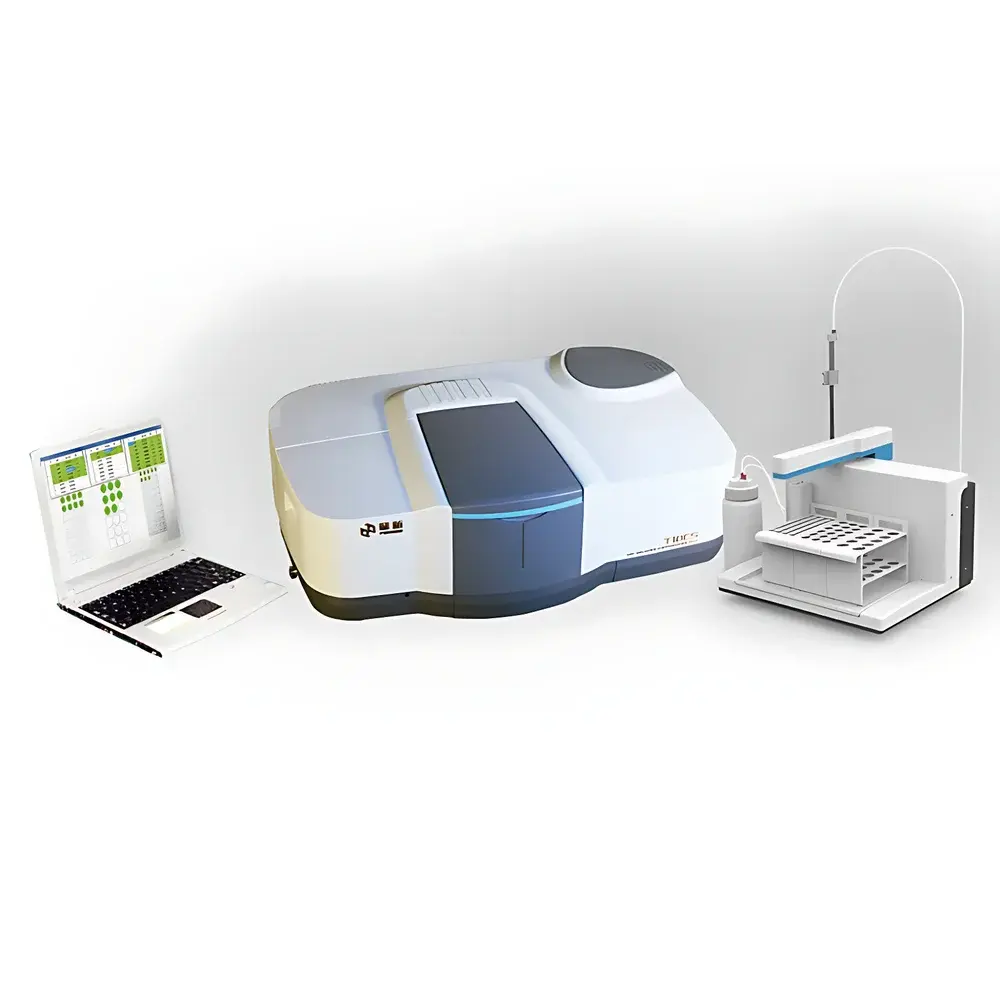
Persee UV-Vis Spectrophotometer with Automated Liquid Sampling System
| Brand | Persee |
|---|---|
| Origin | Beijing, China |
| Manufacturer Type | Direct Manufacturer |
| Product Category | Domestic |
| Model | UV-Vis Automated Liquid Sampling Solution |
| Price Range | USD 14,000 – 21,000 |
| Optical Design | Double-beam |
| Detector | Photomultiplier Tube (PMT) |
| Wavelength Range | 190–1100 nm |
| Spectral Bandwidth | 1.8 nm (typical) |
| Wavelength Accuracy | ±0.3 nm |
| Stray Light | <0.05% T at 220 nm and 360 nm |
| Automation Level | Fully Automated Wavelength Scanning & Sample Handling |
| Sample Capacity | Three Independent Sample Carriers Supporting Configurable Racks (50 mL × 10 wells, 25 mL × 18 wells, or 20 mL × 18 wells) |
| Positioning System | Programmable 3-Axis Robotic Arm with Sub-millimeter Repeatability |
| Cleaning Mechanism | Peristaltic Pump–Driven Dynamic Immersion Rinse with Solvent Exchange Protocol |
Overview
The Persee UV-Vis Spectrophotometer with Automated Liquid Sampling System is an integrated analytical platform engineered for high-throughput, reproducible quantitative and qualitative analysis of liquid-phase samples in regulated and research laboratory environments. Built upon a double-beam optical architecture, the system compensates for source drift and detector instability in real time, ensuring baseline stability and measurement robustness across extended acquisition sequences. Its core photometric engine employs a high-sensitivity photomultiplier tube (PMT) detector, delivering low-noise signal acquisition across the full spectral range of 190–1100 nm—enabling applications from nucleic acid quantification and protein assay development to pharmaceutical dissolution testing and environmental water quality monitoring. Unlike conventional benchtop spectrophotometers requiring manual pipetting and cuvette handling, this solution integrates sample introduction, rinsing, and optical measurement into a single synchronized workflow—minimizing operator intervention while maintaining metrological integrity.
Key Features
- Triple independent sample carrier configuration supporting interchangeable rack formats: 50 mL × 10-position, 25 mL × 18-position, and 20 mL × 18-position—optimized for method flexibility and volumetric compatibility with standard labware.
- Programmable 3-axis robotic positioning system with sub-millimeter positional repeatability (< ±0.1 mm), enabling precise alignment between sample vessels, optical path, and cleaning nozzles.
- Peristaltic pump–driven dynamic immersion rinse protocol: solvent delivery and aspiration occur while the sampling probe remains submerged, eliminating air gaps and residual film formation—critical for minimizing carryover between high-concentration analytes.
- Intelligent endpoint detection algorithm that monitors absorbance kinetics during dilution or reaction-based assays, automatically terminating measurements upon signal stabilization (e.g., enzyme kinetics, colorimetric endpoint assays).
- Double-beam optical design with real-time reference beam correction, reducing photometric noise and enhancing long-term measurement stability under variable ambient conditions.
- Comprehensive wavelength calibration traceable to NIST-traceable holmium oxide and didymium filters, with factory-verified accuracy of ±0.3 nm across the operational range.
Sample Compatibility & Compliance
The system accommodates aqueous, organic, and mixed-solvent matrices without modification to fluidic pathways, provided viscosity remains below 20 cP and particulate content is <5 µm. It supports direct analysis of clarified biological fluids (serum, urine, cell lysates), pharmaceutical formulations (oral suspensions, injectables), and industrial process streams (coolants, electroplating baths). All wetted components—including tubing, probe tips, and rinse chambers—are chemically resistant to common solvents (e.g., ethanol, acetonitrile, 0.1 M HCl, 0.1 M NaOH). The instrument complies with ISO/IEC 17025 requirements for calibration traceability and supports GLP/GMP workflows through configurable audit trails, user access controls, and electronic signature capability. Data export formats (CSV, XML, PDF) conform to FDA 21 CFR Part 11 requirements when deployed with validated software modules.
Software & Data Management
Control and analysis are managed via Persee’s SpectraPro Suite v4.x—a Windows-based application offering method scripting, multi-wavelength kinetic profiling, spectral subtraction, and Beer-Lambert curve fitting with uncertainty propagation. The software implements role-based user permissions (Administrator, Analyst, Reviewer), automatic timestamped log generation for all hardware events (sample injection, lamp ignition, wavelength scan initiation), and secure local database storage with optional network backup. Raw spectral data are stored in vendor-neutral JCAMP-DX format, ensuring long-term archival compatibility. Integration with LIMS is supported via ASTM E1384-compliant API endpoints and HL7 messaging adapters.
Applications
- Pharmaceutical QC: Dissolution profile monitoring per USP , excipient interference screening, and stability-indicating assay validation.
- Clinical biochemistry: Enzymatic assays (ALT, AST, ALP), total protein determination (Biuret/Lowry), and hemoglobin quantification.
- Environmental testing: Nitrate/nitrite, phosphate, and heavy metal (e.g., Cr(VI), Fe(II)) quantification per EPA Methods 353.2, 365.1, and 3500-Fe B.
- Academic research: Ligand-binding studies, nanoparticle size estimation via surface plasmon resonance shifts, and polymer degradation kinetics.
- Food & beverage: Color index (L*a*b*) correlation, preservative (sorbate/benzoate) quantitation, and antioxidant capacity (FRAP/DPPH) assays.
FAQ
What sample volumes can be processed without manual intervention?
The system handles 0.5–50 mL per sample depending on selected rack configuration; minimum dispensing volume is 50 µL with CV <1.2% (n=6) using calibrated syringe pumps.
How is cross-contamination mitigated between high-value clinical samples?
A three-stage dynamic rinse cycle—comprising solvent flush, air purge, and blank measurement verification—is executed before each new sample aspiration, with carryover validated to <0.005% for 100 mg/L caffeine solutions.
Is method transfer possible from legacy Persee instruments?
Yes—SpectraPro Suite maintains backward compatibility with method files from Persee TU-1901, T9, and A3 platforms, including custom wavelength tables and kinetic step definitions.
Can the system operate unattended overnight?
Fully supported: the 3-axis motion controller includes thermal drift compensation, and the PMT detector features auto-gain adjustment to maintain signal-to-noise ratio over 12+ hour runs.
What regulatory documentation is supplied with the system?
Each unit ships with Factory Acceptance Test (FAT) report, IQ/OQ protocols (user-executable), NIST-traceable wavelength and photometric accuracy certificates, and a complete set of CE/ROHS declarations.




