
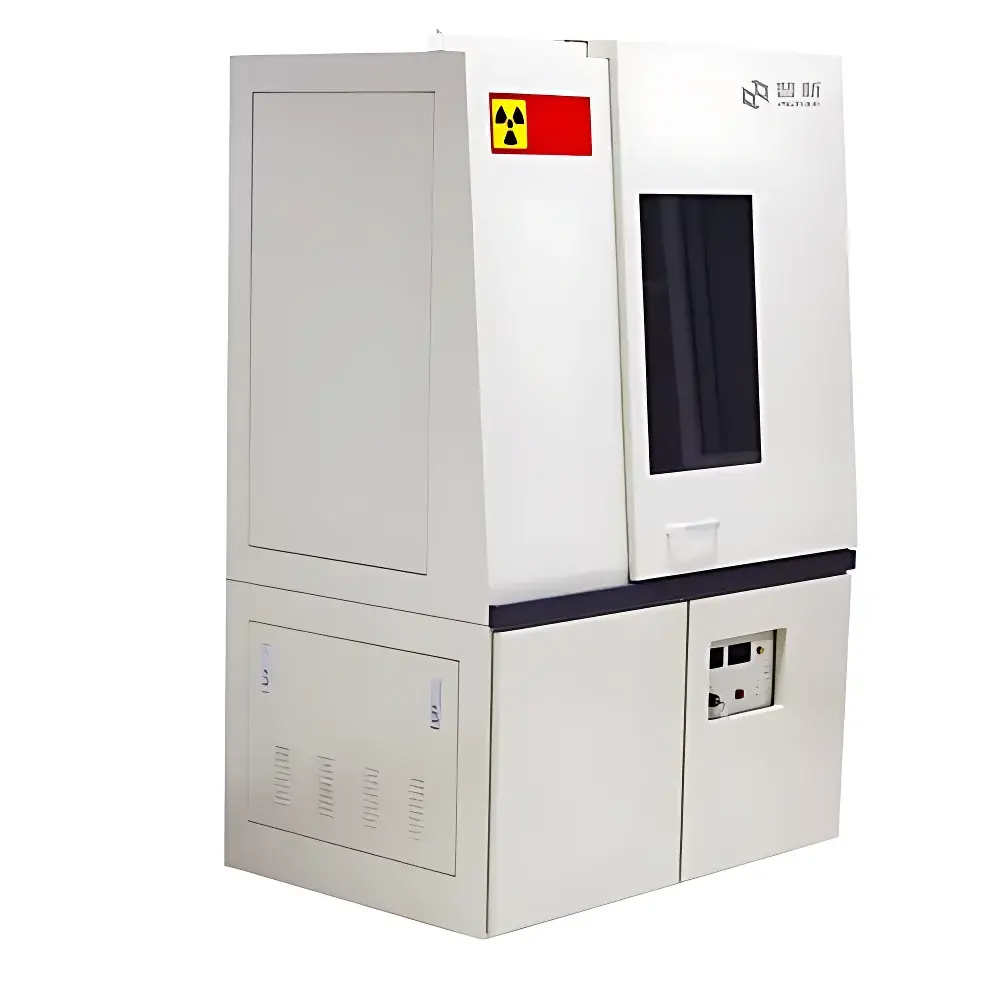
Persee XD-2/XD-3 Automatic Powder X-ray Diffractometer
| Brand | Persee |
|---|---|
| Origin | Beijing, China |
| Manufacturer Type | Direct Manufacturer |
| Product Category | Domestic (China-made) |
| Model | XD-2 / XD-3 |
| Instrument Type | Powder X-ray Diffractometer |
| Price Range | USD 70,000 – 140,000 (FOB China) |
| Detector | Imported NaI Scintillation Counter |
| Goniometer Configuration | Vertical θ–θ geometry with hollow-axis design |
| X-ray Source Control | Fully digital, microprocessor-regulated high-voltage and tube current |
| Software | PDP Diffraction Data Processing Suite (Windows-based, multi-format export support) |
Overview
The Persee XD-2 and XD-3 are fully automated, benchtop powder X-ray diffractometers engineered for routine and research-grade crystalline phase identification, quantitative phase analysis (QPA), lattice parameter refinement, and crystallite size/strain evaluation. Based on Bragg’s law and the fundamental principles of X-ray diffraction (XRD), these instruments utilize Cu Kα radiation (λ = 1.5418 Å) generated by a sealed-tube X-ray source to probe the periodic atomic arrangement in polycrystalline materials. The vertical θ–θ goniometer architecture—featuring a coaxial hollow-axis design—ensures mechanical stability, angular reproducibility, and minimal systematic error across the 2θ range (typically 5°–80° or 5°–90°, depending on configuration). Unlike horizontal configurations, the upright geometry allows unobstructed sample access, simplifies alignment procedures, and reduces gravitational sag effects on detector positioning—critical for long-term measurement consistency in regulated laboratory environments.
Key Features
- Vertical θ–θ goniometer with precision-machined hollow-axis rotation system, enabling high angular accuracy (< ±0.02° 2θ) and repeatable sample-to-detector geometry.
- Integrated X-ray tube housing fabricated from solid copper bar stock, providing superior thermal conductivity, mechanical rigidity, and inherent radiation shielding—reducing external dose rates to < 1 µSv/h at 5 cm from cabinet surface (per GBZ 117-2015 and IEC 61000-6-3).
- High-stability NaI(Tl) scintillation detector with pulse-height discrimination, delivering consistent count-rate linearity up to 500,000 cps and long-term intensity stability (< 2% RSD over 8 h).
- Digital X-ray generator control: microprocessor-managed high-voltage (20–50 kV) and tube current (5–40 mA) regulation with soft-start ramping, real-time interlock monitoring, and automatic fault logging.
- Motorized beam shutter with rotary vane mechanism—switching time 10⁶ operational cycles rated lifetime, and >99.99% X-ray attenuation in closed state.
- Modular sample stage accommodating standard 25 mm Ø powder holders, irregular bulk solids (up to 30 mm height), and capillary-mounted liquid samples—no reconfiguration required between sample types.
Sample Compatibility & Compliance
The XD-2/XD-3 platform supports diverse sample forms without hardware modification: free-flowing powders (including air-sensitive materials via glovebox-compatible sample loading), pressed pellets, sintered ceramics, geological cores, pharmaceutical tablets, and suspension-loaded capillaries. All mechanical and electrical subsystems comply with GB/T 19001–2016 (ISO 9001:2015), GB 4793.1–2019 (IEC 61010-1 safety requirements), and meet CE marking criteria for electromagnetic compatibility (EMC) and low-voltage directive (LVD). The instrument’s firmware and software architecture support audit trail generation, user access levels, and electronic signature functionality—facilitating alignment with GLP, ISO/IEC 17025, and FDA 21 CFR Part 11 readiness when deployed with validated PDP software protocols.
Software & Data Management
The Persee PDP (Powder Diffraction Processor) software suite runs natively on Windows 10/11 and provides full instrument control, data acquisition, real-time background subtraction, peak search and indexing (using Hanawalt and Fink search-match algorithms), Rietveld refinement (via integrated GSAS-II interface), and crystallite size analysis (Scherrer and Williamson–Hall methods). Raw data is stored in industry-standard formats (.raw, .xy, .csv, .mdi), with metadata embedding compliant with CIF (Crystallographic Information File) conventions. Batch processing, report templating (PDF/DOCX export), and database-driven sample tracking enable seamless integration into LIMS environments. Remote operation and diagnostic telemetry are supported via secure TCP/IP communication with TLS 1.2 encryption.
Applications
- Pharmaceutical solid-state characterization: polymorph screening, hydrate/anhydrate identification, excipient compatibility studies, and stability-indicating assay development per ICH Q5A and Q6A guidelines.
- Materials science: phase evolution during thermal treatment (in situ heating stage optional), residual stress mapping in coatings, and quantitative analysis of multi-phase composites (e.g., Al₂O₃–ZrO₂–SiC systems).
- Geology & mining: rapid mineralogical quantification in ore blends, clay speciation in sedimentary cores, and amorphous content estimation using internal standard methods (e.g., SiO₂ added).
- Quality control in battery cathode production: LiCoO₂/LiFePO₄ phase purity verification, carbon coating uniformity assessment, and degradation product detection after cycling.
- Academic research: teaching XRD fundamentals, crystal structure solution from powder data (using TOPAS or FOX), and thin-film texture analysis (with optional parallel-beam optics).
FAQ
What X-ray tube anode material is used, and is it replaceable in the field?
The standard configuration uses a Cu anode sealed-tube source; replacement tubes are available as OEM service parts with factory recalibration documentation.
Does the system support in situ temperature-controlled measurements?
Yes—optional high-temperature stages (up to 1200 °C, ambient to HT) and cryogenic stages (down to −180 °C) are mechanically and software-integrated, with real-time thermal profile logging synchronized to diffraction frames.
Is the PDP software validated for GMP environments?
PDP includes 21 CFR Part 11-compliant modules (audit trail, role-based permissions, electronic signatures); full validation packages—including IQ/OQ/PQ protocols—are available upon request for regulated users.
What maintenance intervals are recommended for the detector and X-ray tube?
NaI detector performance is verified quarterly via reference standard (NIST SRM 660c LaB₆); X-ray tube preventive maintenance—including cooling system inspection and HV cable testing—is recommended every 12 months or after 2000 operating hours.
Can the instrument be upgraded from XD-2 to XD-3 configuration?
Yes—XD-3 enhancements (higher-power generator, enhanced detector electronics, expanded 2θ range) are field-upgradable via hardware retrofit kits and firmware update, preserving original calibration certificates.
Related Products





