
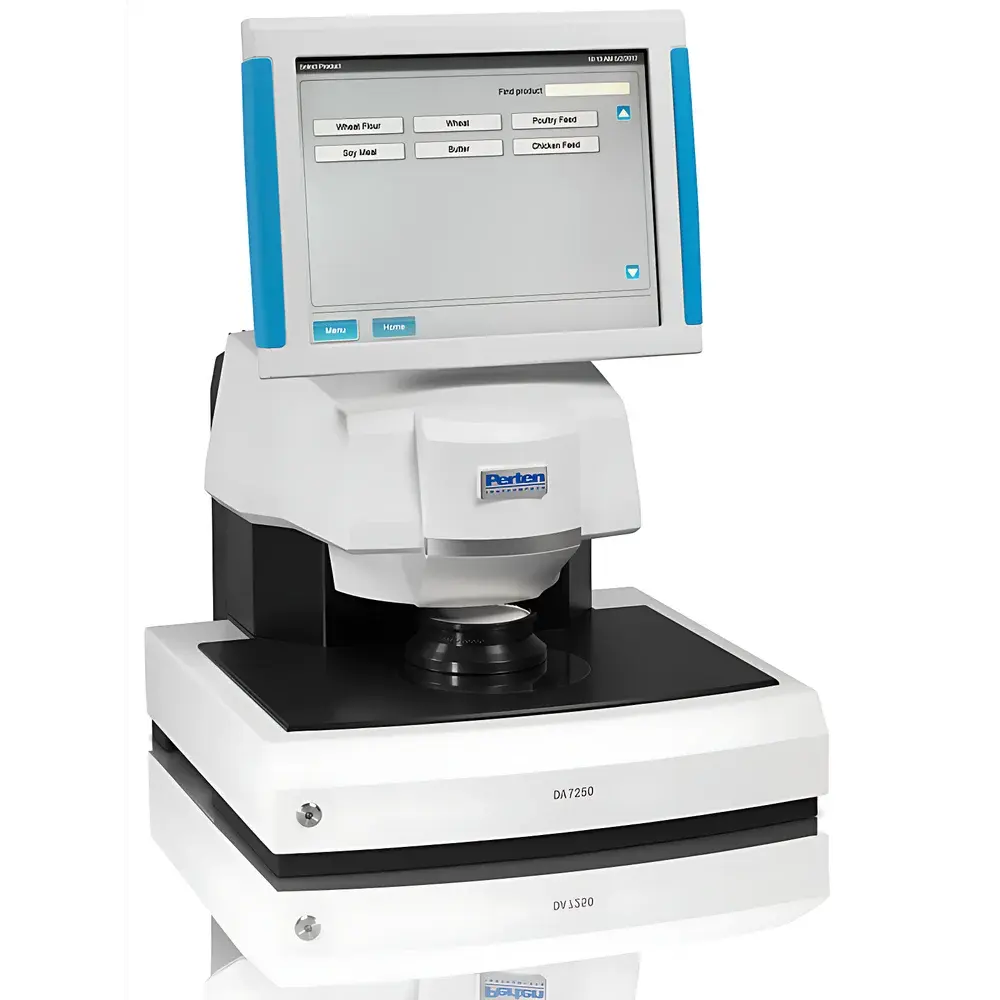
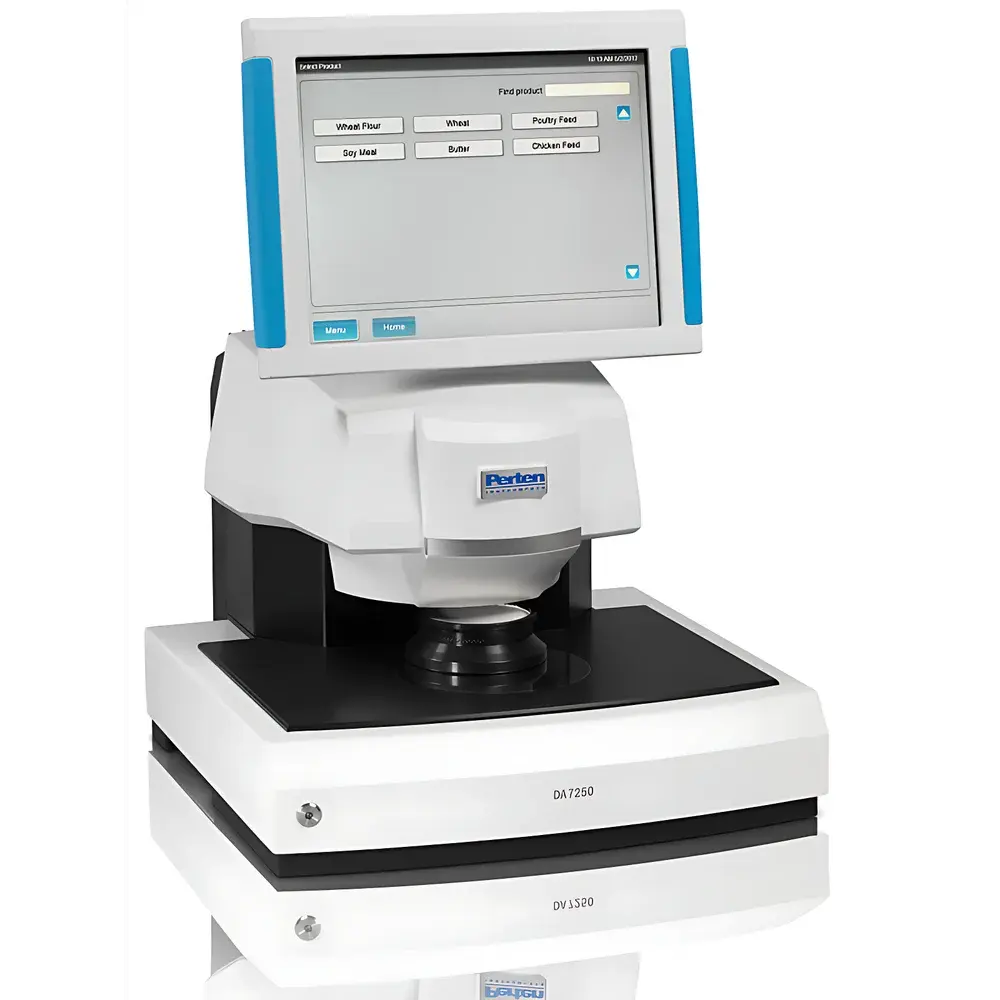
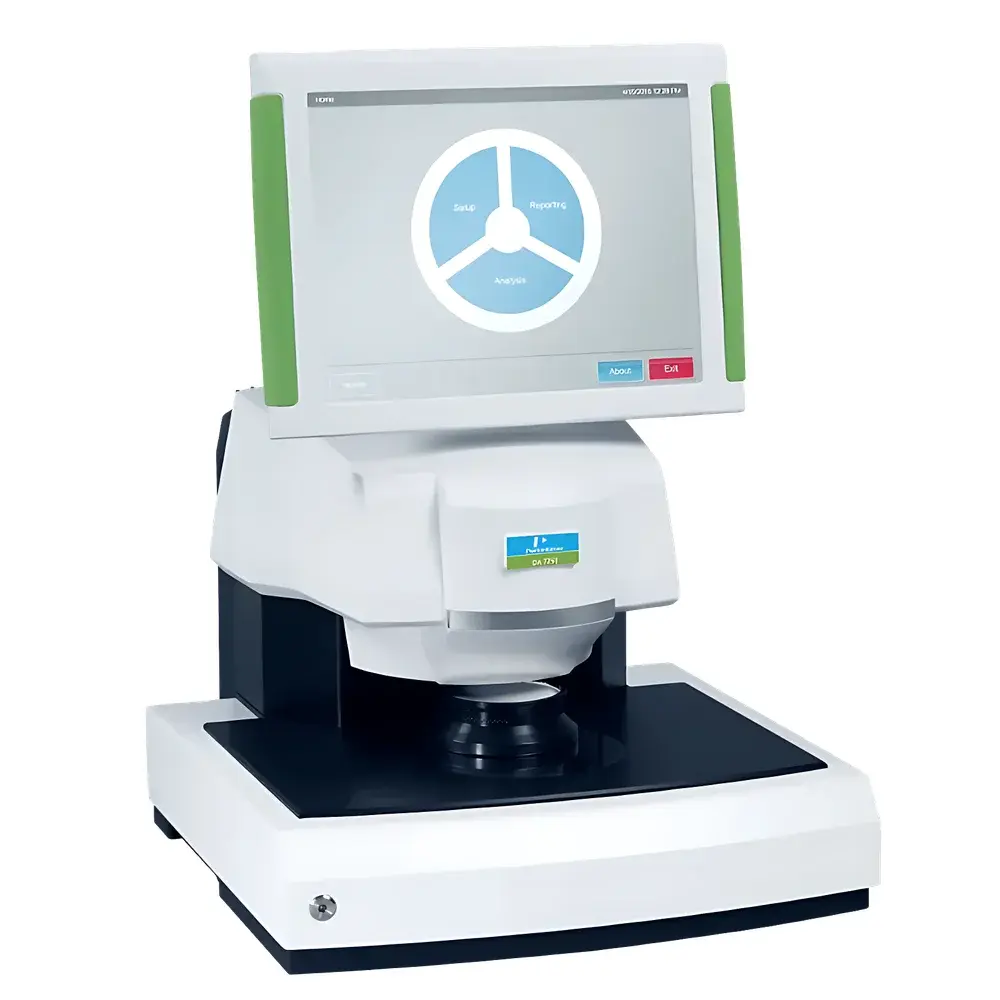
Perten DA7250 Diode Array Near-Infrared Spectrometer
| Brand | Perten |
|---|---|
| Origin | Sweden |
| Model | DA7250 |
| Instrument Type | Laboratory |
| Principle | Grating-based non-scanning diode array spectrometry |
| Wavelength Range | 950–1650 nm |
| Scan Speed | 100 spectra/sec |
| Data Sampling Interval | 0.008 s |
| Measurement Mode | Diffuse Reflectance |
| Chemometrics Software | Unscrambler |
| Detector | Thermoelectrically Cooled InGaAs Diode Array |
| Optical Resolution | Adjustable from 0.1 nm to 10 nm |
| Spectral Bandwidth | ~7 nm |
| Wavelength Accuracy | <0.05 nm |
| Wavelength Repeatability | <0.02 nm (per measurement), <0.2 nm/year |
| Absorbance Range | 0–2.5 AU |
| Noise Level | <20 µA (10 s continuous acquisition) |
| Light Source Lifetime | >10,000 h |
| Operating Temperature | 0–40 °C |
| IP Rating | IP65 |
| Sample Weight Capacity | 0.5–300 g (solids), 2–100 mL (liquids) |
| Standard Sample Area | 154 cm² (large cup), 44 cm² (small cup) |
| Analysis Time | ≤6 s per sample |
| Measurement Geometry | Non-contact rotating scan |
Overview
The Perten DA7250 is a third-generation diode array near-infrared (NIR) spectrometer engineered for high-throughput, non-destructive compositional analysis in agricultural, food, feed, and biofuel laboratories. It employs a fixed holographic gold-coated grating coupled with a thermoelectrically cooled indium gallium arsenide (InGaAs) linear diode array detector, enabling true parallel spectral acquisition across the 950–1650 nm wavelength range. Unlike scanning monochromator systems, the DA7250 captures full-spectrum data simultaneously—eliminating mechanical movement and enhancing long-term optical stability, wavelength reproducibility (<0.02 nm per measurement), and resistance to environmental drift. Its non-contact rotating scan geometry ensures uniform illumination and signal averaging over heterogeneous samples, while the integrated reference light source provides real-time photometric correction. Designed for routine QC and R&D applications, the DA7250 delivers quantitative results for moisture, protein, fat, starch, fiber, ash, amino acids, and other chemically relevant constituents—typically within six seconds per measurement—without sample preparation or consumables.
Key Features
- Fixed-grating diode array architecture with no moving optical parts, ensuring high mechanical robustness and minimal maintenance over extended operational lifetimes.
- Thermoelectrically cooled InGaAs detector delivering low-noise performance (<20 µA over 10 s) and stable responsivity across ambient temperatures (0–40 °C).
- Adjustable spectral resolution (0.1–10 nm) and ~7 nm spectral bandwidth optimized for balancing signal-to-noise ratio and chemical specificity in complex matrices.
- Non-contact rotating scan mode compatible with whole grains, powders, pastes, liquids, and pellets—enabling representative bulk analysis without compaction or dilution.
- IP65-rated enclosure with fully sealed optical path, dust- and splash-resistant design suitable for production-floor or field-deployable laboratory environments.
- Integrated industrial-grade touchscreen PC with USB and Ethernet connectivity, supporting standalone operation or networked deployment in regulated environments.
- Pre-calibrated, application-specific spectral libraries validated against reference wet chemistry methods per ISO 12099, AOAC 984.27, and AACC 39-00 protocols.
Sample Compatibility & Compliance
The DA7250 accommodates diverse physical forms—including intact kernels (wheat, corn, soybean), milled flours, oilseed meals, dairy powders, liquid milks, fermented broths, distillers’ dried grains with solubles (DDGS), and ethanol blends—within standardized sample cups (44 cm² small, 154 cm² large). Its diffuse reflectance geometry minimizes particle-size effects and surface heterogeneity artifacts common in agricultural commodities. The instrument complies with international standards for NIR method validation, including ISO 12099:2017 (animal feeding stuffs), ISO 21542:2020 (cereals and pulses), and ASTM E1655 (standard practices for NIR quantitative analysis). All calibration models are traceable to NIST-certified reference materials and support GLP/GMP documentation requirements, including audit trails, user access controls, and electronic signature functionality when paired with compliant Unscrambler X software configurations.
Software & Data Management
The DA7250 operates natively with CAMO Unscrambler X—a validated chemometrics platform widely adopted in regulated industries. Unscrambler supports partial least squares (PLS), principal component regression (PCR), and multivariate curve resolution (MCR) modeling, with built-in tools for outlier detection, model validation (cross-validation, external test sets), and uncertainty estimation. Raw spectral data (.spc, .csv) and processed results are stored in structured, timestamped databases with full metadata logging (operator ID, sample ID, instrument conditions, calibration version). Data export options include CSV, Excel, and XML formats compatible with LIMS integration. For FDA-regulated environments, optional 21 CFR Part 11 compliance packages provide electronic record integrity, role-based permissions, and immutable audit trails.
Applications
The DA7250 serves as a primary analytical tool across multiple sectors: in cereal breeding programs for rapid phenotyping of protein, hardness, and starch composition; in flour milling for real-time monitoring of moisture, ash, and gluten quality parameters (sedimentation value, water absorption); in oilseed processing for quantifying oil content, free fatty acids, and iodine value in raw seeds and meal fractions; in dairy manufacturing for simultaneous determination of fat, protein, lactose, and non-fat solids in milk powders and whey concentrates; in ethanol biorefineries for tracking fermentation intermediates (glucose, ethanol, glycerol) and final product purity; and in pet food QA for nutritional label verification and adulterant screening (e.g., melamine, soy protein isolate substitution). Its open database architecture allows seamless expansion of calibrations for new commodities and analytes using transfer learning and local model development workflows.
FAQ
What sample preparation is required prior to analysis?
No grinding, drying, or homogenization is needed for most solid or liquid samples—analysis is performed directly on representative subsamples placed in standard cups.
Can the DA7250 be used for regulatory compliance testing?
Yes—when deployed with validated calibrations and Unscrambler X configured for 21 CFR Part 11 or Annex 11 compliance, it meets documentation and data integrity requirements for GMP/GLP environments.
How often does the instrument require recalibration or maintenance?
The fixed-grating design eliminates wavelength drift-related recalibration; routine verification using certified reference standards is recommended every 3–6 months depending on usage frequency and environmental conditions.
Is method transfer possible between different DA7250 units?
Yes—spectral data are instrument-independent when acquired under identical optical geometry and detector settings; PLS models trained on one unit can be deployed on others with minimal bias correction using standardization samples.
What is the expected lifetime of the light source and detector?
The tungsten-halogen source exceeds 10,000 hours of operation; the thermoelectrically cooled InGaAs array maintains stable quantum efficiency for >5 years under typical laboratory use, with no user-serviceable replacement required.






