
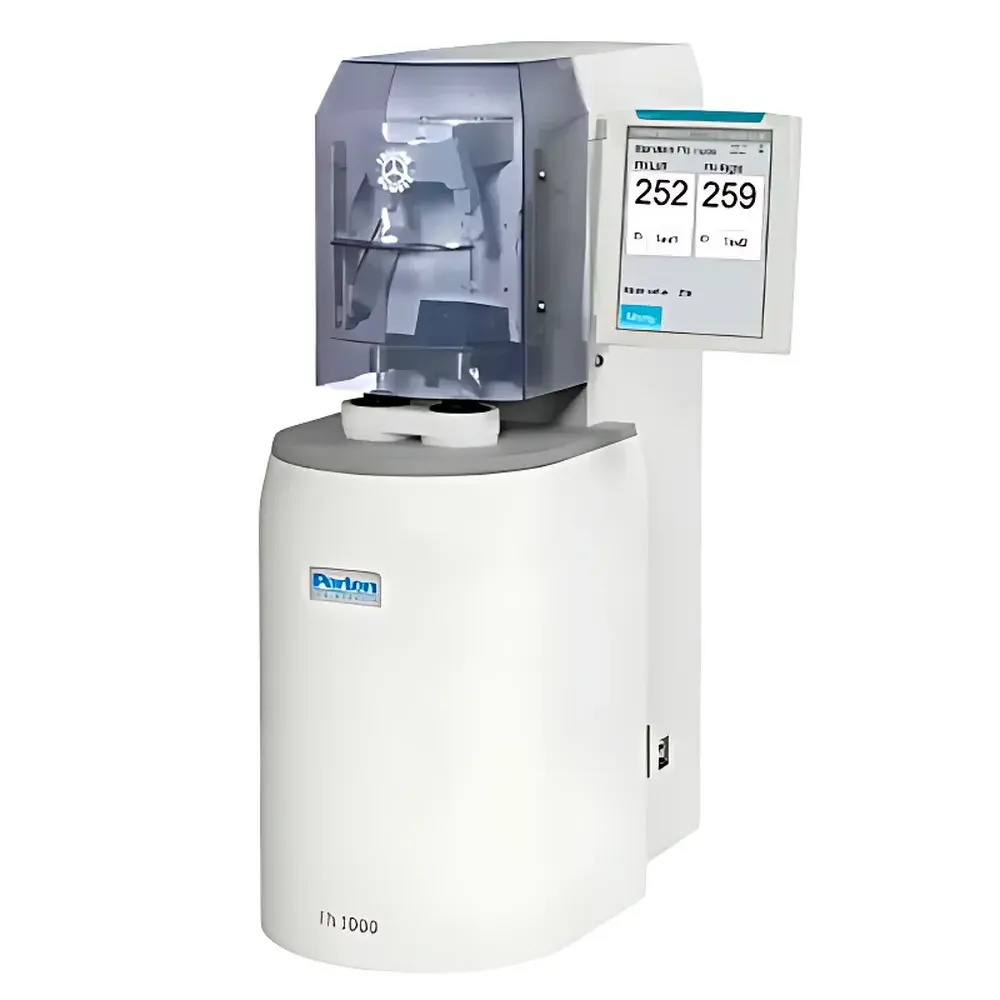
Perten FN1000 Falling Number Analyzer
| Brand | Perten |
|---|---|
| Origin | Sweden |
| Model | FN1000 |
| Compliance | ASTM/ICC/AACC/ISO/GB Standards |
| Sample Type | Wheat, Durum, Rye, Barley, Flour, and Other Cereal Grains |
| Measurement Principle | Viscosity-based enzymatic hydrolysis kinetics (Hagberg-Perten method) |
| Temperature Control | Precise 100 °C water bath with auto-leveling system |
| Dispensing Accuracy | 25.0 ± 0.2 mL deionized water per test |
| Display | 5.7″ color touchscreen with multilingual UI (including Chinese) |
| Connectivity | USB 2.0 + Ethernet (RJ45) for LIMS integration, barcode readers, and thermal printers |
| Altitude Compensation | Automatic correction above 610 m (2000 ft) ASL |
| Dual-Mode Operation | Standard Falling Number (FN) and Fungal Falling Number (FFN) via firmware switch |
| Data Management | Sample ID registration, moisture-corrected reporting, audit-ready result logs |
Overview
The Perten FN1000 Falling Number Analyzer is a fully automated, dual-capillary viscometric instrument engineered for precise quantification of α-amylase activity in cereal grains and milled products—including wheat, durum, rye, barley, and flour. It implements the internationally standardized Hagberg-Perten method, wherein a slurry of ground sample and distilled water is heated to boiling (100 °C) under controlled agitation; the time required for a stirrer to descend a fixed distance through the gelatinizing, enzymatically degraded starch suspension—expressed in seconds—is defined as the Falling Number (FN). Low FN values correlate strongly with elevated α-amylase activity, typically resulting from pre-harvest sprouting damage. The FN1000 delivers traceable, reproducible results aligned with regulatory and quality control requirements across global grain trading, milling, and baking industries.
Key Features
- Fully automated dual-tube measurement system eliminates manual timing errors and operator variability.
- Integrated thermostatically controlled water bath with real-time level monitoring ensures consistent 100 °C thermal environment throughout the 60–300 second assay window.
- High-precision volumetric dispenser delivers exactly 25.0 ± 0.2 mL of deionized water per test, minimizing inter-run dispersion.
- Auto-stop functionality triggers termination upon reaching user-defined target FN thresholds, optimizing throughput in high-volume laboratories.
- Onboard environmental sensors continuously monitor ambient temperature and atmospheric pressure, enabling automatic altitude compensation for installations above 610 m (2000 ft) ASL.
- Dual-mode firmware supports both standard Falling Number (FN) and Fungal Falling Number (FFN) protocols without hardware modification.
- 5.7-inch resistive color touchscreen interface offers intuitive navigation, multilingual support (including English, Chinese, Spanish, and German), and context-sensitive prompts.
- Robust mechanical architecture—featuring corrosion-resistant stainless steel components and sealed electronics—ensures long-term operational stability with minimal scheduled maintenance.
Sample Compatibility & Compliance
The FN1000 accepts whole kernels, cracked grains, and milled flours conforming to particle size specifications outlined in ICC No. 107 and ISO 3093. Moisture content is automatically factored into final FN calculations when sample ID-linked moisture data are entered or imported. The instrument meets all mandatory performance criteria defined in AACC Method 56-81B, ICC Standard No. 107, ISO/DIS 3093, and GB/T 10361–2008. Its design supports GLP-compliant workflows: each test generates a timestamped record containing raw descent time, corrected FN value, moisture-adjusted result, ambient conditions, operator ID, and instrument calibration status—all exportable in CSV or XML format for archival or LIMS ingestion.
Software & Data Management
Embedded firmware provides full audit trail functionality compliant with FDA 21 CFR Part 11 requirements when used with validated network configurations. All measurements are stored locally with immutable metadata—including date/time stamps, sensor readings, and user authentication logs. USB and Ethernet interfaces facilitate direct connection to laboratory printers, barcode scanners for sample tracking, and enterprise data systems. Exported datasets include raw descent curves (time vs. position), intermediate viscosity estimates, and final FN/FFN values with uncertainty indicators derived from internal repeatability validation routines. Optional Perten LabLink software enables centralized instrument fleet management, remote diagnostics, and statistical process control charting across multiple sites.
Applications
- Pre-harvest sprout detection in commercial wheat and barley deliveries at elevators and port terminals.
- Quality assurance testing of flour batches prior to dough formulation in industrial bakeries and noodle manufacturers.
- R&D evaluation of enzyme-inhibiting treatments, storage conditions, and varietal resistance to pre-harvest germination.
- Regulatory compliance verification for export shipments subject to ICC or AACC contractual specifications.
- Validation of malting potential in barley intended for brewing applications via FFN mode.
- Supporting HACCP and GMP documentation frameworks through integrated electronic recordkeeping.
FAQ
Does the FN1000 require periodic calibration?
No. The instrument employs factory-traceable mechanical and thermal references; no user-performed calibration is necessary. Verification is performed via daily system checks using certified reference slurries.
Can the FN1000 be integrated into an existing LIMS environment?
Yes. Native Ethernet and USB host capabilities support seamless bidirectional data exchange with LIMS platforms using standard TCP/IP protocols and delimited text formats.
What standards does the FN1000 satisfy for international trade?
It is the only commercially available analyzer independently verified to meet AACC 56-81B, ICC 107, ISO 3093, and GB/T 10361–2008 simultaneously—making it admissible in arbitration testing under GAFTA and FOSFA contracts.
Is operator training required to achieve ISO 17025-compliant results?
Minimal training suffices due to guided workflow logic and built-in error prevention; however, documented competency assessment remains the laboratory’s responsibility per ISO/IEC 17025:2017 Clause 6.2.
How does altitude affect Falling Number results—and how does the FN1000 compensate?
Boiling point depression at elevation reduces starch gelatinization rate, artificially lowering FN. The FN1000 uses onboard barometric pressure sensing to apply empirically validated correction factors per ISO 3093 Annex B.





