
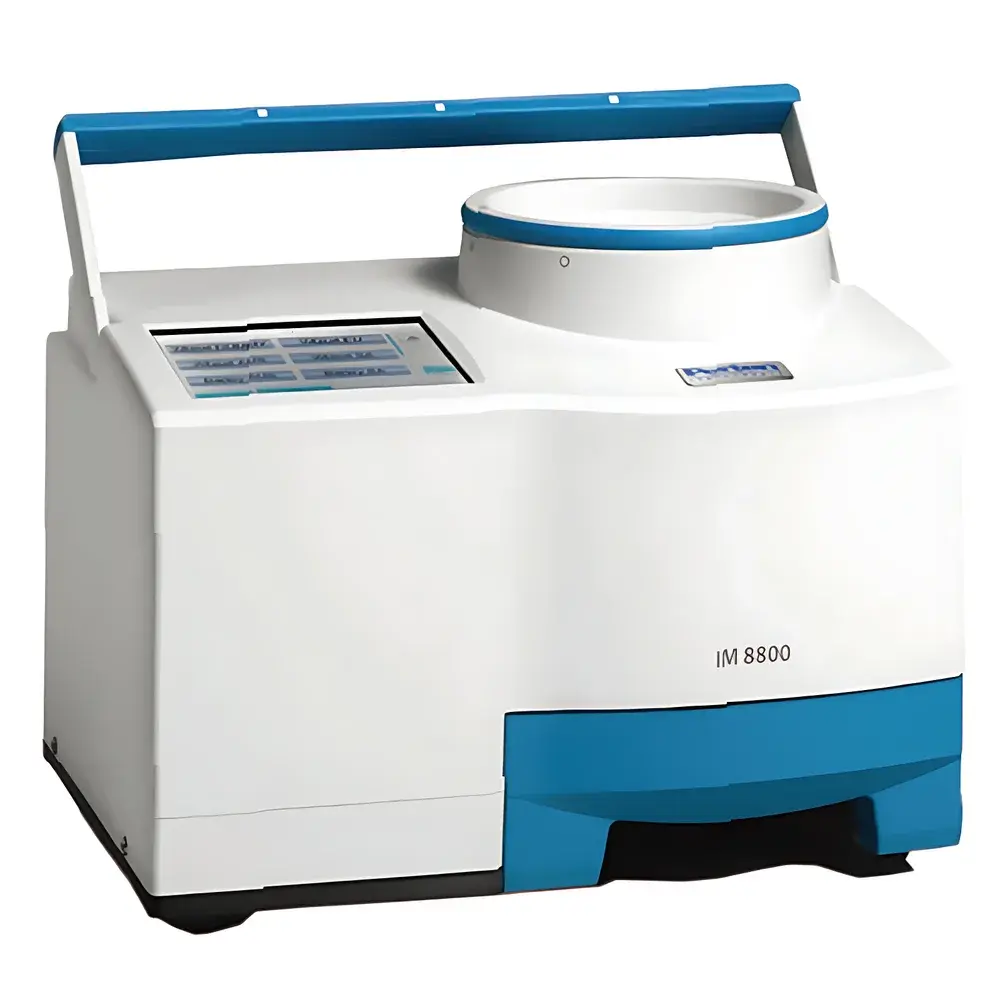
Perten IM 8800 Portable Near-Infrared Spectrometer for Soybean Protein Analysis
| Brand | Perten |
|---|---|
| Origin | Sweden |
| Model | IM 8800 |
| Instrument Type | Portable |
| Application Field | Cereals & Oilseeds |
| Measurement Principle | Grating-based diode array (non-scanning) |
| Wavelength Range | 850–1050 nm |
| Scan Time | 20 seconds |
| Data Sampling Interval | 5 nm |
| Measurement Mode | Transmission |
| Chemometrics Software | Unscrambler® |
| GPS Integration | Yes |
| Power Supply | 12 V DC or internal rechargeable battery (2 h runtime) |
| Compliance | AACC Method 39-25 |
Overview
The Perten IM 8800 is a field-deployable, transmission-mode near-infrared (NIR) spectrometer engineered for rapid, non-destructive quantification of protein and other key compositional parameters in soybeans and cereal grains. Unlike scanning monochromator-based systems, the IM 8800 employs a fixed grating and solid-state diode array detector architecture—eliminating moving optical components to ensure mechanical robustness, long-term photometric stability, and inter-instrument reproducibility. Its spectral acquisition operates across the 850–1050 nm range at 5 nm resolution, optimized for strong absorption bands associated with N–H and C–H overtones in proteins and starches. Designed explicitly for agronomic decision support, the IM 8800 integrates high-precision GPS geotagging to link spectral measurements directly to field coordinates, enabling spatial mapping of protein variability across harvest zones—a capability critical for precision grain marketing, storage segregation, and yield-quality correlation analysis.
Key Features
- True portable form factor: Compact housing (W × D × H: 320 × 240 × 150 mm), weight < 5.5 kg; designed for operation inside combine cabs, grain trucks, silos, and open-field environments.
- Integrated GPS module: Records latitude/longitude, altitude, and timestamp for every spectrum, supporting GIS-compatible export of geo-referenced quality data.
- Transmission measurement geometry: Optimized for homogeneous, low-moisture grain samples; includes calibrated sample cup with consistent pathlength and pressure control.
- Passive thermal stabilization: Solid-state optical train minimizes drift under ambient temperature fluctuations (10–40 °C operating range).
- Dual power options: Operates from 12 V DC vehicle supply or internal Li-ion battery (rated for ≥2 h continuous use per charge).
- Automatic shutter and dust-resistant optics: Protects detector and grating from solar exposure, particulate ingress, and biological contamination during field deployment.
- Firmware-controlled auto-calibration: Uses built-in reference standards to maintain baseline integrity without external hardware.
Sample Compatibility & Compliance
The IM 8800 is validated for intact, unground soybean seeds, wheat, barley, oats, and corn kernels—requiring no sample preparation beyond basic cleaning and moisture equilibration. It supports routine calibration transfer between instruments using PLS regression models developed in The Unscrambler® X software. Regulatory alignment includes full conformance with AACC International Method 39-25 (“Determination of Protein in Cereal Grains by Near-Infrared Reflectance”) when operated with certified calibration sets. While configured for transmission, its performance equivalency to laboratory-grade Perten Inframatic 9500 systems has been verified through multi-laboratory round-robin studies under ISO 5725-2:2019 (accuracy and precision of measurement methods). The system meets GLP documentation requirements via audit-trail-enabled software logging and supports 21 CFR Part 11-compliant user access controls when deployed with validated Unscrambler® X configurations.
Software & Data Management
Data acquisition, preprocessing, and quantitative modeling are executed via The Unscrambler® X v10.5 or later—licensed separately. The software provides full chemometric workflow support: spectral pretreatment (SNV, derivatives, multiplicative scatter correction), PLS and PCR model development, cross-validation (venetian blinds, full cross-validation), outlier detection, and prediction uncertainty estimation. All GPS metadata, instrument status logs, and raw interferograms are embedded in .usp binary files and exportable as CSV or XML for integration into farm management information systems (FMIS) or enterprise LIMS platforms. Firmware updates and method libraries are distributed via secure Perten Cloud portal with version-controlled release notes and validation summaries.
Applications
- On-harvest protein mapping: Generate real-time protein distribution maps across fields to guide selective harvesting, drying schedules, and bin-loading strategies.
- Grain procurement QA/QC: Screen incoming soybean lots at elevator intake points to enforce contractual protein thresholds before unloading.
- Storage management: Monitor protein stability during bulk storage; detect early signs of spoilage-induced compositional drift.
- Seed breeding trials: Rapid phenotyping of segregating populations for protein content under field conditions without lab turnaround delays.
- Contractual verification: Provide auditable, geotagged evidence of grain quality at point-of-sale—reducing disputes and enabling premium pricing for high-protein fractions.
- Regulatory reporting: Support traceability requirements under EU Regulation (EC) No 834/2007 (organic production) and USDA AMS grain grading protocols.
FAQ
Is the IM 8800 suitable for measuring protein in ground versus whole soybeans?
The instrument is calibrated and validated for whole, intact soybean seeds. Grinding introduces particle size effects that invalidate transmission-based calibrations unless re-validated with matrix-matched ground samples.
Can calibration models developed on the IM 8800 be transferred to a laboratory Inframatic 9500?
Yes—Perten’s standardized optical platform enables direct model portability between IM 8800 and Inframatic 9500 when using identical chemometric preprocessing steps and reference methods.
What environmental conditions limit field operation?
Operation is rated for 10–40 °C and ≤85% RH non-condensing. Direct sunlight exposure longer than 30 minutes without shade cover may elevate internal temperature beyond optimal detector operating range.
Does the GPS module require cellular connectivity?
No—the IM 8800 uses standalone GNSS (GPS + GLONASS) receivers; no SIM card or network subscription is needed for geotagging.
How frequently must the instrument be recalibrated against reference methods?
Annual verification against primary Kjeldahl or Dumas reference data is recommended; interim performance checks using control samples should be conducted daily in high-throughput field use.
Related Products






