
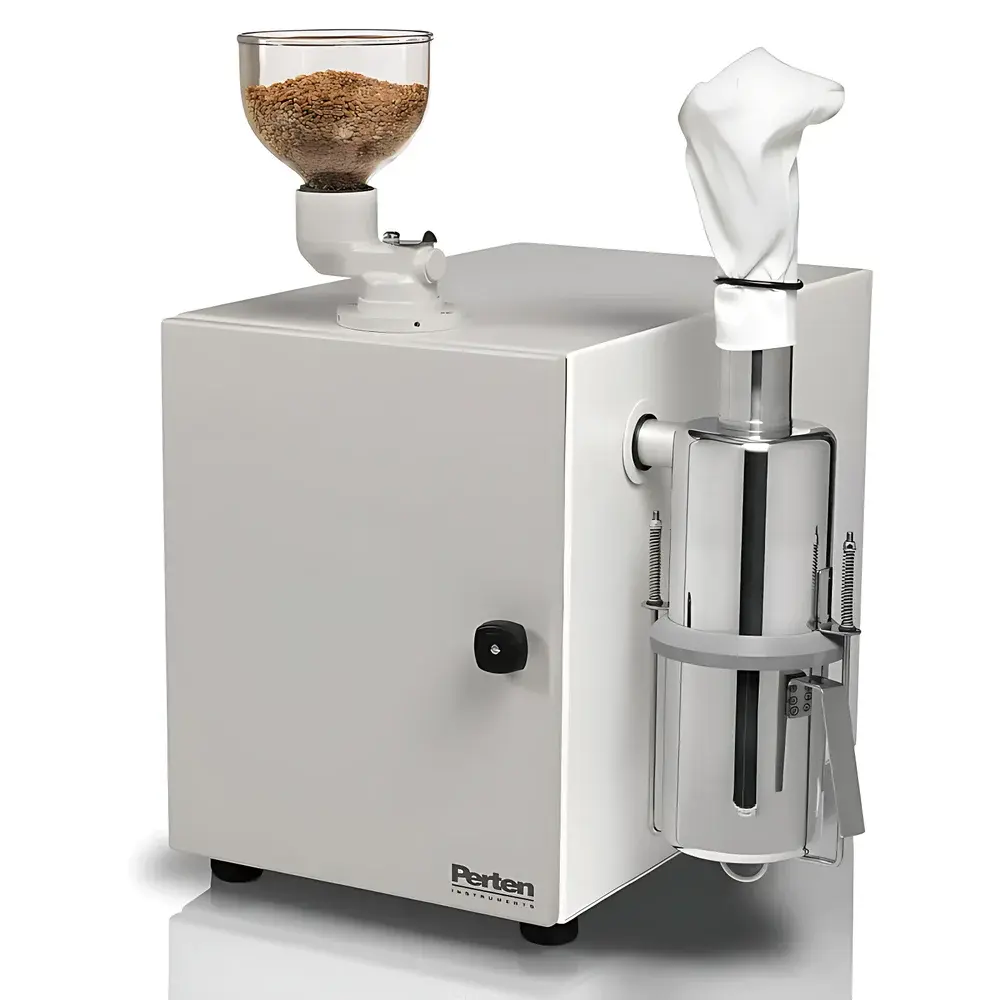
Perten LM3100 Hammer Mill Laboratory Grinder
| Brand | Perten |
|---|---|
| Origin | Sweden |
| Model | LM3100 |
| Grinding Principle | High-Speed Hammer Mill with Pneumatic Feed & Cyclonic Separation |
| Maximum Batch Capacity | ≤300 g |
| Feed Size | 40–80 mesh |
| Output Particle Size | ≥0.5 mm (adjustable via stainless-steel sieve plates: 0.5–2.0 mm standard options) |
| Rotor Speed | 16,800 rpm |
| Grinding Time | 30–50 s for 300 g sample |
| Noise Level | ≤75 dB(A) with acoustic enclosure |
| Power Supply | 110–440 V, single- or three-phase, 50/60 Hz, 1.1 kW |
| Dimensions (LM3100) | 560 × 510 × 630 mm |
| Compliance | Designed for GLP-compliant grain and feed analysis workflows |
Overview
The Perten LM3100 Hammer Mill Laboratory Grinder is a precision-engineered, high-speed pneumatic hammer mill designed specifically for reproducible, low-contamination particle size reduction of hard, brittle, and fibrous biological samples—primarily cereal grains, oilseeds, legumes, and animal feed matrices. Operating on the principle of impact comminution, the LM3100 utilizes a dynamically balanced rotor equipped with hardened steel hammers rotating at 16,800 rpm within a sealed, acoustically insulated chamber. Sample introduction is controlled via an adjustable air-regulated feed regulator, ensuring consistent mass flow into the grinding zone. Ground particles are conveyed by cyclonic airflow through interchangeable stainless-steel sieve plates (standard 0.8 mm; optional 0.5–2.0 mm), enabling precise control over output particle size distribution. The integrated self-cleaning cyclone separator separates fine, uniformly sized material from the air stream and deposits it directly into a removable, easy-access stainless-steel collection vessel—minimizing cross-contamination and eliminating manual cleaning between sequential samples.
Key Features
- Acoustic enclosure reduces operational noise to ≤75 dB(A), meeting occupational safety standards for routine laboratory use.
- Interlocked safety system: motor remains de-energized unless the access door is fully closed; immediate shutdown occurs upon door opening.
- Self-cleaning design: continuous airflow through the grinding chamber and cyclone prevents residue accumulation, enabling rapid sequential processing without manual cleaning.
- Pneumatic feed regulation ensures uniform sample introduction—critical for maintaining analytical repeatability across heterogeneous materials such as high-moisture barley, hulled oats, or paddy rice.
- Dust suppression via integrated filter bag assembly minimizes airborne particulate release, supporting ISO 14644-1 Class 8 cleanroom-adjacent environments and operator respiratory protection compliance.
- Modular sieve plate system allows rapid changeover between 0.5 mm, 0.8 mm, 1.0 mm, 1.5 mm, and 2.0 mm apertures—tailoring particle size to downstream analytical method requirements (e.g., falling number, gluten quantification, NIR calibration, Kjeldahl digestion, Soxhlet extraction).
Sample Compatibility & Compliance
The LM3100 is validated for use with hard, low-moisture botanical matrices including wheat, maize, sorghum, soybean, rapeseed, and compound feed pellets. Its robust construction and optimized impact geometry prevent thermal degradation and minimize starch gelatinization during short-duration grinding cycles (30–50 s). The instrument conforms to sample preparation protocols referenced in ISO 712 (moisture determination), ISO 2795 (crude protein by Kjeldahl), AACC Method 26–20A (falling number), and AACCI 44–15A (NIR calibration). When operated with documented SOPs and maintained per Perten’s service schedule, the LM3100 supports audit readiness for GLP and GMP environments—particularly where traceability, equipment qualification (IQ/OQ), and batch record linkage are required.
Software & Data Management
While the LM3100 operates as a standalone electromechanical grinder without embedded firmware or digital interface, its design integrates seamlessly into regulated laboratory informatics ecosystems. All mechanical parameters—including grinding time, sieve plate ID, batch weight, and operator ID—are manually logged or captured via LIMS-integrated electronic notebooks. Optional Perten 3170 Motorized Feeder enhances process consistency for moisture-variable or irregularly shaped feedstocks and can be assigned unique calibration records. For FDA 21 CFR Part 11 compliance, laboratories may implement third-party electronic signature and audit trail modules when logging LM3100 usage metadata in validated LIMS platforms.
Applications
- Preparation of homogenized grain flour for falling number testing (ISO 3093) and gluten index analysis (AACC 38–12).
- Generation of representative subsamples for near-infrared (NIR) spectral calibration models—where particle size uniformity directly influences prediction accuracy.
- Routine milling prior to Kjeldahl nitrogen determination (ISO 2795) and acid-detergent fiber (ADF) analysis (AOAC 973.18).
- Feed formulation QA/QC, including particle size distribution assessment for pelleted and mash feed products.
- Research-scale comminution studies requiring controlled, repeatable size reduction without oxidative or thermal artifact generation.
FAQ
What sieve plate sizes are included with the standard LM3100 configuration?
The instrument ships with a 0.8 mm stainless-steel sieve plate. Additional plates (0.5 mm, 1.0 mm, 1.5 mm, and 2.0 mm) are available as optional accessories.
Can the LM3100 process high-moisture grains without clogging?
Yes—when paired with the optional Perten 3170 motorized feeder, the LM3100 achieves consistent throughput for grains with moisture content up to 18% (w.b.), including paddy rice and hulled oats.
Is the LM3100 suitable for regulatory submissions under ISO/IEC 17025?
Yes—the device supports method validation per ISO/IEC 17025:2017 Clause 7.2.2 when used with documented calibration, preventive maintenance logs, and traceable sieve plate certification.
Does the LM3100 require compressed air or external vacuum?
No—it operates using internal fan-driven airflow; no external utility connections are needed beyond standard electrical supply.
How often should the hammer set be replaced?
Under typical laboratory use (≤10 batches/day), hardened steel hammers maintain dimensional integrity for ≥12 months; replacement intervals are tracked via Perten’s recommended maintenance log (Form LM3100-MNT-01).



