
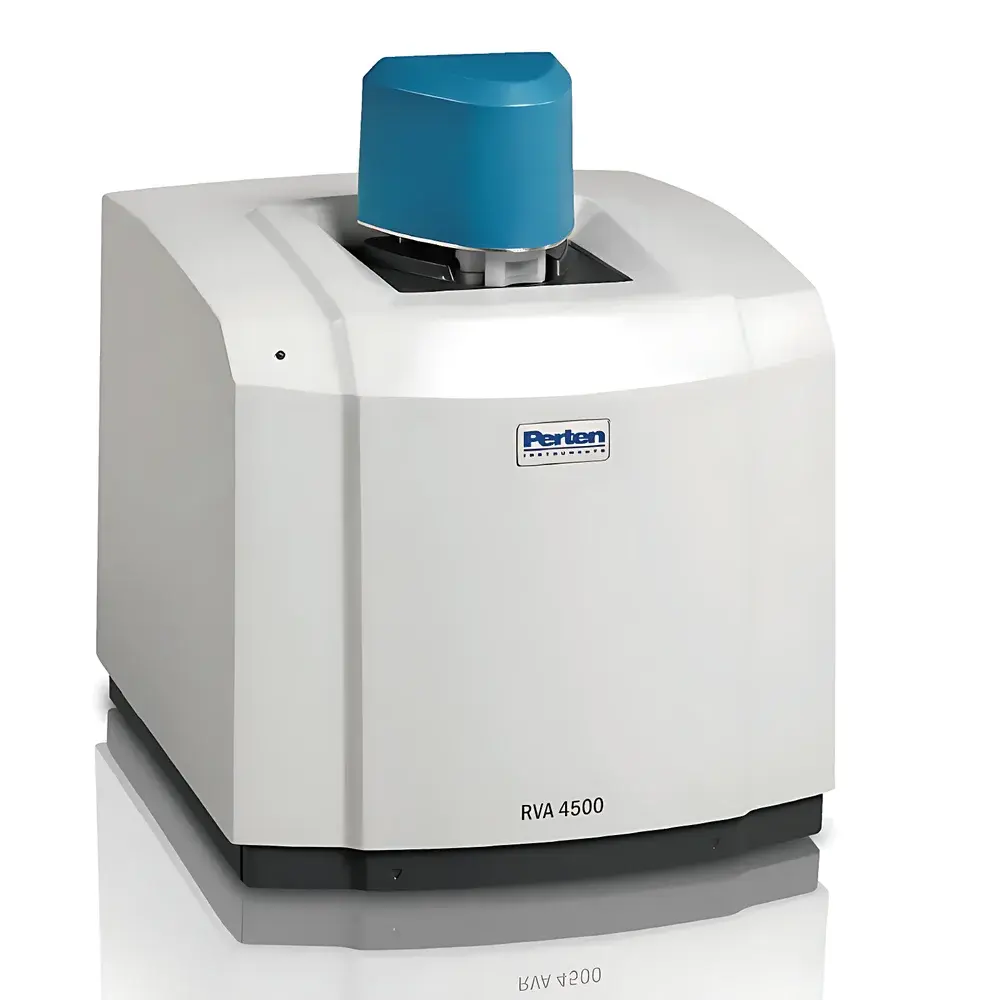
Perten RVA 4500 Rapid Visco Analyzer
| Brand | Perten |
|---|---|
| Origin | Imported |
| Model | RVA 4500 |
| Viscosity Range | 20–50,000 cP (at 80 rpm) |
| Measurement Time | 3 min (stirring value) |
| Sample Mass | 2–3 g |
| Compliance | GB/T 22427.7-2023, GB/T 24852-2010, GB/T 24853-2010, AACC 61-02 (1995), AACC 22-08 (1995), AACC 76-21 (1997) |
| Software | Thermocline for Windows (TCW3) |
| Drive System | Brushless DC motor |
| Temperature Control | Programmable ramping and holding (4–130 °C) |
| Shear Control | Variable rotational speed (up to 160 rpm) |
| Data Output | Time-temperature-viscosity profiles with automated parameter extraction (onset, peak, breakdown, setback, final viscosity) |
Overview
The Perten RVA 4500 Rapid Visco Analyzer is a precision-controlled, programmable rotational viscometer engineered specifically for the quantitative characterization of starch gelatinization behavior and thermal-thickening dynamics in food matrices. Operating on the principle of controlled-shear rheometry under precisely defined temperature ramps, the instrument subjects a small sample (2–3 g) suspended in aqueous medium to a user-defined thermal protocol—typically comprising controlled heating, holding, and cooling phases—while continuously measuring torque-induced resistance to rotation. This yields a time-temperature-viscosity profile that reflects fundamental functional properties: onset of gelatinization, peak viscosity, thermal stability (breakdown), retrogradation tendency (setback), and final cooled-state viscosity. Unlike generic viscometers, the RVA 4500 integrates synchronized thermal programming and variable-speed shear control, enabling simulation of real-world processing conditions—including cooking, steaming, extrusion pre-conditioning, and cooling cycles—making it functionally equivalent to a bench-scale “miniature processing line” for predictive formulation development.
Key Features
- Brushless DC motor drive ensuring long-term torque stability, minimal mechanical drift, and high reproducibility across low- and high-viscosity regimes (10–50,000 cP)
- Programmable temperature control from 4 °C to 130 °C with ±0.1 °C accuracy and ramp rates adjustable between 0.1–20 °C/min
- Variable rotational speed control (1–160 rpm) for precise shear rate modulation, supporting both low-shear sensitivity and high-shear stress simulation
- Automated analytical algorithm embedded in Thermocline for Windows (TCW3) software for real-time extraction of six standardized parameters: onset temperature, peak viscosity, peak time, breakdown, setback, and final viscosity
- Pre-loaded method library compliant with major international standards—including AACC 61-02, AACC 22-08, AACC 76-21, and Chinese national standards GB/T 22427.7-2023, GB/T 24852-2010, and GB/T 24853-2010
- GLP-compliant data handling with full audit trail, electronic signatures, and 21 CFR Part 11–ready configuration options for regulated environments
Sample Compatibility & Compliance
The RVA 4500 accommodates a broad spectrum of native and modified starches (corn, wheat, rice, potato, cassava, tapioca), cereal flours, legume proteins, hydrocolloids (guar gum, xanthan, CMC), dairy ingredients (whey protein, caseinates, gelatin), and composite food systems (batters, doughs, slurries). Its design meets requirements for routine testing in R&D laboratories, QC/QA departments, and contract analytical service providers operating under ISO/IEC 17025, GMP, or HACCP frameworks. All standard methods are traceable to internationally recognized reference protocols, and instrument calibration is supported by NIST-traceable viscosity standards and temperature verification blocks.
Software & Data Management
Thermocline for Windows (TCW3) serves as the central interface for method development, instrument control, real-time visualization, and post-acquisition analysis. The software supports multi-user permission levels, method versioning, raw data export (CSV, XML), and integration with LIMS platforms via ODBC. Each test generates a timestamped, digitally signed report containing full metadata: operator ID, instrument serial number, calibration status, environmental conditions, and complete viscosity-time-temperature arrays. Optional 21 CFR Part 11 modules provide electronic record integrity, change tracking, and role-based access control—critical for FDA-regulated product development and release testing.
Applications
- Starch Industry: Routine quality assessment of native and chemically/enzymatically modified starches; specification verification against contractual gelatinization profiles
- Bakery & Flour Milling: Evaluation of alpha-amylase activity, damaged starch content, and climate-induced grain deterioration through controlled gelatinization kinetics
- Cereal & Tubers: Comparative analysis of rice cultivars, wheat varieties, and root starch sources for texture, digestibility, and processing suitability
- Brewing & Malting: Monitoring malt modification degree, barley storage stability, and adjunct gelatinization efficiency prior to mashing
- Snack & Pet Food: Quantification of starch gelatinization extent during extrusion pre-conditioning and its correlation with expansion ratio and crunchiness
- Dairy & Hydrocolloids: Characterization of synergistic thickening effects in starch–gum blends; gelation onset and melt behavior in cheese analogs and plant-based dairy alternatives
FAQ
What standards does the RVA 4500 support out-of-the-box?
The instrument includes validated methods for AACC 61-02 (rice gelatinization), AACC 22-08 (stirring value), AACC 76-21 (cereal flour pasting), and Chinese national standards GB/T 22427.7-2023, GB/T 24852-2010, and GB/T 24853-2010.
Can the RVA 4500 simulate industrial processing steps?
Yes—its programmable temperature and shear profiles allow replication of heating/cooling cycles, hold times, and shear histories typical of cooking, canning, retorting, extrusion, and UHT processing.
Is TCW3 software compatible with modern Windows OS versions?
Thermocline for Windows v3.5 and later fully supports Windows 10 and Windows 11 (64-bit), including TLS 1.2+ secure communication and high-DPI display scaling.
How is calibration verified on the RVA 4500?
Calibration is performed using certified reference oils for viscosity and NIST-traceable temperature verification blocks at multiple setpoints (e.g., 50 °C, 95 °C, 120 °C), with results logged and reportable within TCW3.
Does the system support unattended operation?
Yes—the instrument supports sequential batch runs with auto-start, sample cup ejection, and error logging; integration with robotic autosamplers is available via optional hardware interfaces.





