
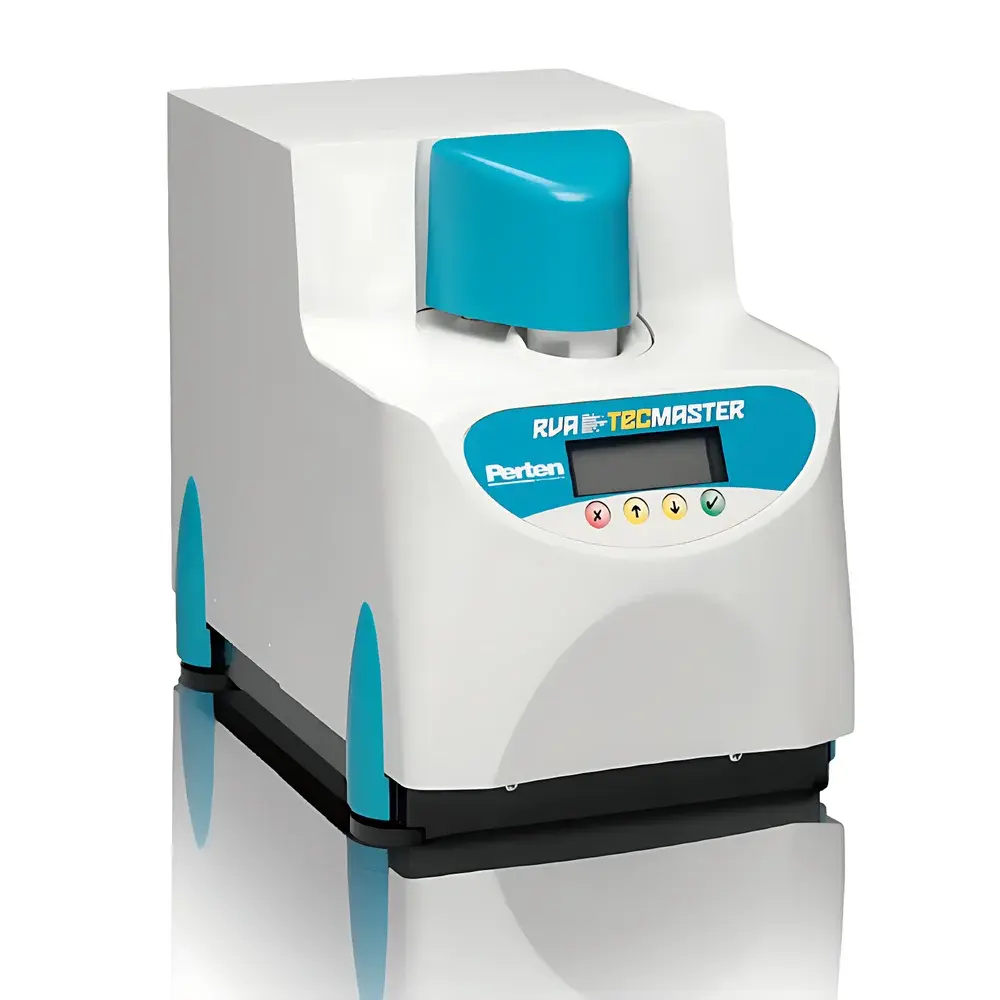
Perten RVA-TecMaster Rapid Visco Analyzer
| Brand | Perten |
|---|---|
| Origin | Imported (Sweden) |
| Model | RVA-TecMaster |
| Viscosity Range | 40–16,000 cP at 80 rpm |
| Sample Mass | 2–3 g |
| Measurement Time | 3 min (stirring value), 13 min (paste viscosity profile) |
| Compliance | GB/T 22427.7-2023, GB/T 24852-2010, GB/T 24853-2010, AACC 61-02 (1995), AACC 22-08 (1995), AACC 76-21 (1997) |
| Software | Thermocline for Windows (TCW3), supports method upload and offline operation |
Overview
The Perten RVA-TecMaster Rapid Visco Analyzer is a programmable, rotational viscometer engineered for precise, high-reproducibility measurement of starch gelatinization behavior and thermal-viscous profiles of food matrices under controlled shear and temperature conditions. Based on the Couette flow principle, it employs a rotating bob in a thermostatically regulated water-jacketed sample cup to quantify torque-derived viscosity across dynamically defined temperature ramps (e.g., 50–95–50 °C), enabling full characterization of pasting parameters—including onset temperature, peak viscosity, holding strength, breakdown, setback, and final viscosity. Its design conforms to internationally harmonized methodologies used in cereal science, starch chemistry, and industrial food R&D, delivering traceable, standardized data suitable for regulatory documentation, process validation, and raw material specification.
Key Features
- Programmable temperature control with ±0.1 °C stability over full 50–130 °C operating range, supporting custom heating/cooling profiles and isothermal holds.
- Adjustable rotational speed (20–200 rpm) with dual-speed calibration modes (80 rpm and 160 rpm) to accommodate diverse sample rheology—from low-viscosity enzyme assays to high-viscosity starch pastes.
- Minimal sample requirement of only 2–3 g per test, reducing material cost and enabling high-throughput screening of limited or expensive ingredients.
- Integrated thermocouple-based real-time temperature monitoring within the sample cup ensures accurate thermal profiling synchronized with viscosity acquisition.
- Robust mechanical architecture with precision-machined stainless-steel rotor and cup assembly, designed for long-term dimensional stability and inter-laboratory reproducibility.
- Automated calculation engine embedded in TCW3 software delivers standardized outputs per ASTM, ISO, and AACC-defined protocols without manual interpretation.
Sample Compatibility & Compliance
The RVA-TecMaster is validated for use with native and modified starches, cereal flours (wheat, rice, maize, sorghum), tuber-based materials (potato, cassava, taro), malted barley, dairy proteins (whey, casein, gelatin), hydrocolloids (guar, xanthan, CMC), and formulated food systems including batters, doughs, and extruded snacks. It meets all requirements specified in GB/T 22427.7-2023 (Starch Viscosity Determination), GB/T 24852-2010 (Rice and Rice Flour Gelatinization), and GB/T 24853-2010 (Wheat and Rye Flour Gelatinization). Internationally, it complies with AACC Method 61-02 (rice pasting), 22-08 (stirring value), and 76-21 (cereal flour pasting), as well as ISO 21502:2020 (Cereals — Determination of paste viscosity using rapid visco analyzers). Data integrity adheres to GLP principles; audit trails, electronic signatures, and user-access controls are configurable in TCW3 to support FDA 21 CFR Part 11 readiness.
Software & Data Management
Thermocline for Windows (TCW3) serves as the instrument’s central control and analysis platform. It hosts pre-loaded standard methods compliant with global cereal and starch testing norms, allows creation and validation of user-defined protocols—including multi-step hydration, shear modulation, and variable ramp rates—and supports secure export of raw torque/time/temperature datasets in CSV and XML formats. Up to four methods can be downloaded directly to the instrument’s internal memory for fully autonomous, PC-free operation—ideal for production-floor deployment or mobile labs. All analytical sessions are timestamped and logged with operator ID, method version, calibration status, and environmental metadata, ensuring full traceability for quality system audits.
Applications
- R&D and formulation: Optimization of starch modification degree, enzyme dosing (e.g., amylase activity screening), and hydrocolloid-starch synergy studies.
- Process control: Monitoring batch-to-batch consistency of flour blends, detecting heat damage or sprout damage in wheat, and validating extrusion or drum-drying endpoints.
- Quality assurance: Release testing of incoming starches, flours, and protein isolates against contractual specifications.
- Brewing & malting: Assessment of malt modification index, diastatic power, and wort filterability prediction via stirring value.
- Dairy & plant-based analogs: Characterizing melt behavior of cheese, gel strength of yogurts, and viscosity hysteresis in plant-protein beverages.
- Feed & pet food: Quantifying starch gelatinization extent in pelleted or expanded feeds to predict digestibility and pellet durability.
FAQ
What standards does the RVA-TecMaster support out-of-the-box?
It includes built-in methods aligned with GB/T 22427.7-2023, GB/T 24852-2010, GB/T 24853-2010, AACC 61-02, 22-08, and 76-21.
Can the instrument operate without a connected computer?
Yes—up to four validated methods can be stored onboard for standalone execution with local display and USB data retrieval.
Is calibration traceable to national metrology institutes?
Viscosity calibration uses NIST-traceable standard oils; temperature calibration is verified with certified RTD probes calibrated per ISO/IEC 17025-accredited procedures.
How is data integrity maintained during regulatory audits?
TCW3 provides full ALCOA+ compliance: attributable, legible, contemporaneous, original, and accurate records—with immutable audit logs, role-based access, and electronic signature capability.
What maintenance is required for long-term accuracy?
Annual verification of temperature uniformity, rotational speed accuracy, and torque sensor linearity is recommended; Perten-certified service technicians perform factory-level recalibration.






