
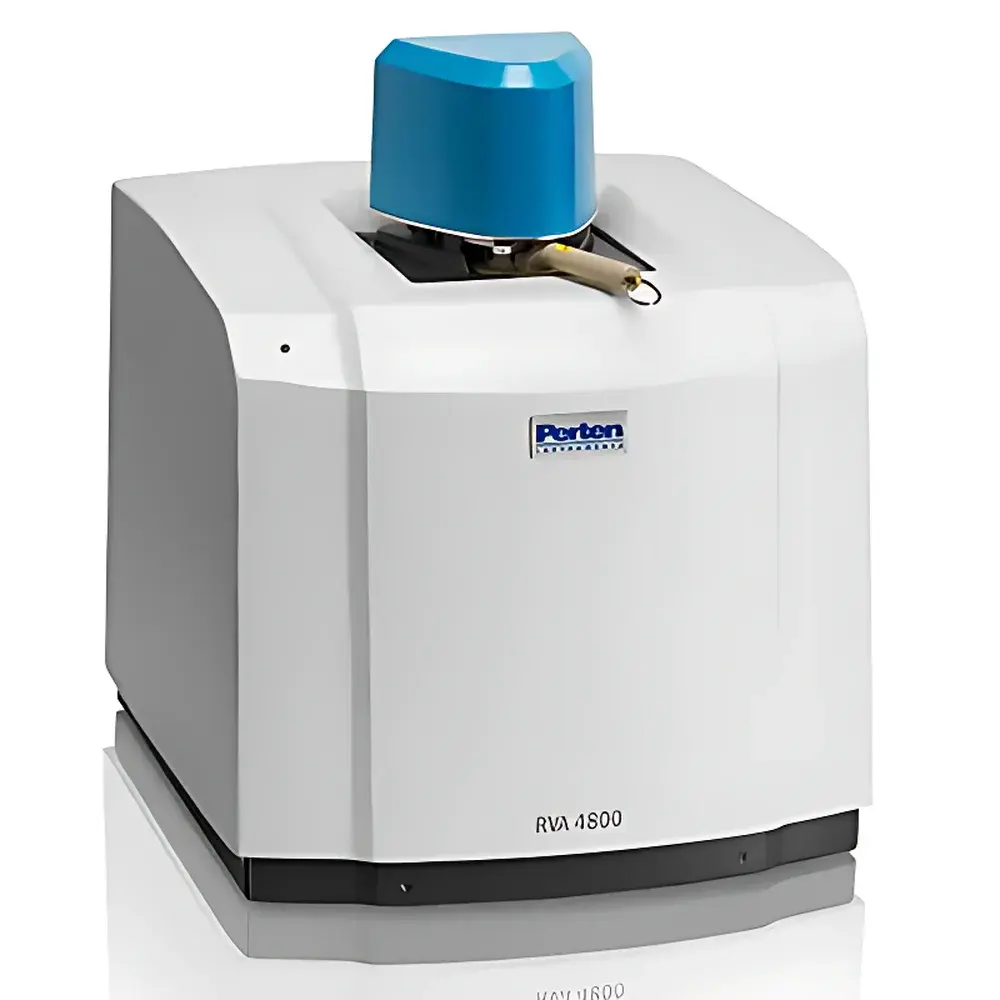
Perten RVA4800 Rapid Visco Analyser
| Brand | Perten |
|---|---|
| Origin | Imported |
| Manufacturer Type | Authorized Distributor |
| Model | RVA4800 |
| Voltage | 230/115 VAC, 5 A, 50/60 Hz |
| Dimensions (H×W×D) | 382 × 306 × 345 mm |
| Net Weight | 19 kg |
| Temperature Range | 0–140 °C |
| Heating/Cooling Rate | Up to 14 °C/min (adjustable) |
| Cooling Requirement | Tap water or recirculating chiller (1 L/min, 100–250 kPa) |
| Speed Range | 0, 20–2000 rpm (software-controlled) |
| Viscosity Range | 20–50,000 cP (at 80 rpm) |
| Viscosity Accuracy | ±2% at 5000 cP (calibrated against S2000 standard oil) |
| Compliance | ISO 9000 / ISO/IEC 17025, GB/T 22427.7–2023, ICC, AACC, FDA 21 CFR Part 11 (ER/ES), GLP/GMP-ready audit trail in TCW3 software |
Overview
The Perten RVA4800 Rapid Visco Analyser is a precision-controlled rotational viscometer engineered for the dynamic rheological characterization of starches, hydrocolloids, flours, dairy ingredients, and formulated food systems under programmable thermal and shear profiles. Operating on the principle of controlled-shear viscometry—where torque response to defined angular velocity is measured during precisely ramped heating, holding, and cooling cycles—the RVA4800 delivers time-resolved viscosity curves that correlate directly with functional behavior during industrial processing. Its extended temperature range (0–140 °C) enables simulation of high-intensity thermal treatments including ultra-high-temperature (UHT) sterilization, jet cooking, extrusion, aseptic processing, and high-pressure thermal sterilization—making it indispensable for R&D labs validating ingredient performance under real-world manufacturing conditions.
Key Features
- Extended Thermal Capability: Maximum temperature of 140 °C supports validation of starch gelatinization, protein denaturation, and hydrocolloid hydration kinetics under extreme process conditions—critical for UHT dairy, sterile soups, infant formula, and shelf-stable convenience foods.
- High-Fidelity Shear Control: Direct-drive motor and closed-loop speed regulation ensure precise, repeatable shear application across 20–2000 rpm, enabling accurate modeling of mixing, pumping, and homogenization stresses encountered in production lines.
- Standardized & Custom Method Execution: Preloaded library of 67 validated test protocols—including ICC 162, AACC 22–10, and GB/T 22427.7–2023—alongside fully customizable temperature/time/speed profiles for proprietary process simulation.
- Robust Mechanical Architecture: Stainless-steel sample vessel, crystal-clear stirrer geometry (designed for laminar flow consistency), and integrated safety interlocks ensure long-term operational stability from pilot plant to QC laboratory environments.
- Traceable Calibration & Audit Readiness: Built-in calibration verification routines aligned with ISO/IEC 17025 requirements; TCW3 software provides full electronic records, user authentication, and 21 CFR Part 11–compliant audit trails for regulated environments.
- Rapid Turnaround: Standard starch pasting analysis completed in ≤13 minutes—enabling high-throughput screening without compromising data integrity or reproducibility.
Sample Compatibility & Compliance
The RVA4800 accommodates a broad spectrum of food matrices—including native and modified starches, cereal flours, gluten-free blends, dairy powders, gums (e.g., xanthan, guar, carrageenan), and multi-component formulations. Its sealed, pressure-regulated test canister maintains mechanical integrity up to 140 °C and automatically locks when internal pressure exceeds safe thresholds—ensuring operator safety and sample containment during high-temperature testing. The system meets international regulatory expectations for method validation and instrument qualification: compliance with ISO 9001 quality management, ISO/IEC 17025 testing laboratory competence, and GB/T 22427.7–2023 for starch viscosity determination is documented and verifiable. For pharmaceutical-grade food ingredient development, the TCW3 software architecture satisfies FDA 21 CFR Part 11 requirements for electronic records and signatures, supporting GLP and GMP-aligned workflows.
Software & Data Management
Controlled exclusively via the TCW3 software platform, the RVA4800 integrates seamlessly into modern digital lab infrastructures. TCW3 provides intuitive method setup, real-time viscosity curve visualization, automated peak detection (peak viscosity, breakdown, setback, final viscosity), and statistical reporting per ASTM E29 and ISO 5725 guidelines. All raw and processed data—including timestamps, environmental logs, user IDs, and version-controlled methods—are stored in encrypted SQLite databases with configurable backup intervals. Export options include CSV, PDF reports, and XML-compatible formats compatible with LIMS and enterprise analytics platforms. Audit trail functionality captures every parameter change, run initiation, calibration event, and report generation—fully traceable and exportable for regulatory submissions.
Applications
- Starch Industry: Rapid assessment of gelatinization onset, peak viscosity, thermal stability, and retrogradation propensity—supporting selection of optimal starch types for instant sauces, frozen meals, and clean-label texturizers.
- Dairy & Plant-Based Alternatives: Evaluation of whey protein solubility, casein micelle behavior, and gum-starch synergies under UHT and HTST conditions; optimization of melt profile in cheese analogs and texture stability in yogurts and desserts.
- Bakery & Flour Milling: Quantification of α-amylase activity, damaged starch content, and dough mixing tolerance—correlating RVA profiles with Farinograph, Mixolab, and baking performance data.
- Hydrocolloid Development: Screening of synergistic thickening, gelling, and freeze-thaw stability in multi-gum systems—especially relevant for low-sugar, high-fiber, or vegan product formulations.
- Process Scale-Up Support: Small-scale thermal-mechanical simulation of extrusion, retorting, aseptic filling, and continuous cooking—reducing pilot trials and accelerating commercial launch timelines.
FAQ
What standards does the RVA4800 support for starch viscosity testing?
The instrument natively supports ICC 162, AACC 22–10, and GB/T 22427.7–2023, with additional methods available upon request for regional or customer-specific compliance.
Is external cooling required for sub-ambient testing?
Yes—operation below ambient temperature requires a recirculating chiller or regulated tap water supply delivering 1 L/min at 100–250 kPa.
How is viscosity accuracy verified and maintained?
Accuracy is confirmed using NIST-traceable S2000 standard oil; routine calibration checks are performed via TCW3’s built-in verification module and logged with full traceability.
Can the RVA4800 simulate high-pressure thermal processing?
While not a pressure vessel, its 140 °C capability allows faithful simulation of thermal profiles used in high-pressure sterilization (e.g., HPT + heat), enabling predictive assessment of ingredient functionality under combined stress conditions.
Does TCW3 support multi-user environments with role-based access?
Yes—TCW3 implements hierarchical user accounts (Administrator, Analyst, Viewer) with password protection, session logging, and configurable permissions for method editing, data export, and system configuration.




