
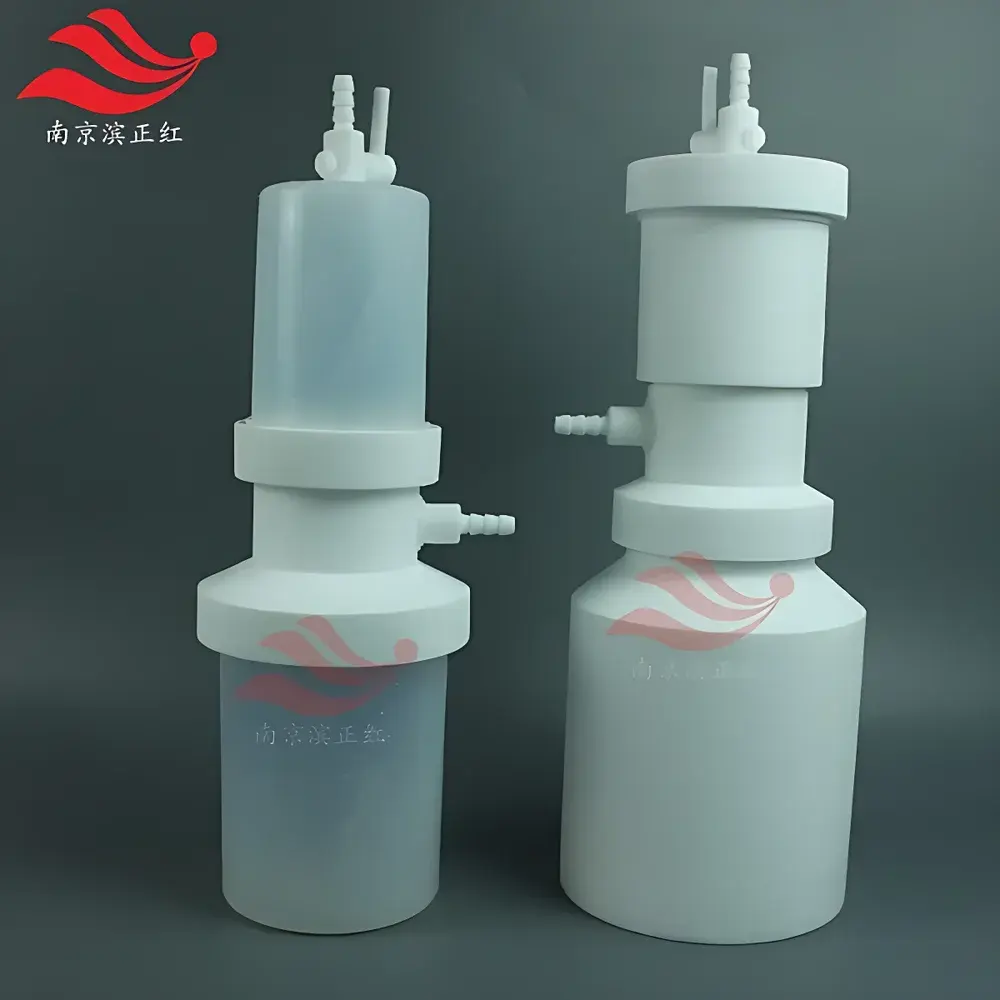
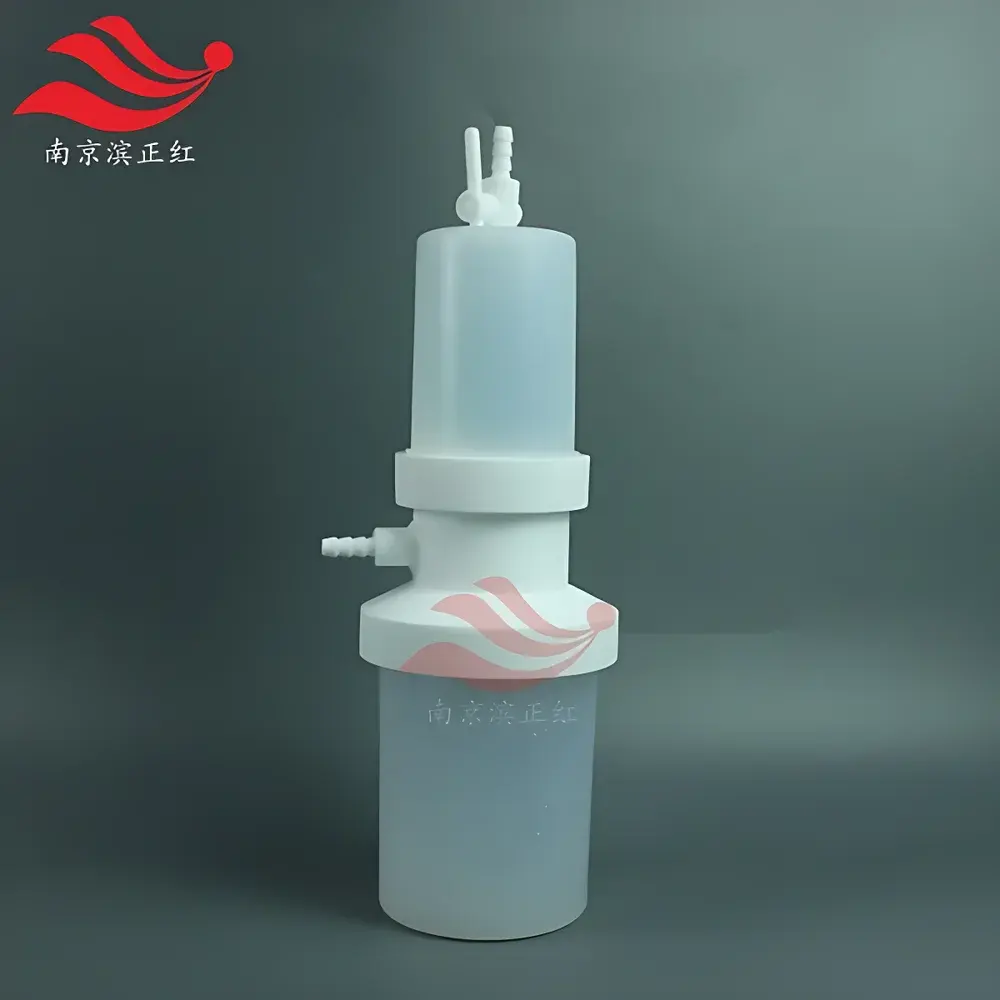
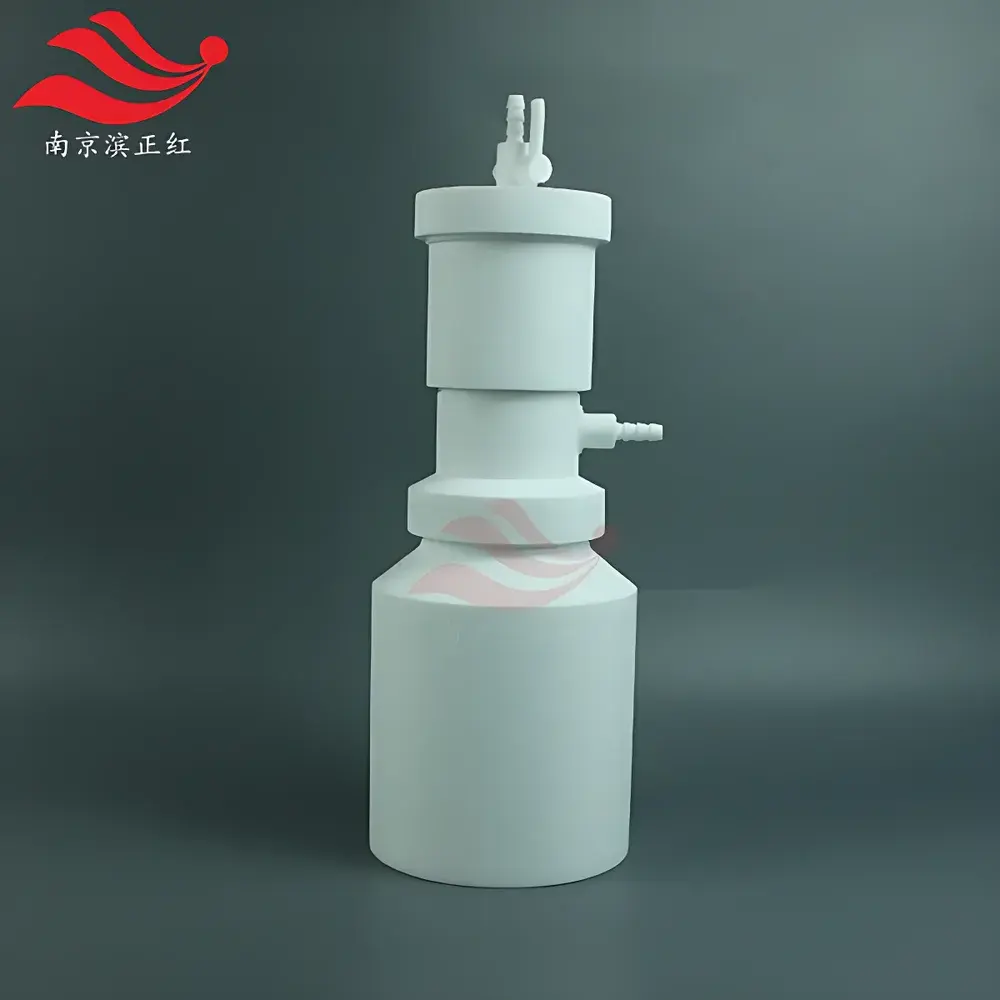
PFA/PTFE Sintered Filter Assembly with Vacuum Filtration Flask
| Brand | Binzhenghong |
|---|---|
| Origin | Jiangsu, China |
| Manufacturer Type | Direct Producer |
| Origin Category | Domestic |
| Model | 500 mL + 1000 mL Combination Set |
| Pricing | Upon Request |
Overview
The PFA/PTFE Sintered Filter Assembly with Vacuum Filtration Flask is a chemically inert, high-purity laboratory filtration system engineered for aggressive solvent handling, high-temperature vacuum filtration, and applications requiring ultra-low extractables. Unlike conventional ceramic or glass Buchner funnels, this assembly integrates a sintered PFA/PTFE fritted disc — fused directly into a precision-machined PFA or PTFE support ring — mounted onto a borosilicate glass or high-borosilicate vacuum flask (available in 500 mL and 1000 mL configurations). The system operates on the principle of vacuum-assisted pressure-driven filtration: a negative pressure differential generated by an external vacuum pump draws liquid phase through the porous sintered matrix while retaining solid particulates on the frit surface. Its design eliminates gasket-dependent sealing interfaces common in traditional Buchner setups, reducing leakage risk and enabling reproducible, contamination-free operation under full vacuum (≤10 mbar) and thermal cycling from –200 °C to +260 °C.
Key Features
- Chemically resistant sintered frit composed of ≥99.9% pure PTFE or perfluoroalkoxy (PFA), certified for use with concentrated acids (e.g., HF, aqua regia), strong bases, halogenated solvents, and peroxides.
- Uniform pore structure with nominal porosity options of 10 µm, 30 µm, and 50 µm — each verified per ASTM E128–17 for sintered metal and polymer filters.
- Integrated flange-seal interface between frit holder and flask neck, eliminating rubber gaskets or O-rings that degrade under UV, ozone, or thermal stress.
- Borosilicate 3.3 glass vacuum flasks conforming to DIN ISO 3585; optional PFA-coated glass or all-PTFE flask variants available for maximum inertness.
- Robust mechanical architecture: sintered disc bonded via thermal fusion (not adhesive), ensuring zero delamination during repeated autoclaving (121 °C, 20 min) or freeze-thaw cycles.
Sample Compatibility & Compliance
This filtration system is validated for use with crystalline precipitates, catalyst residues, cell lysates, nanoparticle suspensions, and thermally labile APIs. It complies with USP for plastic components and meets ISO 13485 requirements for devices used in pharmaceutical process development. When operated with GLP-compliant vacuum controllers and calibrated pressure transducers, the assembly supports audit-ready documentation per FDA 21 CFR Part 11 for electronic records. All PFA/PTFE components are supplied with CoA (Certificate of Analysis) specifying residual metal content (<10 ppb Fe, Cr, Ni), fluoropolymer melt flow index (ASTM D1238), and non-volatile residue (NVR) testing results per IEST-STD-CC1246D.
Software & Data Management
While the hardware operates as a standalone passive filtration unit, integration with digital vacuum control systems (e.g., KNF N860.3FT or Agilent Vacuubrand CVC 3000) enables real-time logging of vacuum level, filtration duration, and endpoint detection via pressure slope analysis. Optional USB-connected vacuum sensors feed data into LIMS-compatible platforms (e.g., LabWare LIMS or Thermo Fisher SampleManager) for traceable batch records. All firmware updates and calibration certificates are archived in secure cloud repositories with role-based access controls aligned with GMP Annex 11 principles.
Applications
- Isolation of air- and moisture-sensitive organometallic crystals following Grignard or lithium-halogen exchange reactions.
- Recovery of palladium nanoparticles from Suzuki coupling reaction mixtures without metal leaching.
- Clarification of monoclonal antibody harvest streams prior to Protein A chromatography — compatible with low-endotoxin processing workflows.
- Preparative-scale removal of silica gel or celite from column chromatography eluates under inert atmosphere (N₂ or Ar purged).
- High-purity solvent recycling in battery electrolyte R&D, where trace transition metals must remain below 1 ppb.
FAQ
Can this assembly be sterilized using gamma irradiation?
Yes — PFA and PTFE exhibit superior radiation resistance up to 50 kGy; however, glass flasks require validation per ISO 11137 for sterility assurance.
Is the sintered frit replaceable without replacing the entire holder?
No — the frit is permanently fused to the support ring; replacement requires full assembly exchange to maintain dimensional tolerances and leak integrity.
What vacuum pump specifications are recommended for optimal throughput with 10 µm frits?
A two-stage diaphragm pump delivering ≤5 mbar ultimate vacuum and ≥25 L/min free air displacement is advised for 500 mL flasks; larger volumes require scroll or oil-lubricated rotary vane pumps.
Does the system meet ASTM E2656 for filter integrity testing?
Yes — when paired with a forward-flow test rig and calibrated gas flowmeter, bubble point and diffusion tests can be performed per ASTM E2656–18 using helium or nitrogen.
Are custom pore sizes or flask geometries available?
Yes — OEM configurations including conical-bottom flasks, side-arm angle variants (30°/45°), and graded porosity stacks (dual-layer 50 µm + 10 µm) are supported under NRE agreement.



