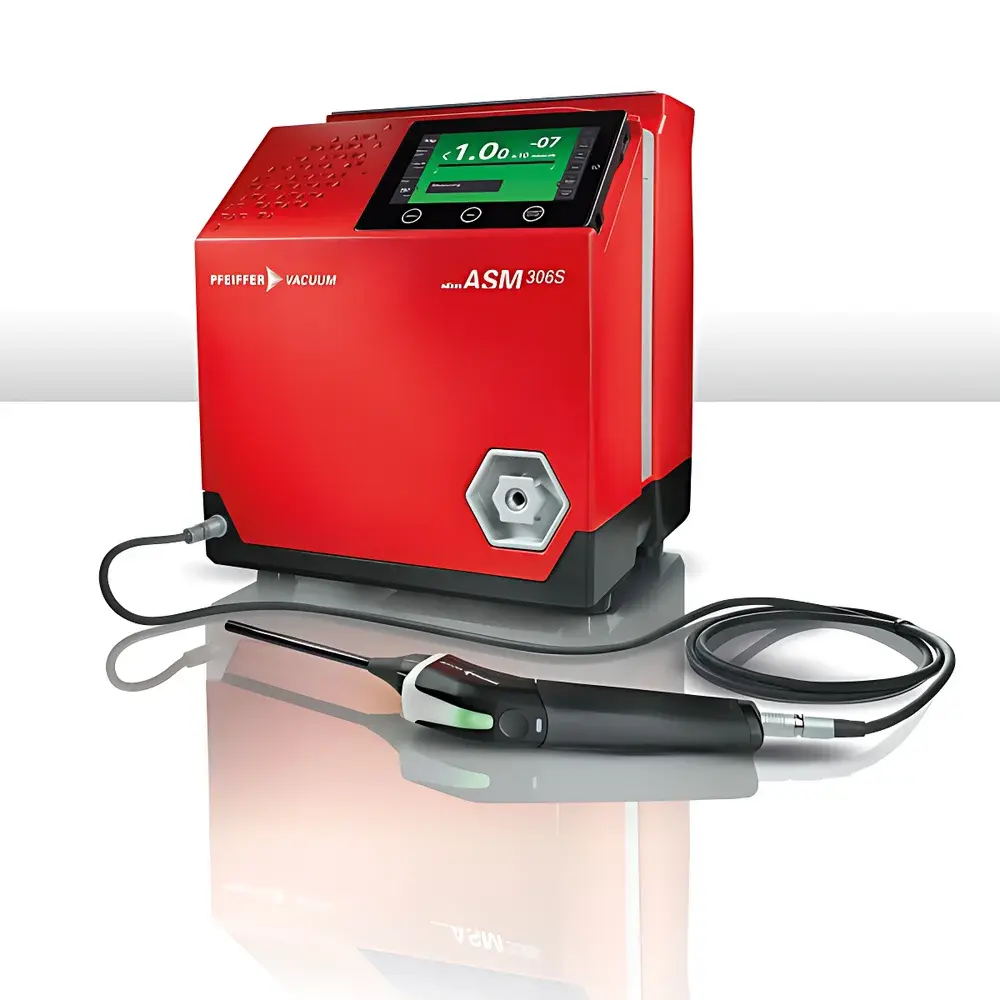
Pfeiffer Vacuum ASM 306 S Helium and Hydrogen Sniffer Leak Detector
| Brand | Pfeiffer Vacuum |
|---|---|
| Origin | Germany |
| Manufacturer | Pfeiffer Vacuum GmbH |
| Type | Imported Industrial Leak Detector |
| Model | ASM 306 S |
| Detection Gases | Helium (He) and Hydrogen (H₂) |
| Minimum Detectable Leak Rate (He) | 1 × 10⁻⁷ mbar·L/s |
| Minimum Detectable Leak Rate (H₂) | 5 × 10⁻⁷ mbar·L/s |
| Warm-up Time | 2 min |
| Response Time | < 1 s |
| Sniffer Probe Flow Rate | 300 sccm ± 10% |
| Noise Level | 55 dB(A) |
| Interfaces | RS-232, Digital I/O, Fieldbus Options |
| Operating Temperature | 10–40 °C |
| Power Supply | 100–240 V AC, 50/60 Hz |
| Max. Power Consumption | 300 VA |
| Weight | 22 kg |
| Dimensions (L×W×H) | 350 × 305 × 421 mm |
Overview
The Pfeiffer Vacuum ASM 306 S is a high-performance, dual-gas sniffer leak detector engineered for precision in-line and final-process leak verification across demanding industrial environments. It operates on the principle of residual gas analysis (RGA) coupled with mass spectrometry-based detection, optimized specifically for helium (⁴He) and hydrogen (H₂) as tracer gases. Unlike conventional single-gas instruments, the ASM 306 S integrates a robust quadrupole mass filter and a high-efficiency ion source calibrated to resolve both He⁺ (m/z = 4) and H₂⁺ (m/z = 2) with minimal cross-sensitivity—enabling reliable discrimination even in mixed-gas or humid ambient conditions. Its design reflects over five decades of vacuum science expertise, targeting applications where test repeatability, short cycle times, and operational resilience are critical—particularly in refrigeration manufacturing, HVAC assembly, and pressure vessel qualification. The instrument complies with ISO 10893-8 (non-destructive testing of welds), ASTM E1002 (standard practice for helium leak testing), and supports traceability frameworks aligned with ISO/IEC 17025 and FDA 21 CFR Part 11 when integrated into validated production systems.
Key Features
- Dual-tracer capability: Simultaneous, switchable optimization for helium and hydrogen—eliminating need for separate instruments or hardware swaps.
- Sub-second response time (< 1 s) and rapid warm-up (≤ 2 min), enabling integration into high-throughput production lines without throughput penalty.
- 7-inch full-HD capacitive touchscreen HMI with magnetic detachable mount—designed for ergonomic operation in confined spaces or on metal surfaces near test stations.
- Integrated real-time LED status ring on the sniffer probe, synchronized with on-screen display and audible alerts, providing immediate visual feedback during scanning.
- High-flow, ergonomically balanced sniffer probe (300 sccm ± 10%) with dual white LEDs for localized illumination and low false-alarm rate due to advanced signal filtering algorithms.
- Front-access calibration leak port accommodating certified reference leaks (He or H₂, 4–6 × 10⁻⁵ mbar·L/s), traceable to national standards (e.g., PTB, NIST).
- Low-maintenance architecture: No consumables beyond replaceable probe filters; service intervals exceed 12 months under typical industrial use.
Sample Compatibility & Compliance
The ASM 306 S is validated for use on metallic, polymer-coated, and composite components commonly found in refrigerant circuits—including evaporators, condensers, expansion valves, manifolds, and sealed accumulator tanks. Its sensitivity range (1 × 10⁻⁷ mbar·L/s for He; 5 × 10⁻⁷ mbar·L/s for H₂) meets or exceeds requirements specified in ISO 13373-2 (condition monitoring via leak detection) and EN 14511 (air-conditioning and heat pump equipment). All firmware and calibration data support audit-ready electronic records, including timestamped test logs, operator ID, probe position metadata (when used with optional encoder-integrated carts), and pass/fail thresholds defined per test plan. The system is CE-marked and conforms to EMC Directive 2014/30/EU and Low Voltage Directive 2014/35/EU.
Software & Data Management
Firmware v3.2+ includes embedded test protocol management with up to 100 configurable test sequences, each supporting multi-point scanning, threshold zoning, and dynamic sensitivity adjustment based on background gas concentration. Data export is supported via USB, RS-232, or optional Ethernet/IP fieldbus modules—delivering CSV-structured reports compatible with MES platforms (e.g., Siemens Opcenter, Rockwell FactoryTalk). Audit trails record all parameter changes, calibration events, and user logins with SHA-256 hashing. Optional software packages include Pfeiffer’s LeakTest Suite for statistical process control (SPC) charting, trend analysis, and automated non-conformance flagging per ISO 9001 clause 8.5.2. Language support covers English, German, French, Spanish, Italian, Chinese (Simplified), Japanese, Korean, Russian, and Portuguese—without requiring firmware reload.
Applications
- Final leak verification of domestic and commercial refrigeration units pre-refrigerant charge.
- In-process validation of brazed joints and laser welds in heat exchangers and piping assemblies.
- Leak screening of solenoid valves, pressure switches, and refrigerant metering devices.
- Quality gate testing for automotive A/C components, including compressors and receiver/driers.
- Maintenance diagnostics of industrial gas distribution manifolds and cryogenic storage vessels.
- GLP-compliant R&D testing of novel sealing materials and gasket formulations under controlled environmental chambers.
FAQ
What tracer gases does the ASM 306 S support—and why is hydrogen included?
The ASM 306 S is factory-calibrated for both helium and hydrogen. Hydrogen offers cost efficiency and safety advantages in high-volume production settings, while maintaining sufficient sensitivity for most HVAC applications. Its lower molecular weight enables faster diffusion through micro-leaks compared to helium, improving detection speed in certain geometries.
Can the ASM 306 S be integrated into an automated production line?
Yes—it features programmable digital I/O (8 in / 8 out), Modbus TCP, and PROFINET options for seamless PLC synchronization, trigger-based start/stop, and pass/fail signal output to downstream stations.
Is external calibration required—and how often?
Annual calibration is recommended for ISO/IEC 17025 compliance. Internal verification using the front-mounted reference leak can be performed daily or per shift, with results logged automatically.
Does the instrument meet regulatory requirements for medical device manufacturing?
While not certified for sterile barrier integrity testing per ISO 11607, the ASM 306 S satisfies Annex I essential requirements of the EU MDR for non-invasive leak verification of gas-handling subsystems in Class IIa/IIb devices.
What maintenance is required beyond filter replacement?
No routine vacuum pump oil changes or filament replacements are needed—the ASM 306 S uses a sealed, long-life ion source and dry pumping technology with no moving parts in the analyzer section.
Related Products