
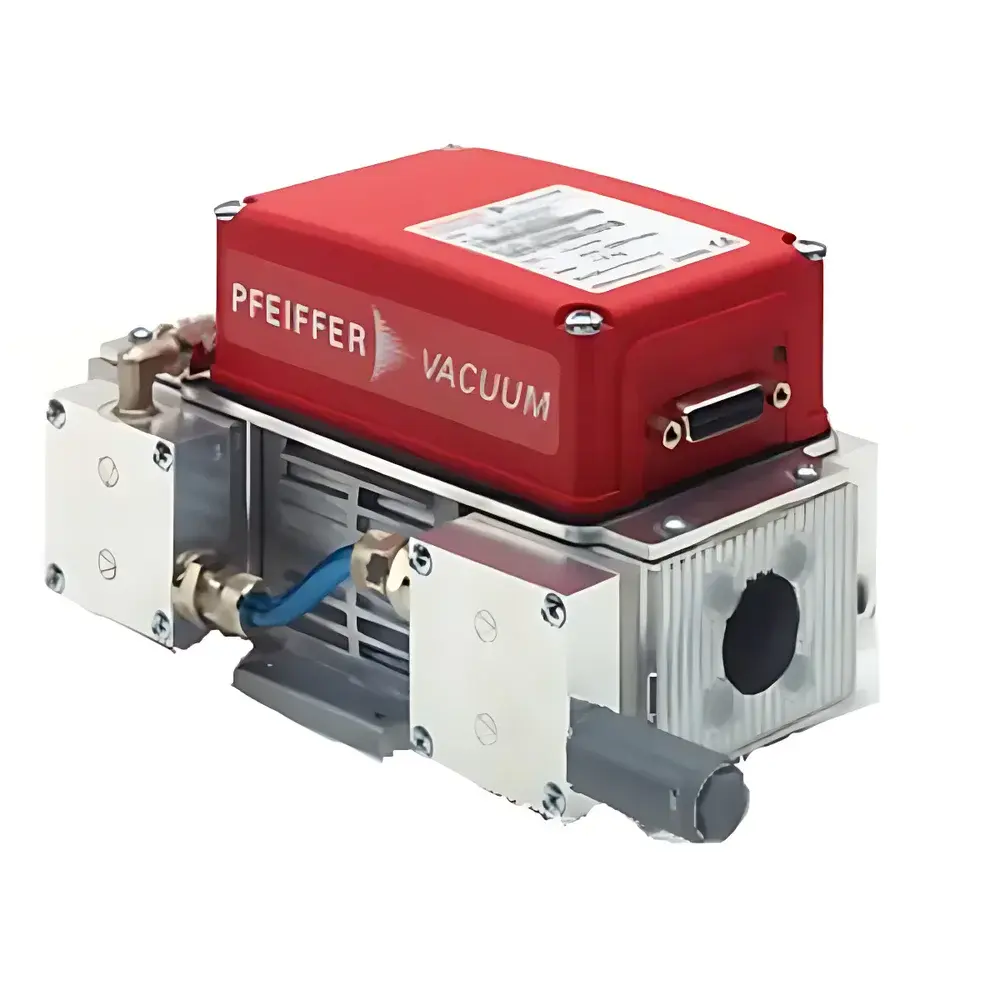
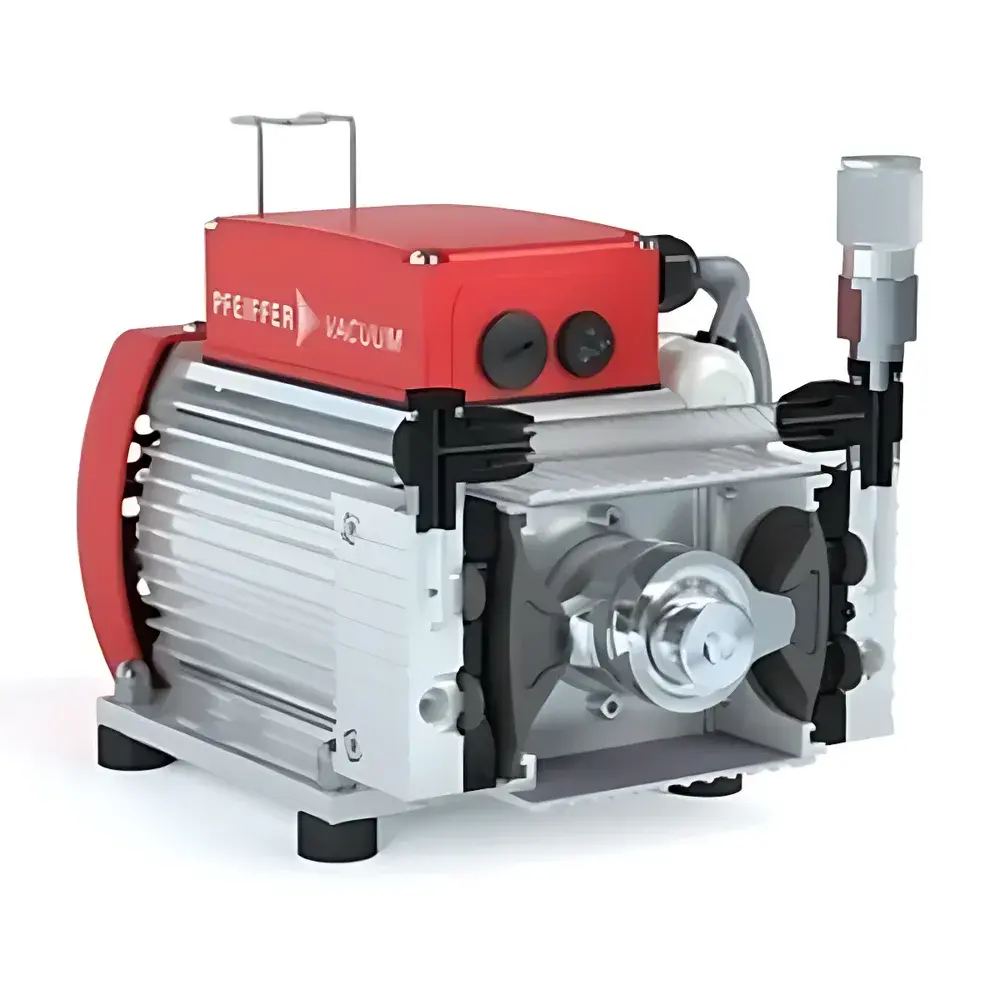
Pfeiffer Vacuum MVP015-2 Diaphragm Pump
| Brand | Pfeiffer Vacuum |
|---|---|
| Origin | Germany |
| Model | MVP015-2 |
| Power Supply | 24 V DC |
| Noise Level | <50 dB(A) |
| Operating Temperature Range | 5–40 °C |
| Pumping Speed (at 100 mbar) | 1.5 m³/h |
| Ultimate Vacuum (with gas ballast open) | ≤10 mbar |
| Ultimate Vacuum (with gas ballast closed) | ≤3 mbar |
| Motor Type | Electronically Commutated DC Motor (ECM) |
| Stages | Two-stage |
| Gas Ballast | Magnetic Solenoid Valve |
| Maintenance Interval | Up to 2 years under typical lab conditions |
| Weight | ~6.2 kg |
Overview
The Pfeiffer Vacuum MVP015-2 is a compact, two-stage diaphragm vacuum pump engineered for clean, oil-free, and dry vacuum generation in ultra-high-purity applications. Designed explicitly as a forepump for HiPace turbo-molecular pumps, it operates without lubricating oil—eliminating hydrocarbon backstreaming, particulate contamination, and vapor-phase interference. Its core principle relies on reciprocating elastomeric diaphragms driven by an electronically commutated DC motor, enabling precise volumetric displacement while maintaining hermetic seal integrity across the entire pressure range from atmosphere down to ≤3 mbar (gas ballast closed). This architecture ensures compatibility with analytical systems where sample integrity, baseline stability, and vacuum cleanliness are non-negotiable—particularly in mass spectrometry, electron microscopy, residual gas analysis (RGA), and surface science instrumentation.
Key Features
- Oil-free operation: Eliminates risk of hydrocarbon contamination, ensuring baseline stability in sensitive detection systems.
- 24 V DC power architecture: Enables seamless integration with HiPace turbo pumps’ native DC bus; supports safe low-voltage deployment in confined or mobile setups.
- Intelligent speed control: ECM motor allows dynamic RPM adjustment—full-speed startup for rapid pump-down, followed by automatic speed reduction upon reaching target vacuum (Auto-Boost Mode), extending diaphragm life and reducing acoustic emission.
- Magnetic gas ballast valve: Provides precise, wear-free regulation of inert gas admixture to prevent condensable vapor lock during roughing of moist or solvent-laden gases—critical for leak detection and process chamber conditioning.
- Low-noise & low-vibration design: Acoustic output <50 dB(A) at 1 m distance; vibration amplitude <0.5 mm/s RMS—minimizing mechanical coupling into adjacent metrology stages or optical tables.
- Extended service life: Rated for up to 2 years of continuous operation under standard laboratory conditions (≤8 h/day, ambient 20–25 °C); modular construction enables field-replaceable diaphragm kits without specialized tools.
Sample Compatibility & Compliance
The MVP015-2 is compatible with non-corrosive, non-condensable, and mildly aggressive gases (e.g., N₂, Ar, He, air, trace O₂, CO₂) commonly encountered in UHV-compatible analytical platforms. It is not rated for halogenated solvents, strong acids (e.g., HCl, HF), or oxidizing agents (e.g., O₃, ClO₂). All wetted materials—including diaphragms (EPDM/FKM), valves (stainless steel + PTFE seats), and housing (anodized aluminum)—comply with ISO 8573-1 Class 0 (oil-free air) and meet EU RoHS 2011/65/EU requirements. The pump’s electrical design conforms to IEC 61000-6-3 (EMC emission) and IEC 61000-6-2 (immunity), supporting integration into GLP- and GMP-regulated environments where audit-ready documentation is required.
Software & Data Management
While the MVP015-2 operates as a standalone unit, its 24 V DC interface supports optional analog (0–10 V) or digital (RS-485 Modbus RTU) feedback for system-level monitoring. When integrated into Pfeiffer’s Vacuum Controller Suite (e.g., VACOM® or TPG300 series), real-time parameters—including actual pumping speed estimation, motor current draw, thermal status, and gas ballast actuation history—are logged with timestamped metadata. Audit trails comply with FDA 21 CFR Part 11 requirements when deployed with validated controller firmware and secure user authentication protocols—ensuring traceability for QC/QA workflows in regulated laboratories.
Applications
- Forepumping for HiPace series turbomolecular pumps in mass spectrometers (GC-MS, ICP-MS, TOF-MS) requiring hydrocarbon-free vacuum integrity.
- Rough vacuum source for scanning/transmission electron microscopes (SEM/TEM), where vibration-induced image drift must be minimized.
- Residual gas analysis (RGA) systems and surface analysis tools (XPS, AES, SIMS) demanding ultra-clean vacuum baselines.
- Leak detection systems using helium or hydrogen tracer gases—enabled by magnetic gas ballast for stable flow control during pressurization cycles.
- Modular vacuum stations for R&D labs, portable analytical platforms, and OEM instrument integration where weight (<6.2 kg), footprint (<200 × 120 × 220 mm), and DC power compatibility are critical constraints.
FAQ
Can the MVP015-2 be used as a standalone roughing pump without a turbomolecular pump?
Yes—it achieves ultimate pressures down to ≤3 mbar (gas ballast closed) and is suitable for applications requiring only medium vacuum, such as vacuum drying, degassing, or basic leak testing.
Is the pump compatible with vacuum chambers containing water vapor or solvents?
It handles moderate moisture loads via the magnetic gas ballast valve; however, prolonged exposure to condensables (e.g., acetone, ethanol, water-saturated air) will reduce diaphragm service life and require more frequent maintenance.
What is the recommended maintenance schedule?
Under typical analytical lab usage (≤8 h/day, ambient 20–25 °C), Pfeiffer specifies a 2-year diaphragm replacement interval; gas ballast valve and inlet filter inspection is advised every 6 months.
Does the pump support remote start/stop and vacuum setpoint control?
Via optional RS-485 Modbus RTU interface, yes—enabling integration into LabVIEW, EPICS, or PLC-based vacuum management systems with programmable ramp rates and interlock logic.
How does the Auto-Boost Mode affect energy consumption?
In standby mode, power draw drops to <1.5 W; combined with speed modulation, total energy use over a 24-h cycle is typically 30–40% lower than fixed-speed equivalents—contributing to LEED-certifiable lab infrastructure goals.



