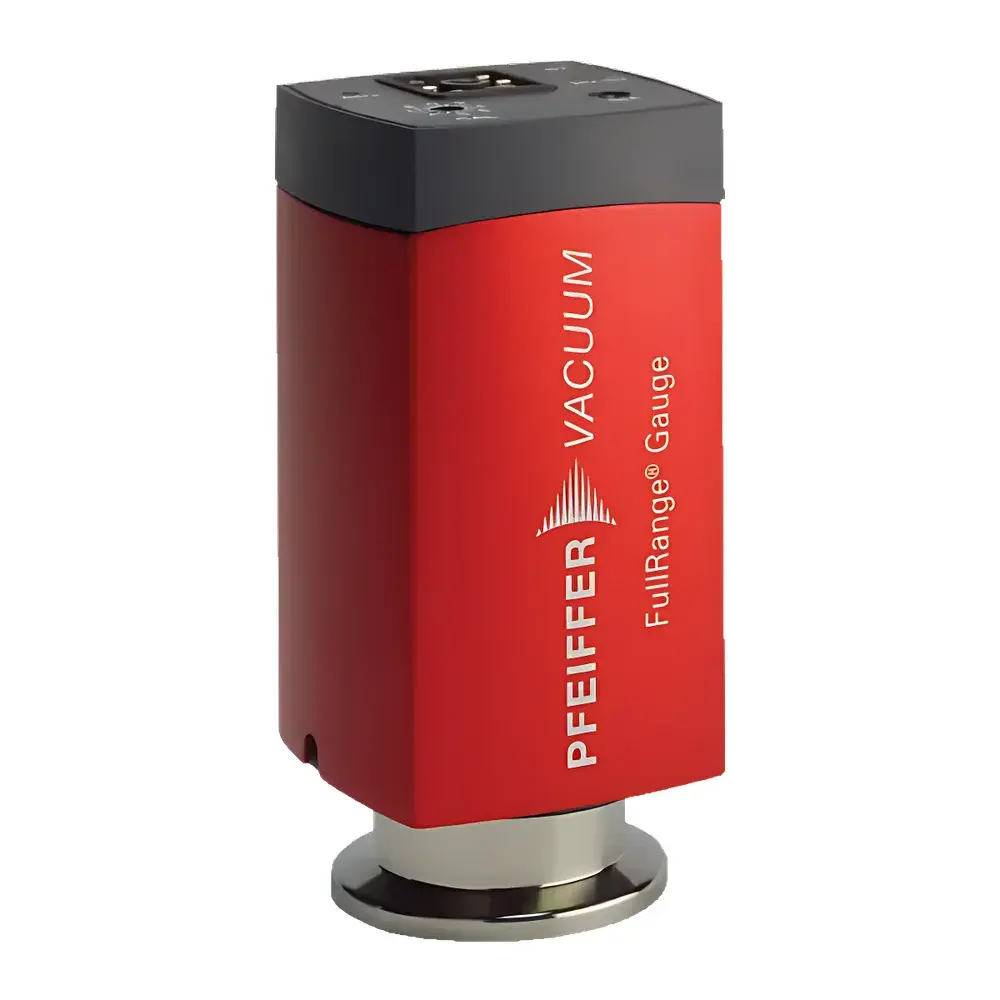
Pfeiffer Vacuum PKR 361 Full-Range Vacuum Gauge
| Brand | Pfeiffer Vacuum |
|---|---|
| Origin | Germany |
| Model | PKR 361 |
| Measurement Principle | Pirani + Cold Cathode |
| Range | 5×10⁻⁹ to 1000 hPa (calibrated for air or N₂) |
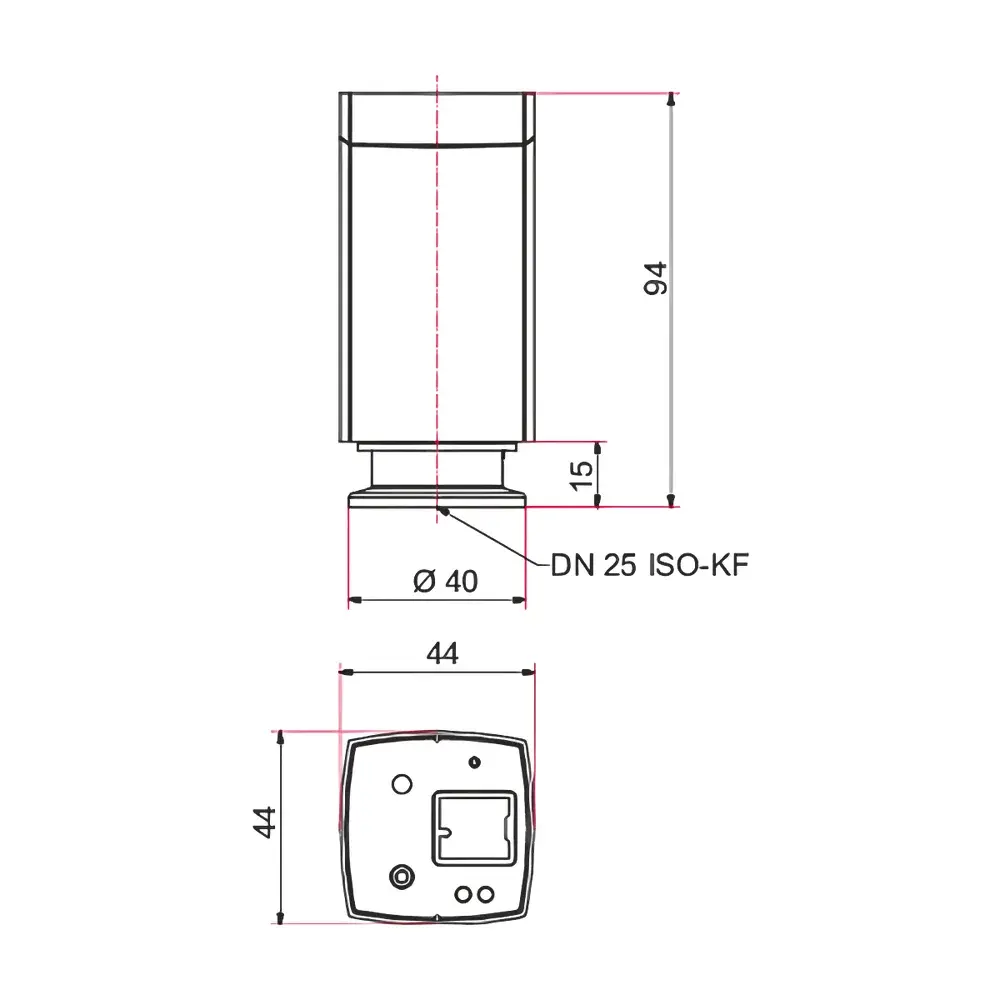
| Vacuum Port Options | KF 25, CF 40, KF 40 |
| Repeatability | ±1% of reading (1×10⁻⁸ to 100 hPa) |
| Bakeout Temperature | ≤150 °C |
| Anode Material | Molybdenum |
| Flange Material | 1.4435 stainless steel |
| Compliance | CE, RoHS, EN 61326-1 |
Overview
The Pfeiffer Vacuum PKR 361 is a rigorously engineered full-range vacuum gauge designed for continuous, high-stability pressure monitoring across ultra-high vacuum (UHV), high vacuum (HV), medium vacuum (MV), and rough vacuum regimes. It integrates two complementary measurement principles—Pirani thermal conductivity sensing for the upper range (1000 hPa down to ~1×10⁻³ hPa) and cold cathode ionization (inverted magnetron design) for the lower range (down to 5×10⁻⁹ hPa)—within a single, compact sensor head. This dual-sensor architecture eliminates the need for manual switching or external range bridging, enabling seamless, uninterrupted pressure acquisition during dynamic vacuum processes such as chamber pump-down, leak testing, thin-film deposition, or accelerator beamline conditioning. The gauge operates on a robust, digitally stabilized power supply and delivers analog (0–10 V) and digital (RS-485 Modbus RTU) outputs, supporting integration into industrial PLC environments and laboratory automation systems.
Key Features
- Single-sensor, dual-principle measurement covering 5×10⁻⁹ hPa to 1000 hPa without range gaps or calibration discontinuities
- High repeatability of ±1% of reading over 1×10⁻⁸ to 100 hPa—validated per ISO 20487:2019 for vacuum instrumentation
- Stainless steel (1.4435 / AISI 316L equivalent) flange construction with ultra-low outgassing characteristics, suitable for UHV applications
- Cold cathode anode fabricated from molybdenum for enhanced electron emission stability and resistance to sputtering under prolonged operation
- Maximum bakeout temperature of 150 °C—compatible with standard UHV chamber conditioning protocols while maintaining sensor integrity
- Multiple vacuum interface options: KF 25 (ISO-KF), KF 40 (ISO-KF), and CF 40 (ConFlat) flanges—enabling flexible integration into existing vacuum architectures
- EMC-compliant design meeting EN 61326-1 requirements for industrial electromagnetic environments
Sample Compatibility & Compliance
The PKR 361 is calibrated for nitrogen and dry air, with documented correction factors available for common process gases (e.g., Ar, He, H₂, O₂) via Pfeiffer’s technical documentation library. It is not intended for corrosive, condensable, or reactive gas environments (e.g., Cl₂, NH₃, silanes) without protective measures such as gas-specific shielding or inline filters. The device conforms to CE marking directives, RoHS 2011/65/EU, and carries a Declaration of Conformity aligned with the EU Electromagnetic Compatibility Directive 2014/30/EU. Its design supports GLP and GMP-aligned vacuum system qualification when paired with traceable calibration certificates (available upon request). While not intrinsically safe, it may be deployed in non-hazardous areas per IEC 60079-0.
Software & Data Management
The PKR 361 communicates via RS-485 using the open Modbus RTU protocol, allowing direct integration with SCADA systems, LabVIEW, Python-based control frameworks (e.g., PyModbus), or custom HMI interfaces. Analog output (0–10 V) provides plug-and-play compatibility with analog data loggers and PLC analog input modules. Pfeiffer’s optional Vacuum Control Software (VCS) enables real-time graphing, multi-gauge synchronization, alarm threshold configuration, and CSV export of time-stamped pressure logs. All digital communication supports audit trail functionality—including timestamped parameter changes and firmware version reporting—facilitating compliance with FDA 21 CFR Part 11 requirements when deployed in regulated pharmaceutical or medical device manufacturing settings.
Applications
- UHV systems in surface science laboratories (XPS, AES, molecular beam epitaxy)
- Industrial vacuum furnaces and heat-treatment chambers requiring stable low-pressure control
- Coating and PVD/CVD equipment where process pressure must be maintained within narrow bands across multiple stages
- Leak detection workflows integrating with helium mass spectrometers or pressure-rise tests
- Accelerator and synchrotron vacuum systems demanding long-term drift stability and bakeout resilience
- Research-grade vacuum test stands used for component outgassing characterization per ASTM E595
FAQ
Is the PKR 361 suitable for hydrogen or helium measurement?
Yes—calibration data and gas correction factors for H₂ and He are provided in the technical manual; however, accuracy is reduced relative to N₂ due to differences in ionization cross-section and thermal conductivity.
Can the sensor be installed vertically or upside-down?
Yes—the cold cathode section is orientation-insensitive due to its inverted magnetron geometry; no performance degradation occurs in non-horizontal mounting configurations.
Does the PKR 361 require periodic recalibration?
While factory calibration remains valid for 12 months under normal operating conditions, annual verification against a certified reference standard is recommended for metrologically critical applications.
What is the maximum cable length for RS-485 communication?
Up to 1,200 meters at 9.6 kbps; signal integrity requires twisted-pair shielded cable (e.g., Belden 9841) and proper termination resistors.
Is firmware upgrade supported in the field?
Yes—firmware updates are distributed via Pfeiffer’s official support portal and applied using VCS software or a dedicated USB-to-RS485 adapter.