
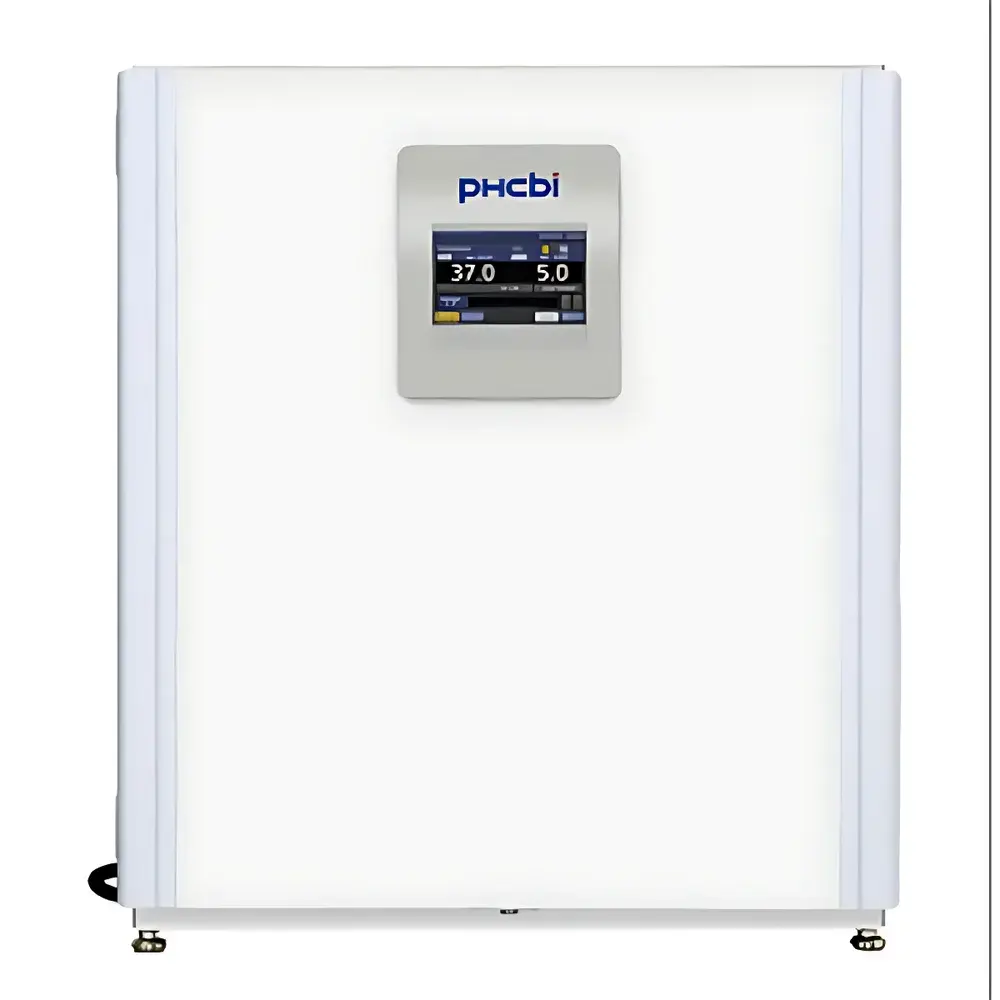
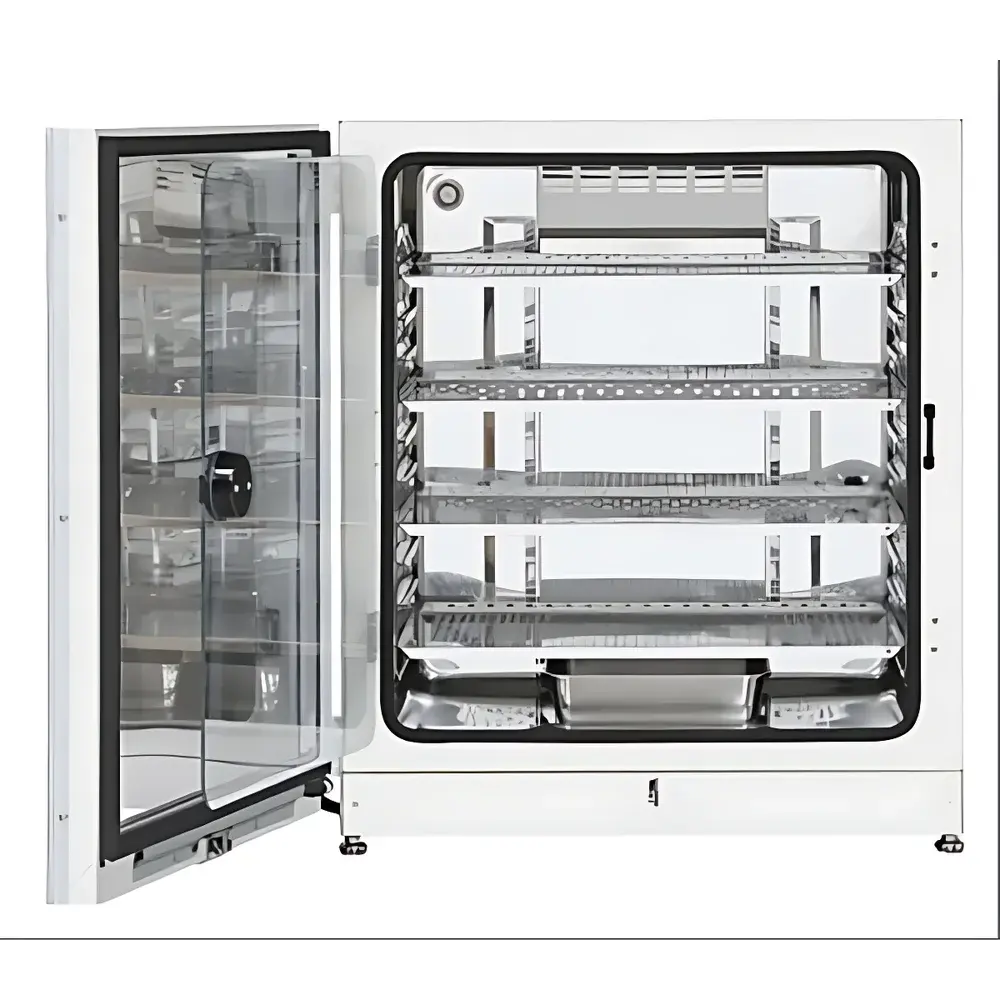
PHCbi MCO-230AICUVL / MCO-230AICUVHL Dual-IR Carbon Dioxide Incubator
| Brand | PHCbi |
|---|---|
| Origin | Japan |
| Instrument Type | Air-Jacketed CO₂ Incubator |
| CO₂ Detection | Dual Infrared (IR) Sensors |
| Temperature Control Range & Accuracy | RT+5°C to 50°C, ±0.1°C |
| Temperature Uniformity | ±0.25°C |
| CO₂ Concentration Control Range & Accuracy | 0–20%, ±0.15% |
| Humidity Control | 95% RH ±5% RH (Natural Evaporation via Humidification Pan) |
| Chamber Capacity | 230 L |
| External Dimensions (W×D×H) | 770 × 730 × 905 mm |
| Standard Configuration | SafeCell UV Sterilization System, H₂O₂ Decontamination Plate, Password-Protected Electronic Door Lock, Integrated H₂O₂ Generator & Reagent Kit, CO₂ Pressure Regulator, Automatic CO₂ Cylinder Switching System, Standard Gas Auto-Calibration Kit, Copper-Alloy Stainless Steel Shelving, Copper-Alloy Stainless Steel Half-Width Partition, Stackable Mounting Brackets, Castor-Mounted Base |
Overview
The PHCbi MCO-230AICUVL and MCO-230AICUVHL are high-integrity, air-jacketed carbon dioxide incubators engineered for demanding cell culture applications in academic research laboratories, biopharmaceutical QC/QA environments, and clinical cell therapy facilities. These models implement a dual infrared (IR) CO₂ sensing architecture—comprising two independent, temperature- and humidity-compensated IR sensors—to deliver real-time, drift-free gas concentration monitoring and rapid recovery (<60 seconds) following door openings. Unlike single-sensor systems vulnerable to cross-interference from ambient fluctuations, the dual-IR design ensures measurement stability across variable lab conditions without recalibration. Temperature control is achieved via a triple-zone PID-regulated air-jacket system: primary chamber heating, heated base plate (preventing condensation and enhancing thermal homogeneity), and heated outer door (suppressing moisture accumulation and accelerating post-access temperature re-equilibration). The chamber employs inCu-safe™ construction—a proprietary copper-alloy stainless steel (equivalent to ASTM F2841-grade antimicrobial alloy) that provides continuous surface-level microbial suppression while retaining the corrosion resistance and mechanical durability of standard 304 stainless steel.
Key Features
- Dual IR CO₂ sensing with automatic cross-calibration and zero-drift compensation
- Triple-zone PID-controlled air-jacket heating system (chamber, base, and outer door)
- inCu-safe™ copper-alloy stainless steel interior surfaces (ASTM E2149-compliant antimicrobial efficacy)
- SafeCell UV sterilization system (253.7 nm low-pressure mercury lamp, ozone-free)
- Integrated vaporized hydrogen peroxide (VHP®) decontamination cycle (≤180 min, no sensor removal required)
- Password-protected electronic door lock with multi-user ID support (up to 99 accounts)
- Full-featured color LCD touchscreen interface with glove-compatible operation and graphical data visualization
- USB port for secure export of operational logs, temperature/CO₂/humidity trend data, and user activity records (CSV format)
- Stackable configuration with castor-mounted base and inter-unit thermal isolation for concurrent sterilization and operation
- 180°C dry-heat sterilization mode (11-hour cycle); no disassembly required; post-cycle calibration not needed
Sample Compatibility & Compliance
The MCO-230AICUVL/HL supports long-term cultivation of sensitive mammalian cell lines (e.g., iPSCs, primary neurons, hybridomas), stem cells, and co-cultures requiring stringent environmental fidelity. Its humidity management—maintained at 95% RH ±5% via passive humidification pan—minimizes evaporation from culture vessels during extended incubation. All critical parameters (temperature, CO₂, humidity) meet ISO 13408-1:2015 requirements for aseptic processing environments. The system supports 21 CFR Part 11-compliant audit trails when paired with PHCbi’s optional LabManager™ software suite. Hardware-level security—including encrypted user authentication, tamper-evident access logs, and role-based permissions—aligns with GLP/GMP documentation standards. The copper-alloy interior complies with JIS Z 2801 and ISO 22196 for sustained antimicrobial activity under normal use conditions.
Software & Data Management
The embedded controller enables local parameter logging at user-defined intervals (1–60 min), with timestamped records stored internally and exportable via USB to standard spreadsheet formats. Event logs capture door openings, alarm triggers, sterilization cycles, and user logins—each tagged with operator ID and time stamp. Optional integration with PHCbi LabManager™ (v5.0+) provides remote monitoring, centralized fleet management, automated report generation, and electronic signature workflows compliant with FDA 21 CFR Part 11 Annex 11. All data transfers use TLS 1.2 encryption; no cloud storage is performed unless explicitly enabled by the end user. Audit trail integrity is preserved through write-once memory allocation and cryptographic hashing of log entries.
Applications
These incubators are routinely deployed in regulated cell therapy manufacturing (ATMPs), regenerative medicine R&D, monoclonal antibody production, and high-content screening platforms where environmental reproducibility directly impacts assay validity. Their rapid CO₂ recovery and dual-sensor redundancy make them particularly suitable for high-throughput labs with frequent access patterns. The VHP decontamination cycle meets ISO 14644-3 Class 5 cleanroom recovery requirements, enabling safe transition between biosafety level 2 (BSL-2) cell lines. The inCu-safe™ interior reduces bioburden accumulation in shared core facilities, extending maintenance intervals and lowering contamination-related experimental failure rates.
FAQ
Does the dual IR CO₂ sensor require periodic calibration?
No—automatic cross-sensing and built-in reference compensation eliminate routine calibration; only annual verification using certified gas standards is recommended per ISO/IEC 17025.
Can the incubator operate while stacked with another unit?
Yes—the thermally isolated stackable design allows one unit to undergo 180°C dry-heat sterilization while the adjacent unit maintains active cell culture conditions.
Is the H₂O₂ decontamination process validated for mycoplasma elimination?
Yes—validated cycle parameters achieve ≥6-log reduction of Mycoplasma genitalium and Bacillus atrophaeus spores per ISO 15739:2021 Annex B.
What happens to the UV lamp during VHP decontamination?
The SafeCell UV system is automatically deactivated during H₂O₂ injection and reactivated post-purge to photolyze residual vapor into H₂O and O₂.
Are all internal components compatible with 180°C dry-heat sterilization?
Yes—sensors, fans, humidity pans, and shelving remain installed; only consumables (e.g., water pan refills) require replacement post-cycle.




