
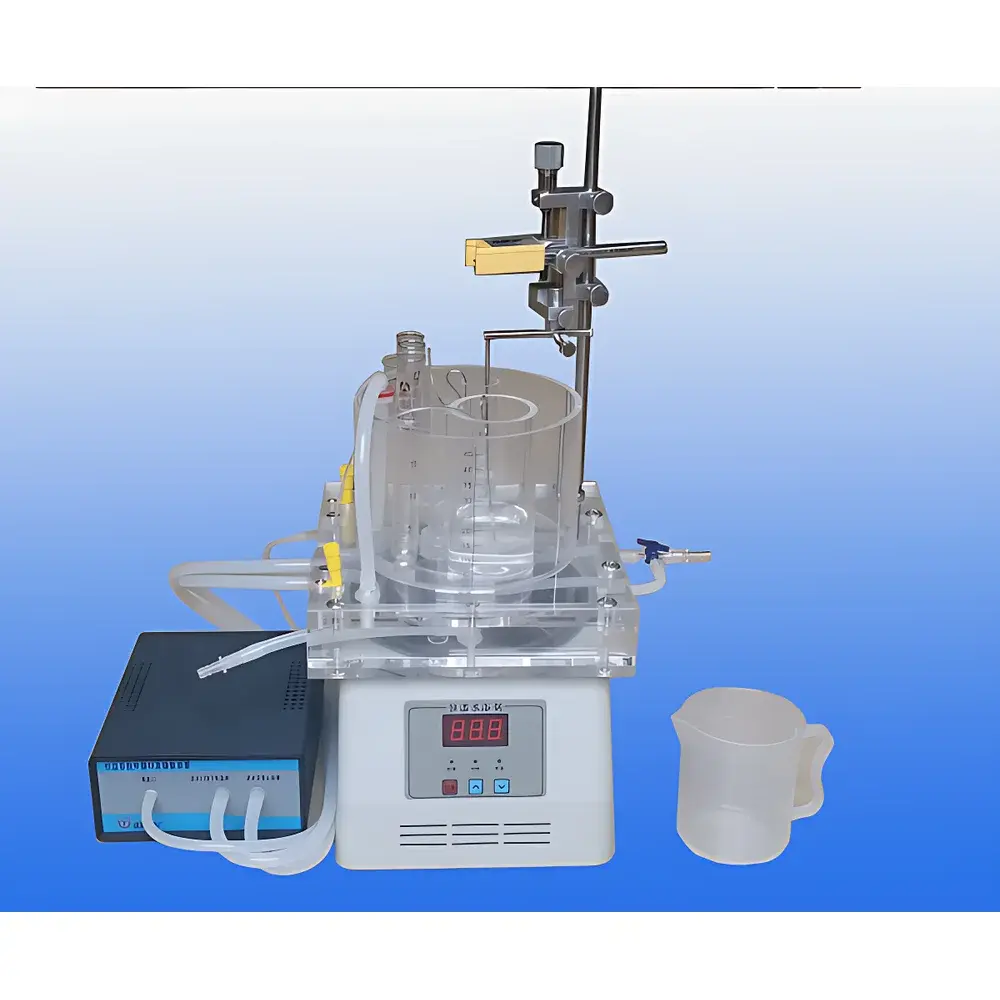
PHG-1 Multi-Function Isolated Intestinal & Smooth Muscle Organ Bath System
| Brand | SCChengyi |
|---|---|
| Model | PHG-1 |
| Temperature Range | Ambient to 100°C |
| Max Heating Power | 350 W |
| Heating Time (Ambient → 38°C) | <10 min |
| Operating Voltage | AC 220 V, 50 Hz |
| Temperature Control Accuracy | ≤0.2°C |
| Display Resolution | 0.1°C |
| Dual Display | Actual & Set Temperature |
| Dual Preheating Reservoirs | 45 mL and 200 mL |
| Preheating Glass Tubes | Three 20 mL + One 60 mL Quartz Tubes |
| Leakage Protection | 10 mA Trip Current |
Overview
The PHG-1 Multi-Function Isolated Intestinal & Smooth Muscle Organ Bath System is an engineered platform designed for ex vivo pharmacological and physiological studies of gastrointestinal smooth muscle contractility, vascular tone, and other isolated tissue preparations. It operates on the principle of precisely controlled thermal and gaseous microenvironments—critical for maintaining tissue viability and functional integrity during long-term recordings. The system integrates a thermostatically regulated bath chamber, independent external circulation and oxygenation modules, and a mechanically synchronized tissue-sensor mounting assembly. Unlike conventional organ baths that couple heating, aeration, and mechanical support in a single unit, the PHG-1 decouples these subsystems to eliminate vibration-induced signal noise and ensure high-fidelity force transduction—particularly essential when measuring sub-milligram contractile responses using isometric or isotonic transducers.
Key Features
- Independent external temperature circulation unit isolates pump and gas injection mechanisms from the bath chamber, eliminating mechanical coupling and preserving baseline stability during force measurement.
- Dual preheating reservoirs (45 mL and 200 mL) with bottom-connected fluid pathways enable continuous, temperature-matched drug delivery without manual pipetting or thermal shock to the tissue bath.
- Four quartz glass preheating tubes—three 20 mL and one 60 mL—provide scalable, inert storage for multiple test compounds while maintaining thermal equilibrium prior to introduction.
- Modular bath chamber design allows full disassembly for thorough cleaning, sterilization, or replacement of sealing gaskets—supporting GLP-compliant lab hygiene protocols.
- Micrometer-driven, one-dimensional vertical adjustment mechanism synchronizes movement of both tissue hook and force transducer; this prevents axial strain artifacts during tissue positioning or length-tension calibration.
- High-resolution dual LED display shows real-time actual and set temperatures simultaneously, with 0.1°C resolution and ≤0.2°C steady-state control accuracy across the full 20–100°C operating range.
- Configurable gas supply interface supports switchable air or oxygen delivery with continuously adjustable flow rate, enabling hypoxic, normoxic, or hyperoxic experimental conditions per ISO 17025-aligned protocol requirements.
Sample Compatibility & Compliance
The PHG-1 accommodates standard rodent ileum, jejunum, colon, tracheal rings, and vascular strips (e.g., rat aorta or mesenteric artery) mounted on stainless-steel hooks and connected to force transducers via silk or nylon sutures. Its bath geometry conforms to ASTM E291–22 guidelines for organ bath dimensions relative to tissue cross-sectional area. All wetted components—including quartz glass tubes, silicone circulation tubing, and stainless-steel brackets—are chemically inert and autoclavable. The system meets IEC 61010-1 safety standards for laboratory electrical equipment and incorporates a 10 mA residual-current device (RCD) for personnel protection. Optional integration with validated data acquisition systems enables compliance with FDA 21 CFR Part 11 requirements for electronic records and signatures when used in nonclinical pharmacology studies.
Software & Data Management
While the PHG-1 is hardware-controlled via front-panel薄膜 keypad (no embedded OS), it is fully compatible with industry-standard data acquisition platforms including ADInstruments LabChart, BIOPAC AcqKnowledge, and Spike2. Analog outputs (±10 V) from connected force transducers interface directly with DAQ inputs, supporting synchronized acquisition of tension, temperature, and gas flow metadata. When paired with compliant software, the system supports audit-trail generation, user access controls, and electronic signature workflows required under GLP and GMP-regulated environments. Calibration logs, temperature ramp profiles, and drug addition timestamps can be exported in CSV or HDF5 format for traceable analysis.
Applications
- Concentration-response curve generation for spasmogens (e.g., acetylcholine, histamine) and relaxants (e.g., isoproterenol, sodium nitroprusside) in GI smooth muscle.
- Investigation of receptor-mediated signaling pathways using selective agonists/antagonists in isolated tissue models.
- Evaluation of myogenic tone regulation under varying oxygen tensions or metabolic inhibitors.
- Preclinical assessment of novel gastrointestinal motility modulators in accordance with OECD Test Guideline 407 and ICH S7A.
- Teaching laboratories requiring robust, reproducible setups for undergraduate and graduate pharmacology curricula.
FAQ
Can the PHG-1 be used with third-party force transducers?
Yes—the system provides standardized mechanical mounting interfaces and analog output compatibility with most commercially available isometric and isotonic transducers (e.g., Grass FT03, ADInstruments MLT0210).
Is the quartz glass tubing resistant to organic solvents commonly used in pharmacological assays?
Quartz exhibits excellent chemical resistance to ethanol, DMSO, methanol, and aqueous buffer solutions; however, prolonged exposure to hydrofluoric acid or strong alkalis is not recommended.
Does the system support automated drug addition via syringe pump integration?
The dual-reservoir design permits direct connection to programmable syringe pumps via Luer-lock adapters on the inlet ports, enabling timed, volume-precise compound administration.
What maintenance is required for long-term reliability?
Routine inspection of silicone tubing elasticity, quartz tube integrity, and O-ring condition is advised every 6 months; calibration of temperature sensors against NIST-traceable references is recommended annually.




