
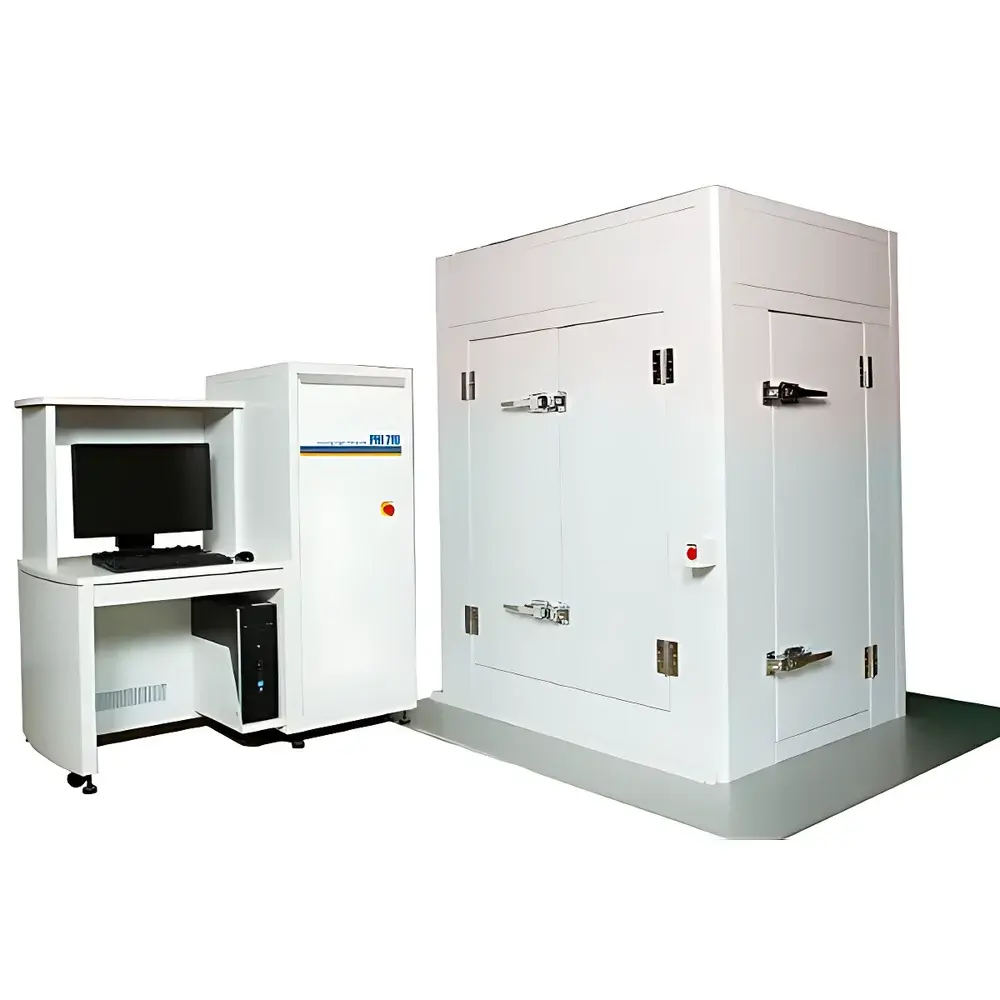
PHI 700 Scanning Auger Nanoprobe (AES)
| Brand | PHI |
|---|---|
| Origin | Japan |
| Model | PHI 700 |
| Type | Scanning Auger Electron Spectrometer |
| Detection Principle | Auger Electron Spectroscopy (AES) |
| Spatial Resolution | <10 nm (typical) |
| Beam Energy Range | 1–20 keV (electron gun) |
| Depth Profiling Capability | Sub-nanometer to several micrometers |
| Energy Resolution | ≤0.3% (ΔE/E at E = 1 keV) |
| Imaging Magnification | Up to 500,000× |
| Vacuum System | Ultra-High Vacuum (UHV), ≤5×10⁻¹⁰ Torr base pressure |
| Sample Stage | High-precision motorized XYZ + tilt/rotation |
| Compliance | ASTM E1508, ISO 18115-2, USP <1057>, GLP/GMP-ready data audit trail |
Overview
The PHI 700 Scanning Auger Nanoprobe is a UHV-based surface analytical instrument engineered for quantitative elemental mapping, chemical state identification, and nanoscale depth profiling of solid materials. Operating on the principle of Auger Electron Spectroscopy (AES), it detects characteristic low-energy electrons (20–2500 eV) emitted following core-level ionization by a focused electron beam. Unlike XPS or SIMS, AES offers superior spatial resolution—down to <10 nm under optimal conditions—making it uniquely suited for analyzing grain boundaries, thin-film interfaces, semiconductor device structures, and nanomaterial heterojunctions. The PHI 700 integrates a coaxial electron column with a hemispherical analyzer, eliminating shadowing artifacts and enabling unobstructed acquisition from complex topographies—including tilted, curved, or particulate surfaces. Its ultra-stable electron optics, active vibration damping, and thermal isolation platform ensure reproducible nanoscale imaging and spectral acquisition over extended acquisition periods.
Key Features
- Sub-10 nm lateral resolution Auger imaging enabled by high-brightness field-emission electron source and optimized electron optical column
- Coaxial geometry design ensures uniform collection efficiency across all sample orientations—critical for accurate compositional analysis of rough, textured, or three-dimensional microstructures
- Dual-beam capability: high-current electron beam (1–20 keV) for excitation and a floating-column oxygen or argon ion gun (0.5–5 keV) for controlled sputter depth profiling
- Energy-resolved spectrum acquisition with ≤0.3% energy resolution (ΔE/E) at 1 keV, supporting fine chemical shift discrimination (e.g., Si⁰ vs. SiO₂, TiN vs. TiO₂)
- Motorized 5-axis sample stage (XYZ + tilt + rotation) with sub-micron repeatability for precise region-of-interest navigation and multi-point automated analysis
- Ultra-high vacuum system maintained at ≤5×10⁻¹⁰ Torr via turbomolecular pumping and NEG (non-evaporable getter) panels, minimizing surface contamination during analysis
Sample Compatibility & Compliance
The PHI 700 accommodates conductive and semi-conductive samples up to 25 mm in diameter and 10 mm in height, including wafers, TEM lamellae, catalyst particles, metallurgical cross-sections, and MEMS devices. Non-conductive specimens require thin conductive coating (e.g., C or Cr, ≤2 nm) or charge neutralization via low-energy electron flood gun. All hardware and software configurations support compliance with international standards governing surface analysis: ASTM E1508 (Standard Guide for Quantitative Auger Electron Spectroscopy), ISO 18115-2 (Surface Chemical Analysis — Vocabulary — Part 2: Terms specific to Auger electron spectroscopy), and USP <1057> (Surface Analytical Methods for Pharmaceutical Materials). Data acquisition logs include timestamped metadata, operator ID, instrument configuration, and calibration history—fully traceable for GLP and GMP audits per FDA 21 CFR Part 11 requirements.
Software & Data Management
Acquisition and processing are managed through PHI’s MultiPack™ software suite, which provides real-time spectral deconvolution, PCA-assisted multivariate analysis, and overlay-capable elemental mapping (including line scans, area maps, and 3D intensity reconstructions). All raw spectra and image stacks are stored in vendor-neutral formats (e.g., .spc, .tif, .csv) with embedded metadata compliant with NIST SRM traceability protocols. Audit trail functionality records every user action—including parameter changes, calibration events, and report generation—with immutable timestamps and digital signature options. Remote monitoring and scheduled unattended operation are supported via secure TLS-encrypted client-server architecture, enabling integration into centralized laboratory information management systems (LIMS).
Applications
- Interface chemistry and interdiffusion analysis in advanced CMOS gate stacks, high-k/metal gate structures, and ferroelectric memory layers
- Contamination identification and localization at solder joint interfaces, wire bond pads, and PCB surface finishes
- Quantitative thickness and stoichiometry determination of ALD-grown oxide/nitride films (<2 nm)
- Grain boundary segregation mapping in Ni-based superalloys and stainless steels under thermal aging conditions
- In situ oxidation kinetics studies using differential pumping-compatible environmental stages (optional)
- Failure analysis of delaminated thin-film solar cells and OLED encapsulation barriers
FAQ
What is the minimum detectable atomic concentration for AES on the PHI 700?
Typical detection limits range from 0.1–0.5 at.% depending on element mass, matrix effects, and acquisition time—optimized via background subtraction and peak-to-background enhancement algorithms.
Can the PHI 700 perform chemical state analysis comparable to XPS?
Yes—while XPS offers broader chemical sensitivity, the PHI 700 delivers high-fidelity chemical shift resolution (e.g., 0.2–0.8 eV full-width-at-half-maximum) for distinguishing oxidation states of transition metals, nitrides, carbides, and silicates.
Is depth profiling limited to flat samples?
No—the coaxial design and precision stage control enable accurate depth profiling on angled cross-sections, trench sidewalls, and patterned substrates without geometric distortion.
How is charge compensation handled for insulating samples?
A dual-mode low-energy electron flood gun (0–10 eV) and optional argon ion neutralizer provide dynamic charge balancing during both imaging and spectral acquisition.
What vacuum level is required for reliable Auger signal acquisition?
A base pressure ≤5×10⁻¹⁰ Torr is mandatory to suppress hydrocarbon adsorption and ensure surface cleanliness over multi-hour acquisitions—achieved via integrated UHV pumping and bake-out protocols.




