
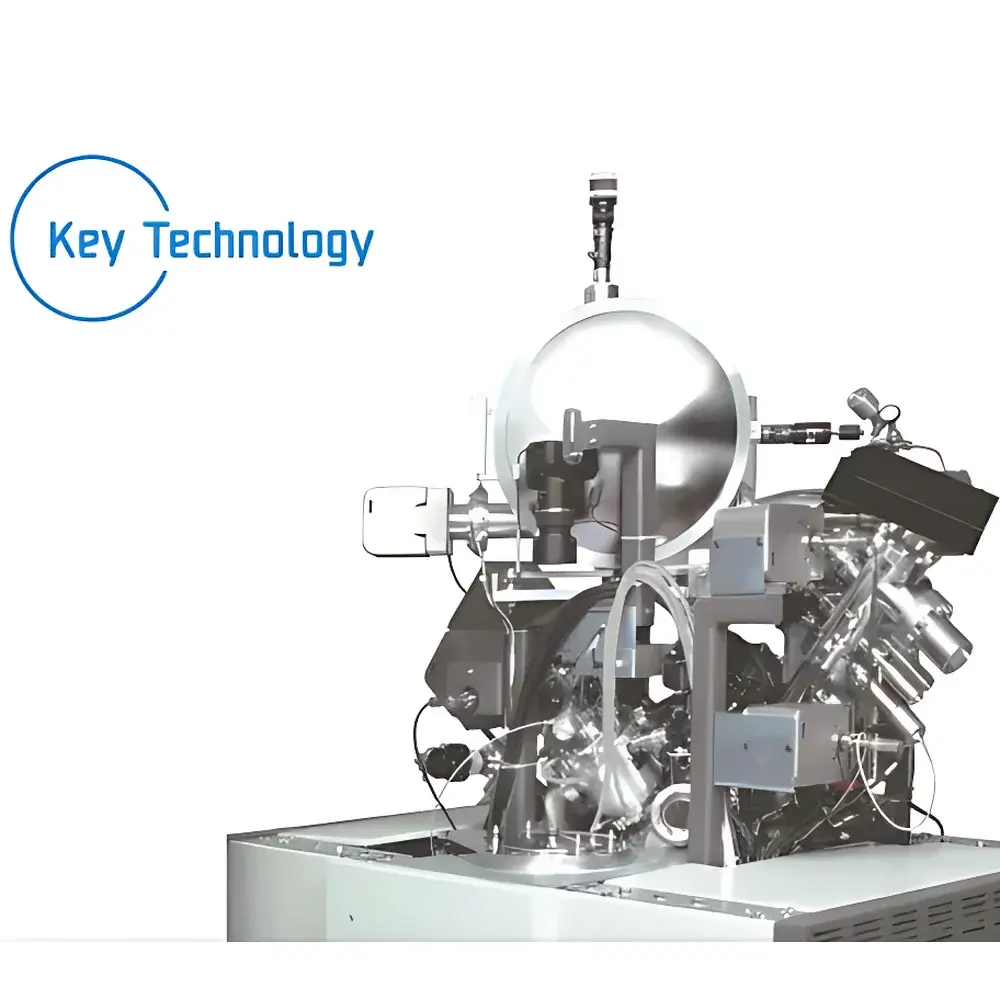
PHI TRIFT™ Time-of-Flight Secondary Ion Mass Spectrometer
| Brand | PHI (Physical Electronics) |
|---|---|
| Model | TRIFT™ |
| Origin | Japan |
| Instrument Type | Time-of-Flight Secondary Ion Mass Spectrometry (TOF-SIMS) |
| Mass Analyzer | Triple-Focusing Reflectron TOF |
| Spatial Resolution | ≤ 100 nm (typical, dependent on primary ion source and sample conditions) |
| Imaging Modes | 256 × 256, 512 × 512, 1024 × 1024 pixel formats |
| Depth Profiling | Sputter-driven sequential layer removal with synchronized mass spectral acquisition |
| 3D Reconstruction | Voxel-based data integration from depth-resolved imaging stacks |
| Sample Stage Temperature Range | –150 °C to +200 °C (LN₂ cooling + resistive heating) |
| Sample Mounting Options | Back-mount (25 mm diameter), front-mount (100 mm × 100 mm planar support) |
| Compliance | Designed for GLP/GMP-aligned workflows |
Overview
The PHI TRIFT™ Time-of-Flight Secondary Ion Mass Spectrometer is a high-performance surface analysis instrument engineered for molecular-level characterization of solid materials at nanoscale spatial and sub-monolayer depth resolution. Based on time-of-flight mass spectrometry principles, the system employs pulsed primary ion beams (e.g., Bi+, C60+, or Arn+) to induce secondary ion emission from the top 1–3 nm of a sample surface. These ejected ions are accelerated into a field-free drift tube, where mass separation occurs via differential flight times—enabling high mass resolution (>10,000 M/ΔM), wide dynamic range (>106), and simultaneous detection of all masses per pulse. Unlike quadrupole or magnetic sector instruments, the TRIFT™ architecture integrates a triple-focusing reflectron that corrects for kinetic energy spread and angular divergence, significantly enhancing mass accuracy and peak shape fidelity across the full m/z range (typically 1–10,000 Da). This makes it particularly suitable for untargeted chemical mapping, organic/inorganic interface analysis, and trace contaminant identification in semiconductor, pharmaceutical, and advanced materials R&D environments.
Key Features
- Triple-focusing reflectron TOF mass analyzer delivering high mass resolution and excellent mass accuracy without scanning limitations
- Multi-modal operation: static SIMS imaging, depth profiling, and 3D molecular reconstruction from correlated sputter/analysis cycles
- Configurable primary ion sources including monatomic Bi+, polyatomic C60+, and gas cluster ion beams (GCIB) for controlled damage accumulation during depth profiling
- High-resolution imaging with selectable pixel matrices (256 × 256 to 1024 × 1024), where each pixel stores a complete mass spectrum—enabling retrospective region-of-interest (ROI) extraction and multivariate spectral analysis
- Integrated cryogenic and resistive heating stages with real-time temperature monitoring (-150 °C to +200 °C), supporting studies of thermally labile compounds, phase transitions, and diffusion kinetics
- Dual-sample mounting configurations: back-mount holders for standard 25 mm wafers and front-mount platforms accommodating up to 100 mm × 100 mm substrates—facilitating rapid alignment and large-area survey mapping
Sample Compatibility & Compliance
The TRIFT™ accommodates conductive, semiconductive, and insulating samples—including polymers, oxides, biological thin films, battery electrode layers, and metallurgical cross-sections—without mandatory charge neutralization for many routine analyses. Optional electron flood guns mitigate surface charging on dielectrics. The system meets essential requirements for regulated analytical environments: raw spectral data and acquisition metadata are timestamped and stored in vendor-neutral formats (e.g., .tdf, .imf), supporting audit trails aligned with FDA 21 CFR Part 11 principles when deployed with compliant LIMS or ELN integrations. Instrument performance verification follows ASTM E1527–22 guidelines for TOF-SIMS instrument calibration and sensitivity assessment. Routine operation supports ISO/IEC 17025 documentation standards for accredited testing laboratories conducting surface chemistry validation.
Software & Data Management
Acquisition and processing are managed through PHI’s MultiPack™ software suite, which provides intuitive workflow control for method development, automated raster optimization, and synchronized sputter/detection timing. All acquired spectra—including full-frame imaging datasets and depth-resolved spectral stacks—are stored with embedded experimental parameters (beam energy, dwell time, detector gain, temperature log). Post-acquisition tools include PCA-based spectral clustering, ion image overlay, depth-concentration profiling, and voxel-wise 3D rendering. Data export supports common interchange formats (mzML, imzML) for interoperability with open-source chemometric platforms such as SCiLS Lab and OpenMS. Audit logs record user actions, parameter changes, and instrument state transitions—ensuring full traceability for GLP-compliant reporting.
Applications
- Organic thin-film transistor (OTFT) interface chemistry and degradation mechanism studies
- Pharmaceutical tablet coating homogeneity and API distribution mapping
- Corrosion product layer stratification on aerospace alloys
- 3D dopant distribution in next-generation FinFET and GAAFET structures
- Protein adsorption orientation and conformational changes on biomaterial surfaces
- Contaminant identification and lateral migration tracking in photovoltaic encapsulants
FAQ
What primary ion sources are supported on the TRIFT™ platform?
The system is configured with Bi+ and C60+ sources as standard; GCIB options (e.g., Ar2000+) are available as factory-installed modules.
Can the TRIFT™ perform quantitative analysis?
Quantitative interpretation requires matrix-matched standards and careful consideration of relative sensitivity factors (RSFs); the instrument delivers highly reproducible semi-quantitative results suitable for comparative studies and trend analysis.
Is vacuum interlock compatibility available for integration with other UHV systems?
Yes—the TRIFT™ features standard CF-150 and CF-63 ports and can be integrated into multi-chamber UHV platforms using gate valves and pressure interlocks.
How is depth resolution maintained during extended sputter profiling?
Depth resolution depends on primary ion species, energy, and incidence angle; C60+ and GCIB sources minimize atomic mixing and provide superior interface sharpness compared to monatomic beams.
Does the system support in situ temperature-controlled experiments during analysis?
Yes—real-time temperature feedback is continuously logged alongside spectral acquisition, enabling correlation of thermal behavior with chemical evolution at the surface.





