
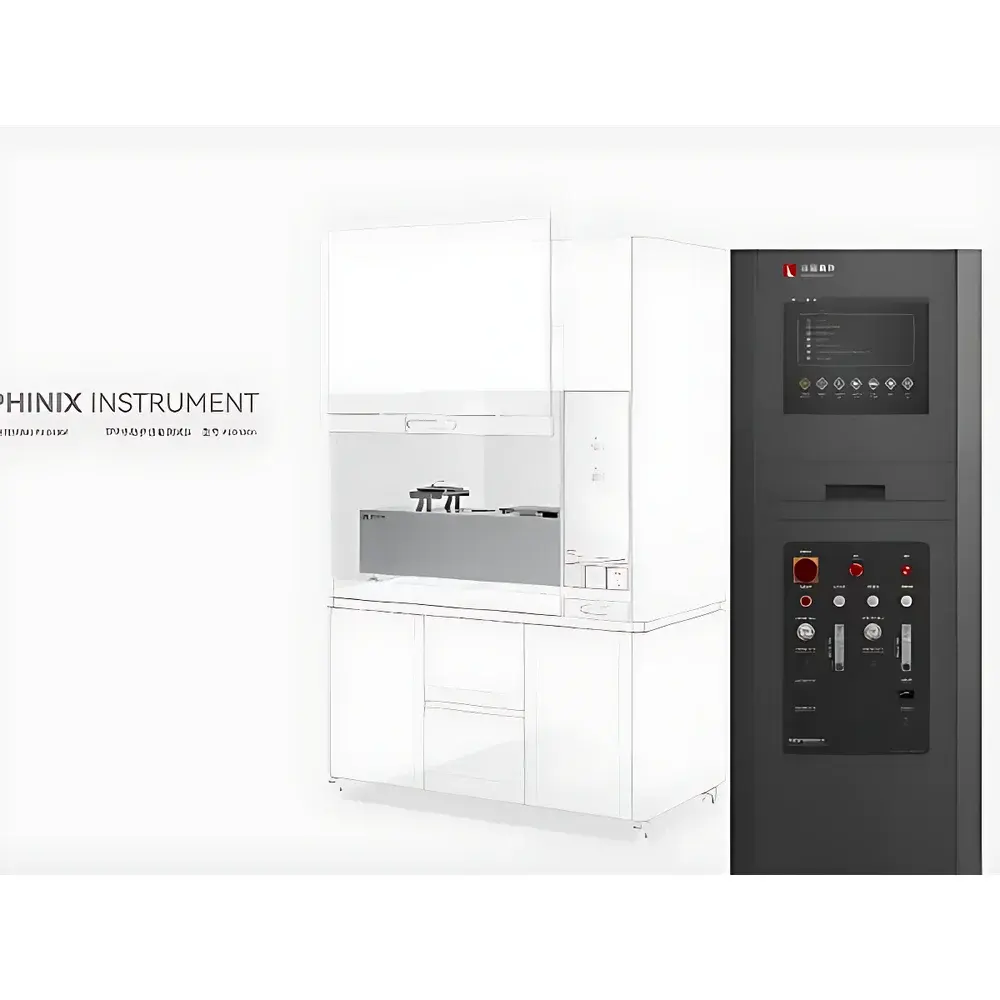
Phinix PX04006 Thermal Protective Performance (TPP) Tester
| Brand | Phinix |
|---|---|
| Model | PX04006 |
| Combustion Chamber Dimensions | 750(W) × 300(D) × 900(H) mm |
| Control Cabinet Dimensions | 650(W) × 650(D) × 1600(H) mm |
| Power Supply | AC 220 V, 50 Hz, 16 A |
| Weight | ~180 kg |
| Fuel Source | Propane (≥95% purity) |
| Heat Flux Calibration Range | 0–100 kW/m² |
| Heat Flux Accuracy | <±3% |
| Response Time | 0.2 s |
| Emissivity | >0.95 |
| Radiant Heat Source | Nine T150 quartz infrared tubes (13 kW/m² ±4 kW/m²) |
| Convective Heat Source | Two 45°-inclined Meker burners (38 mm outer diameter, 5/16″ inner orifice), 25 kW total output |
| Total Incident Heat Flux | 84 kW/m² ±2 kW/m² |
| Temperature Measurement | OMEGA thermocouples with stainless-steel calibration disk, 0–1100 °C range, 0.1 °C display resolution |
| Cooling System | Integrated chiller (10 L/min flow rate), water-cooled aluminum heat sink plate (340 × 286 mm), portable closed-loop water source |
| Automation | PLC-controlled electromechanical positioning modules for specimen and heat flux sensor actuation |
| Software Platform | NI LabVIEW-based HMI with real-time curve visualization, data logging, audit-trail-enabled reporting, and GLP-compliant export formats |
Overview
The Phinix PX04006 Thermal Protective Performance (TPP) Tester is a precision-engineered instrument designed to quantify the thermal protective capability of flame-resistant (FR) textiles and multilayer fabric systems under controlled convective and radiant heat exposure. It operates in strict accordance with internationally recognized test standards—including NFPA 1971 (Standard on Flame-Resistant Garments for Structural Fire Fighting), ASTM D4018 (for carbon and graphite fiber bundles), and GB 8965.1–2009 (Technical Requirements and Test Methods for Flame-Retardant Clothing). The system implements a dual-mode thermal challenge: simultaneous exposure to calibrated convective heat from two angled Meker burners and regulated radiant heat from a nine-tube quartz infrared array. This configuration replicates the complex thermal environment encountered during flash fire or structural firefighting scenarios, enabling quantitative determination of time-to-second-degree skin burn (TPP value), expressed in cal/cm² (or kW·s/m²). The device is engineered for high reproducibility, traceable calibration, and operational safety—critical requirements for certification laboratories, PPE manufacturers, and regulatory testing facilities.
Key Features
- Robust aluminum-alloy combustion chamber with integrated thermal shielding and ergonomic access doors for safe specimen handling.
- Dedicated control cabinet—physically separated from the combustion zone—to protect sensitive electronics from thermal drift and electromagnetic interference.
- Two independently adjustable Meker burners mounted at 45°, each equipped with precision air/gas mixing valves, high-stability pulse ignition, and certified 25 kW combined output capacity.
- Nine T150 quartz infrared emitters delivering uniform radiant flux of 13 kW/m² ±4 kW/m²; total incident heat flux (convective + radiant) precisely tunable to 84 kW/m² ±2 kW/m² via coordinated burner and IR array control.
- Water-cooled calorimetric heat flux sensor (0–100 kW/m² range) featuring <±3% accuracy, 0.2 s response time, and emissivity >0.95—calibrated per ASTM E1079 and ISO 13506-1 protocols.
- Integrated cooling infrastructure: closed-loop chiller (10 L/min flow), custom aluminum heat sink plate (340 × 286 mm), and portable water reservoir—eliminating dependency on facility-supplied chilled water.
- Automated electromechanical positioning system for rapid, repeatable placement and retraction of both specimen holder and heat flux sensor—reducing operator variability and improving test throughput.
- Industrial-grade PLC-based control architecture coupled with a 19-inch touch-enabled HMI running NI LabVIEW software, supporting real-time thermographic curve plotting, configurable alarm thresholds, and timestamped data archiving.
Sample Compatibility & Compliance
The PX04006 accommodates standard textile specimens measuring 150 mm × 150 mm (per NFPA 1971 and ASTM F2703), including single-layer fabrics, laminated composites, and full-system garment assemblies (e.g., outer shell/moisture barrier/thermal liner combinations). Specimen mounting utilizes stainless-steel clamping fixtures compatible with both flat and contoured configurations. All thermal calibration procedures align with ISO/IEC 17025 requirements for testing laboratories. Data acquisition and reporting modules support audit-trail functionality compliant with FDA 21 CFR Part 11 and GLP/GMP documentation standards. Instrument validation documentation—including as-found/as-left calibration records, uncertainty budgets, and traceable NIST-traceable reference standards—is provided upon commissioning.
Software & Data Management
The embedded LabVIEW application provides a secure, role-based interface for test setup, execution, and post-processing. Users define test parameters—including exposure duration, heat flux setpoints, and pass/fail criteria—via intuitive configuration panels. Real-time temperature and heat flux curves are plotted synchronously with second-level timestamp resolution. All raw data (thermocouple voltage, flowmeter readings, valve positions, sensor output) are logged in binary TDMS format with metadata tagging (operator ID, sample ID, environmental conditions). Export options include CSV, PDF reports with embedded calibration certificates, and XML files compatible with LIMS integration. Electronic signatures, user access logs, and immutable audit trails ensure compliance with regulatory data integrity expectations.
Applications
- Performance qualification of firefighter turnout gear components per NFPA 1971 Chapter 5 and ISO 11612.
- Comparative evaluation of FR fabric innovations—including meta-aramids, polybenzimidazole (PBI), modacrylic blends, and next-generation bio-based char-forming polymers.
- Validation of thermal barrier integrity in military combat uniforms (MOPP Level 4) and industrial arc-flash ensembles (ASTM F1959/F2675).
- Root-cause analysis of thermal degradation mechanisms through controlled exposure ramping and time-to-breakopen assessment.
- Supporting R&D workflows for predictive modeling of skin burn injury using validated heat transfer algorithms (e.g., Henriques’ model).
- Third-party certification testing accredited under CNAS, UKAS, or A2LA scopes.
FAQ
What standards does the PX04006 explicitly support?
NFPA 1971 (2022 edition), ASTM F2703, ASTM D4018, ISO 11612, ISO 13506-1, and GB 8965.1–2009.
Is external chilled water required?
No—the system includes a self-contained chiller and portable water reservoir; no facility-supplied cooling loop is necessary.
How is heat flux sensor calibration maintained?
Calibration is performed using a NIST-traceable blackbody reference source prior to each test series; automated zero-drift compensation occurs during idle cycles.
Can the system be integrated into an existing LIMS?
Yes—via configurable TCP/IP or OPC UA interfaces; structured XML exports enable seamless ingestion into enterprise laboratory informatics platforms.
What safety interlocks are implemented?
Dual-channel gas shutoff (electromagnetic valve + mechanical fail-safe), flame-out detection, overtemperature cutoff (>1100 °C), door-open emergency shutdown, and real-time pressure monitoring with visual/audible alarms.



