
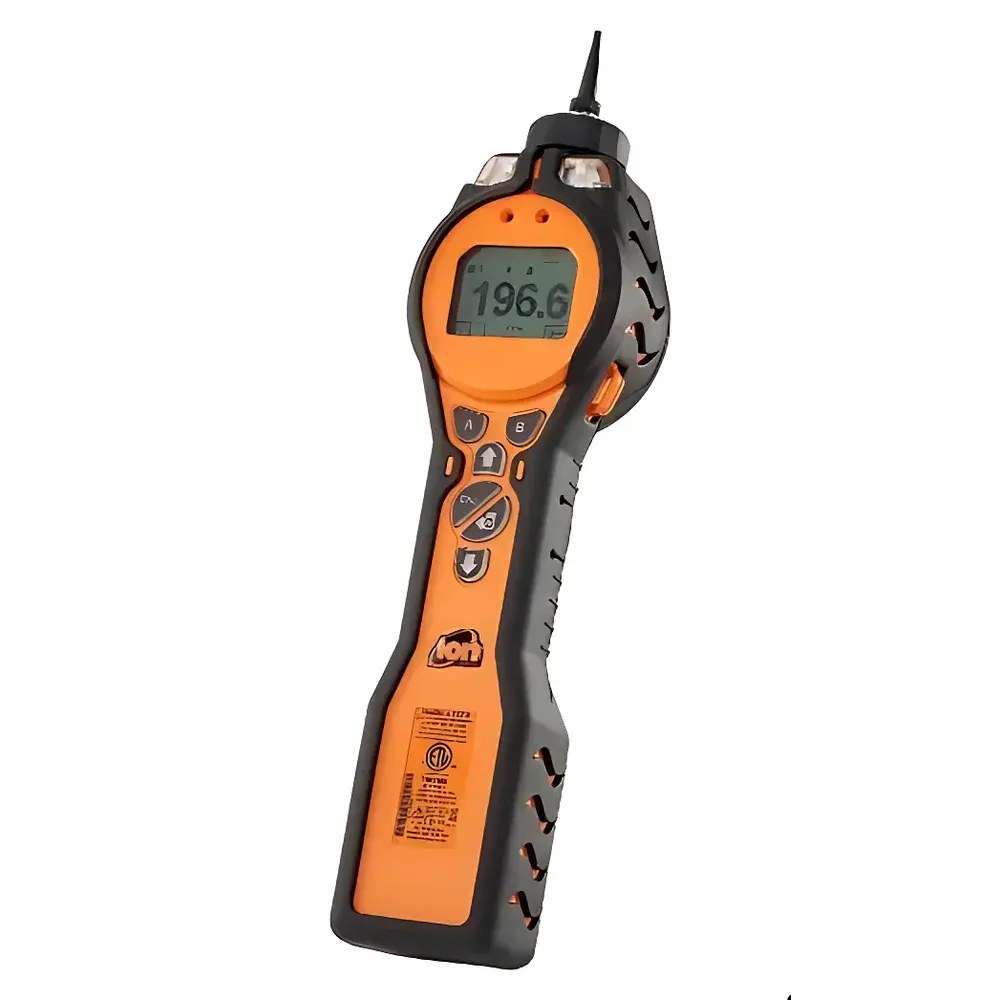
PhoCheck Tiger Portable VOC Gas Detector
| Origin | UK |
|---|---|
| Manufacturer Type | Authorized Distributor |
| Origin Category | Imported |
| Model | PhoCheck Tiger |
| Instrument Type | Portable |
| Configuration | Multi-Gas VOC Detector |
| Detection Range | 1 ppb to 20,000 ppm (or 20,000 mg/m³) |
| Resolution | 1 ppb (0.001 mg/m³) |
| Accuracy | ±5% of reading or ±1 digit |
| Response Time | <10 s |
Overview
The PhoCheck Tiger Portable VOC Gas Detector is a high-performance, intrinsically safe photoionization detector (PID) engineered in the United Kingdom for real-time, quantitative detection of volatile organic compounds (VOCs) across industrial hygiene, environmental remediation, hazardous waste site assessment, and confined space entry applications. Built upon patented gridded electrode PID technology, the instrument delivers rapid response (<10 s T90) and stable signal output under variable humidity and particulate-laden conditions—critical for field reliability in demanding outdoor or process environments. Its core sensing principle relies on ultraviolet photon energy (standard 10.6 eV Kr lamp, optional 9.8 eV or 11.7 eV lamps) to ionize VOC molecules, generating a current proportional to concentration. The resulting signal is processed using linearized digital algorithms traceable to NIST-certified calibration standards, ensuring metrological integrity across its full dynamic range from 1 ppb to 20,000 ppm.
Key Features
- Patented gridded electrode architecture minimizes humidity interference and extends sensor lifetime in high-RH environments (0–99% RH, non-condensing)
- Modular mini-PID sensor chamber with 6-pin interface enables tool-free replacement of lamp, electrode stack, and hydrophobic filter—reducing downtime and lifecycle cost
- Intrinsically safe design certified to ATEX II 1G Ex ia IIC T4 Ga, IECEx Ex ia IIC T4 Ga, and UL/cUL Class I, Division 1, Groups A–D, T4 — approved for use in Zone 0/20 hazardous locations
- Large backlit LCD display with intuitive button navigation; no software installation required for basic operation
- Dual audible alarm (95 dBA at 300 mm) with visual LED strobe and optional vibration alert; configurable TWA/STEL thresholds per OSHA and ACGIH guidelines
- Integrated low-flow sensor with automatic flow alarm; nominal sample flow rate: 220 mL/min
- Rugged IP65-rated housing with removable rubber overmold for impact and abrasion resistance
- Extended battery life: up to 30 hours on rechargeable Li-ion (6.5 h charge time) or 15 hours on 3×AA alkaline cells
Sample Compatibility & Compliance
The PhoCheck Tiger detects over 450 VOCs—including benzene, toluene, xylene, styrene, chlorinated solvents, aldehydes, and terpenes—with sensitivity dependent on ionization potential (IP) relative to lamp energy. It complies with ISO 16000-22 (indoor air—determination of VOCs), ASTM D5466 (standard test method for VOCs in soil using PID), and supports GLP/GMP-aligned workflows through audit-trail-capable data logging. While not FDA 21 CFR Part 11–compliant out-of-the-box, raw data export via USB 1.1 enables integration into validated laboratory information management systems (LIMS) when paired with documented calibration and change control procedures.
Software & Data Management
Data logging is performed internally with timestamped storage of >120,000 readings (e.g., one reading per second for >33 hours). USB 1.1 interface allows direct connection to Windows-based PCs without drivers; proprietary PC software (supplied) enables configuration of alarm setpoints, TWA/STEL parameters, data download, and report generation in CSV or PDF formats. All logged entries include date/time stamp, measured value, unit, alarm status, and battery level—supporting traceability requirements under ISO/IEC 17025 and EU ILAC MRA frameworks.
Applications
- Leak detection and repair (LDAR) programs per EPA Method 21 and EU IED Directive
- Soil vapor intrusion (SVI) screening at brownfield sites
- Confined space atmospheric monitoring prior to entry (OSHA 1910.146)
- Indoor air quality (IAQ) assessments in commercial buildings and laboratories
- Emergency response for chemical spills or clandestine lab investigations
- Process safety monitoring during tank cleaning, solvent recovery, or paint spray operations
FAQ
What lamp energies are available, and how do they affect compound detection?
The standard lamp is 10.6 eV (krypton), suitable for most aromatics and unsaturated compounds (IP < 10.6 eV). Optional 9.8 eV (argon) lamps increase selectivity for lower-energy compounds like ammonia or hydrogen sulfide, while 11.7 eV (xenon) lamps extend detection to higher-IP species such as formaldehyde and methane—though with reduced lamp lifetime.
Is field calibration possible, and what standards are recommended?
Yes—calibration is performed using certified isobutylene gas (100 ppm in air, NIST-traceable), delivered via dedicated calibration kit with flow regulator and zero air source. Daily bump testing is recommended before each use per OSHA 1910.120 and HSE INDG437 guidance.
Can the instrument operate continuously in extreme temperatures?
Operating temperature range is –20 °C to +60 °C (–4 °F to +140 °F); performance outside this range may affect lamp stability and electronics reliability. For extended cold-weather use, lithium battery capacity decreases below –10 °C and requires thermal management.
How does the gridded electrode reduce humidity interference?
The grid structure creates a controlled electric field that repels polar water clusters while permitting ionized VOCs to reach the collector electrode—effectively decoupling humidity-induced baseline drift from target analyte signal.
What maintenance intervals are recommended for routine operation?
Lamp replacement every 6–12 months (depending on usage), filter replacement every 3 months or after exposure to heavy particulates/oils, and full system verification annually using multi-point calibration gases per ISO 6141.
Related Products







